Steve Deeley

Naturalist. Nature writer. Nature photographer.

I once was lost but now am found

If you’re trying to remember it, the headline is from the lyrics to the hymn “Amazing Grace”. As a hymn, it extolls the power of restoration. I have a growing discomfort with the nature conservation movement, who all too often equate “conservation” with “management”. Mankind has all but eradicated many species from this country, and it seems a little ironic that we always believe that  nature can only ever recover with our help, even though it was often our ignorance of a species and their specific needs that drove them towards extinction in the first place. Personally, I sit in the “build it and they will come” camp, believing that all nature needs is for us to stop interfering. In that way, I’m an advocate for rewilding, the principle of letting large areas of landscape revert to their natural habitat.  That does require one caveat, though – humankind has been interfering in the natural landscape of this country for so long that many of our species have adapted to work around mankind in the same way that adapt to any other natural disaster – by evolving. In some cases, species are now dependent on our management of the environment. But yesterday, on the hottest day of the year so far, I went to see a species that proves it doesn’t always need to be that way.

In a sheltered cove in Portland, a slight onshore breeze kept reminding me that it was still March, not July. I was here because this cove has a wealth of Elm trees. In the 1960, Dutch Elm Disease was imported from Holland and rapidly spread across the country, killing more than 90% of our Elm trees. This loss contributed to a native British butterfly, the Large Tortoiseshell, going extinct in Britain – some say in the 1970s, but there is evidence that some populations may have clung on until the 1990s. Whoever is right, by the turn of the millennium, the large tortoiseshell was gone.

Through the next two decades, odd Large Tortoiseshells would be found, blow-ins from Northern Europe where it sill survives, albeit in reducing populations. And then, two years ago, eggs were found in the very cove I was visiting. A second visit showed caterpillar damage. And the following Sumer, fresh adults were seen. That pattern was repeated last year. The Large Tortoiseshell overwinters as adults, being seen on the wing between February and April. The adults then die, before the next generation take to the wing in June.  The butterflies I was seeking were those who had been born here, and had overwintered here, as had their parents. British natives, in fact, making the Large Tortoiseshell now officially Britain’s rarest native butterfly.

The Large Tortoiseshell looks a lot like a familiar butterfly, the Small Tortoiseshell. It a paler orange, and perhaps 30% bigger, with slightly different markings. The sad irony is that just as the Large Tortoiseshell is returning from extinction, its smaller cousin seems to be heading towards it, with numbers dropping significantly. Since the 1970s, the population of the Small Tortoiseshell, a butterfly which was common when I was a child,  has dropped by 75%. So I had a clear example of what I was looking for in my mind, as I patrolled the cliffs and buildings of the cover looking for this Lazarus of butterflies.

It took six hours of patience before I was finally rewarded. A large butterfly dropped from the sky and started feeding on the pale pink-white flowers of Blackthorn. This was an end-of-year, rummage-sale butterfly, with tattered and torn wings – but it was unquestionably a Large Tortoiseshell. And in a way, I quite liked the fact that it was battered. This was a battle-scarred veteran, a survivor, one of  the leading platoon of returning army, coming to recapture the home that is rightfully theirs,  a butterfly that is fighting to reclaim the land its ancestors once called home.

So to the butterfly I saw, and the others that will be born here this coming summer, I say: welcome back,
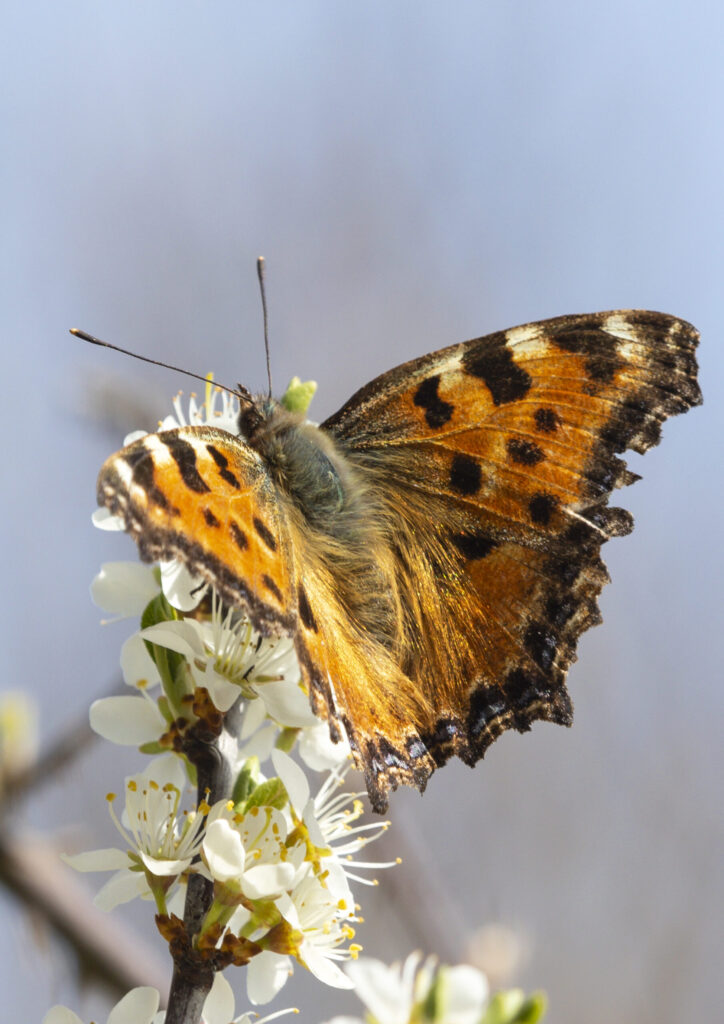
Large Tortoiseshell butterfly
Large Tortoiseshell butterfly

The danger of complacency

On Friday this week my wife and I went on our usual lockdown walk, following a path along a local stream. It’s a path I must have walked hundreds, if not thousands, of times. It’s easy to become complacent about your local patch, to assume that you have seen all there is to see, to overlook the gradual change as environments age, trees grow taller, bushes grow thicker, and the ground beds down under layers of bramble and rotting leaves. But the lesson that you should never presume that you have seen it all was brought home to me as we walked alongside this small stream, bounded on one side by houses and on the other by the slowly maturing woodland that was planted on top of a reclaimed tip.

My attention was first caught by an alarm call from a bluetit, a constant “dit-dit-dit” sound. The small bird was sitting on the uppermost stems  of willow branch that had broken and bridged the stream. And as I watched, the cause of its alarm appeared. Something long and thin and brown moving rapidly down the branch towards the ground. At first, I thought it was a young watervole, because I know they live in waterways in the area, and have been known to climb trees to get vegetation. But this animal was too long and thin, too pointed of the face, and moved rapidly, unlike the water vole’s more sedate scuttle. It was a weasel. Even though I had my camera with me, before I could begin to lift its the weasel vanished underneath a chunk of branch and disappeared into the undergrowth. I waited patiently, desperate to see it again, but that’s been my experience of weasels to date: you see them once, and you never see them again. I’ve been privileged to see weasels a number of times, but is always been an accidental encounter like this one. Even when I knew where a weasel nest was, and haunted the space for hours, watching from a distance through binoculars, they contrived to wait until I had gone before moving.

From its size, I believe this was a juvenile weasel. They have been seen on the old tip, and it makes me wonder if this one is setting out into the world to make a life of its own, crossing the stream in search of a new territory to establish. For once, this blogger doesn’t have a photo, but that doesn’t matter. I stood yards from houses in an urban housing estate, and watched a wild weasel, and if that isn’t something worth writing about, I don’t know what is. And so, every time I walk past this part of the stream again, I will be watching just that little bit more carefully for the faint flicker of a tale or rustle in the undergrowth – and perhaps now I will be watching all of my walk just that little bit more carefully for the things that I never expect to see. Of such experiences are naturalists made.

When it comes to nature versus nurture, I’m voting nature

Snow was forecast for today, so when a hungry cat woke me at 4 AM I did what any sensible person would do: I pushed him off and tried to go back to sleep.

When he tried again at 5 AM, and resorted to his usual ploy of jumping up on to the bedside table and progressively knocking things one by one to the floor to get some attention, I did what any sensible person would do, gave up, went downstairs and fed him and his larger and less annoying sibling.  Since I was up anyway, I looked out of the window for the promised snow, and saw nothing.

I woke again at 6 AM, this time at my own urging, since this is the time of morning I get up to go to work. I have done so for so many years now that my body automatically wakes me at this time whether I want it to or not. I looked out of the window for the promised snow and saw nothing.  By 7 AM, when I pulled the curtains back in the lounge ready to start my day, I looked out of the window for the promised snow and saw 3 inches had suddenly arrived.  This wasn’t the timid snow that we normally get in this country, snowflakes like grains of rice that really couldn’t be bothered to get out of bed themselves.  No, this was big fat fluffy snow, the size of three cornflakes welded together drifting down from a grey sky  and piling up in front of my very eyes.  From the upstairs windows of my house it looked white,  like swan down floating downwards.  From downstairs in my kitchen, it looked grey, and I wondered how something grey could be visible against a grey sky, but somehow it was.

Normally in weather like this, I’d head out into the countryside in the hope of seeing a fox or deer standing out against a field of snow.  But this year, with lockdown in full swing and the health services stretched to breaking point, I felt that would be a responsible.  So instead I went for a slow and measured walk around my local lake and the small piece of woodland that sits atop it. The sky was grey, and the air cold.  It’s an odd thing: cold air has no smell, or rather it has its own smell. Cold air smells only of cold air,  you can’t detect the other scents that lie beneath it. I stepped out into Narnia, into filigree tracery of black twigs each outlined above with a white line, as if a mad painter had been out and highlighted the tops of every one.  Cold air has its own smell, and snow has its own sound. The scrunch and squeak when you walk on it is like nothing else, except perhaps rubbing blocks of polystyrene together.

For some time as I walked, I saw no wildlife.  The waters of the lake had a grey stillness to them, covered as they were in most places by a thin floating layer of slush. The swan family paddled through it effortlessly, with the adolescent cygnets, now shedding the last of their brown feathers for the pure white coat of an adult, looking around themselves in wonder at how the whole world had suddenly turn to swan. It wasn’t until I reach the woodland that I started to see and hear things move.  A family of long – tailed tits chattered their way through the trees, searching for insects, creating little flurries of snowfall as they bounced onto a twig and off again. One even managed to score a direct hit on me, a small softness of cold hitting exactly on the back of my neck and sliding down beneath my clothes.  But I didn’t begrudge the long-tail that caused it: there is something cheerful about the relentless busyness of longtails, especially when they are all puffed up against the cold,  looking for all the world as though someone has stuffed a small pencil into the pom-pom lost from somebody’s fluffy hat.  I find them irresistibly cute.

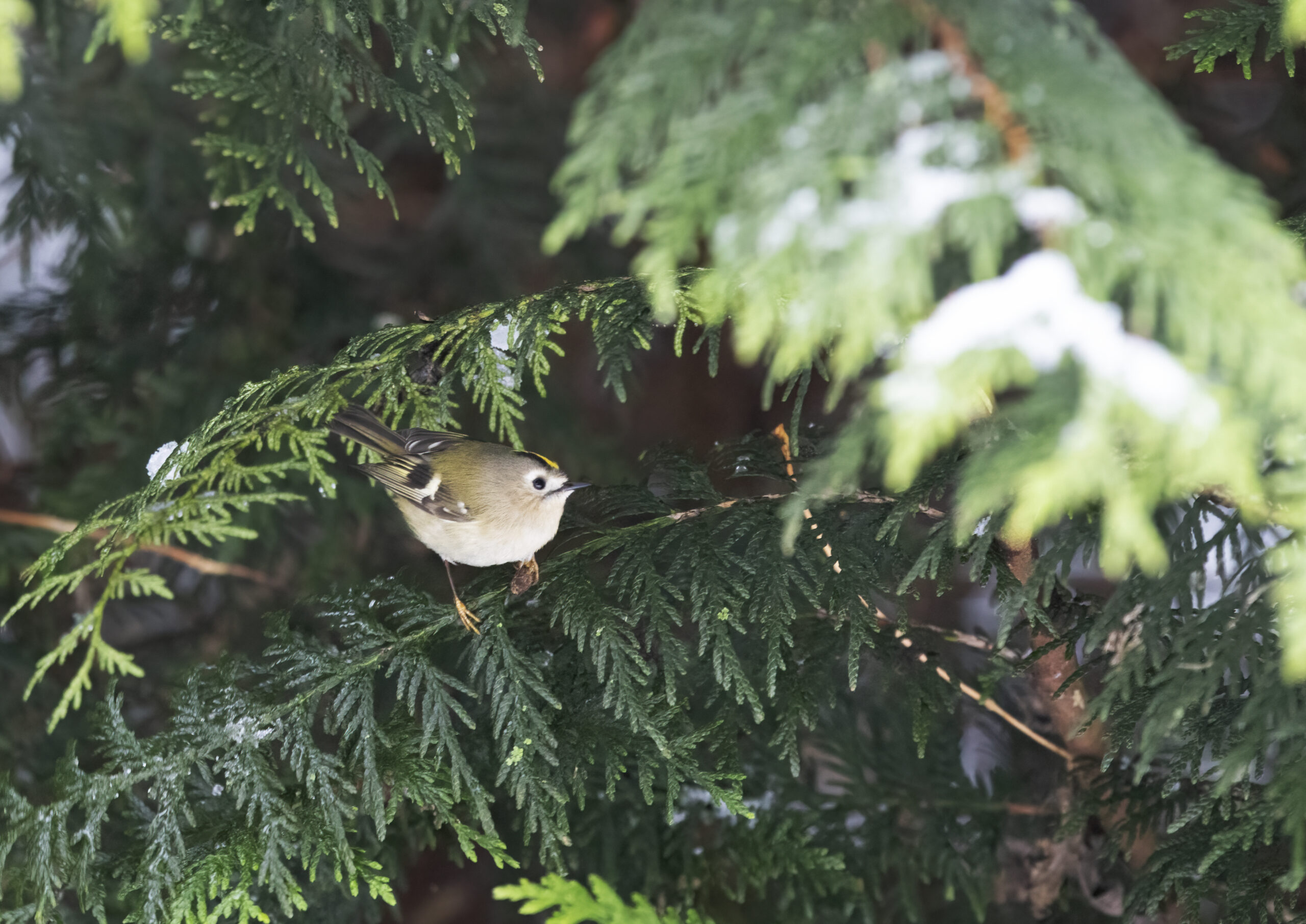
Further into the woodland, I heard a high-pitched sound, fluttering on the very edge of my hearing, and caught sight of a small olive shape fluttering.  Three pine trees, their branches still green, were bent and bowed under blankets of white snow.  And beneath them our smallest bird, the Goldcrest, searching them on hovering wings. Weighing no more than half a Jaffa cake, the Goldcrest is our answer to the Hummingbird, and I watched as it hovered on blurring wings as it poked its slender beak into nooks and crannies looking for spiders.  They are short lived birds, with an average life expectancy of about eight months, so this bird had never seen snow before, and its parents hadn’t lived long enough to to teach it what was snow was like. As so much of our wildlife does, this small bird was operating on instinct.

As long-lived as humans are, we often forget how ephemeral the lives of much of our wildlife can be. Consider for a moment the mayfly, which has lived all of its life underwater until the day when it emerges, changes its body shape entirely, grows wings, and and then has to learn how to fly and mate and lay eggs on the wing without any instruction or previous experience at all. Like its parents, it will live less than a day, and will never pass the skills that it has so quickly learned on to its own offspring. While my Goldcrest may live for longer, it still faces the same challenge.  The world it knew changed completely in the space of an hour, the temperature plummeted, and this tiny bird, which has to feed almost constantly all day simply in order to stay alive, had to adapt or die.

Humankind likes to think that it is very intelligent, but I wonder how many people, if suddenly picked up and dropped into a desert, say, or the Arctic, would manage to adapt so thoroughly and so quickly. But the simple fact that I saw a Goldcrest today means that at least two other Goldcrests managed this trick last year.  And my Goldcrest’s great – great – grandparents somehow managed to survive the “Beast from the East” which brought much of the human world to a shuddering halt this time two years ago.  The same is true of every bird and animal that I’ve seen these last few days.  Each of them has survived through conditions that no person would have managed to survive without help, and in a great many cases, they’ve done it without guidance of any kind.  My Goldcrest is living, breathing proof that it is nature, not nurture, that makes us what we are. And what it makes my little Goldcrest is one very tough little bird indeed.

goldrcrest

goldcrest


The God of small things

A break in walking and blogging due to the pressures of a family illness and several weeks of interminably grey weather saw me champing at the bit to get out of doors again. Now don’t get me wrong: I like a bit of  bad weather. I’m a fan of the Scandinavian edict that there is no such thing as the wrong weather, just the wrong clothing. But grey weather, that kind that floats an almost invisible drizzle in the air day after day just seems to sap the fun out of life. So I was delighted this morning to find a light dusting of snow on the ground when I pulled the curtains back. Light snow is an almost perfect weather condition in my book. It’s bright and cheery, with all of the reflected brightness and cleanliness of a snowfall, whilst having none of the wheel-spinning, train-delaying, sock-soaking, frost-biting coldness that a deep snowfall brings.  It allows the small child in me to engage fully, without the sombre adult in me tutting somewhere in the background. I even got to engage the four-wheel-drive setting on my car. It probably wasn’t needed, but as I specifically bought a four wheel drive vehicle after the “beast from the East” in 2018, there was a sense that I could finally turn to my wife and say “See! I told you needed it!” Man the Smug, the next evolutionary step after Homo Purchase Indecision.

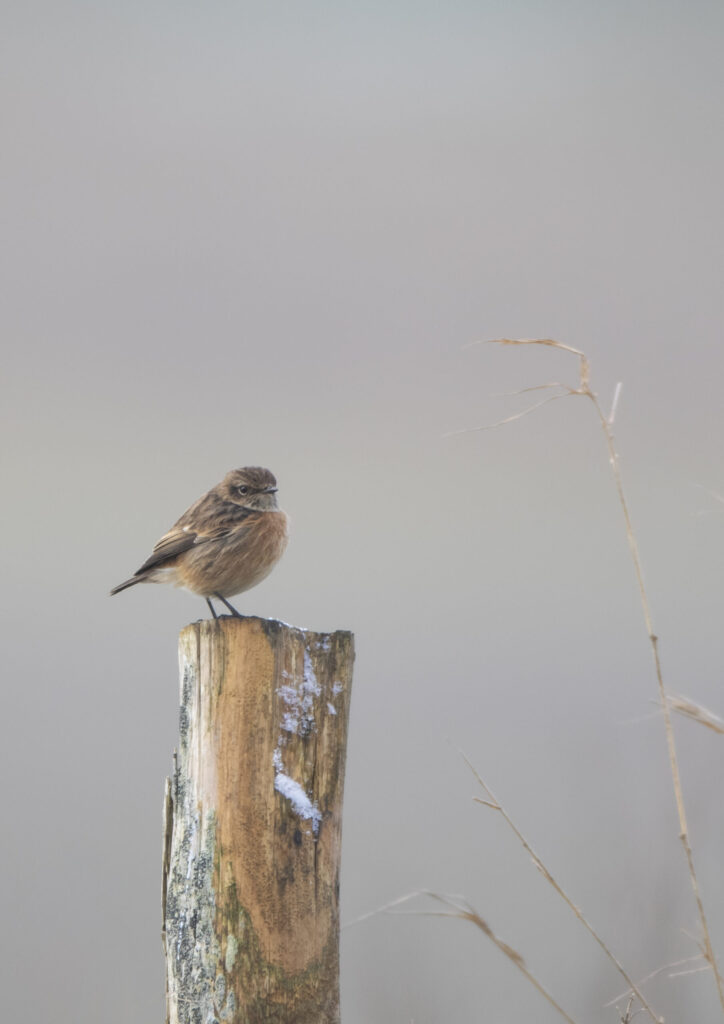
This morning I went up to Barbury Castle.  It sits high up on the Wiltshire Ridgeway,  and its elevation means that it frequently gets a little more snow than we do lower down. On this day, it made the difference between the light dusting of icing sugar in my back garden, and the demented-baker-throwing-flour-around that appeared as I arrived at the Castle. I was hoping to get a photograph of a Stonechat, a small bird looks very much like a Robin: it’s a similar size, and has a similar red breast, although nowhere near as intense and deep a red as that of a Robin. I was really hoping to get a photograph of a Stonechat on something covered in snow, thinking it would make a nice image for next year’s Christmas card. Stonechats often perch on fence posts, so I went to a spot where I knew Stonechats frequently hang around which was adorned with snow-covered fence posts, and waited. And waited. The sun came out. A million dogwalkers, part of the . And then, perhaps an hour after I first arrived, a beautiful female stonechat finally turned up. In the manner of Stonechats, she hopped down to the ground to forage between the bent-over stems of bleached grasses, each accompanied by a miniature snowdrift on its leeward side, then hopped back up to the fence line. Ground, fence wire. Ground, fence wire. She diligently hopped her way along a hundred yards of fence without ever once stopping on a snowy fence post. I had also left my gloves behind in my rush this morning, so my hands were freezing and I was fed up. I I was just about to scream when a passing couple asked me if I’d seen anything good today.

“Not a …”

I stopped. It was  beautiful sunny morning. I was outside. The cold wind that was making my hands ache was also reminding that I was alive and well and able to see this day.  I had watched a bird which, while not rare or endangered, is still one that few people would recognise. There was snow on the ground, and people were out enjoying themselves. Perhaps it was time to remind myself to value the small things in life, the small pleasures that we can so easily take for granted, like health, and wildlife, and blue skies and sun shining on snow.

Half an hour later, most of the snow had gone, but my stonechat found a small puddle of it on top of a post and stood in it. A pair of red kites drifted over the escarpment, startling a hare, which lolloped off downhill at breakneck speed, disappearing into a woodland a quarter-mile away. A kestrel lofted, wings slowly beating until it dropped unseen on something small, one life exchanged for another. I met (at a very respectful distance) a friend I hadn’t seen for months. I watched an unexpected flock of linnets – now that is a rare bird – dance over me. Eventually the skies darkened, sleet started to fall,  and I turned for home, but not before I said a prayer of thanks for the God of small things, of small mercies and small successes and small kindnesses and, yes, even small birds.

stonechat

stonechat

A tale of the unexpected

For weeks now, my wife and I have taken to walking every morning before we start work, not so much from a lockdown “permitted daily exercise” perspective as from a lockdown “stomach needs resizing” one. We walk a few different routes, but my favourite is down to our local lake. I like it because if we get a nice sunrise the waters reflect it, which is always cheering when all that the rest of the day holds is work. But mainly I like it because there is the chance to spot some wildlife. In my relentless drive to see the rare and exotic away from my home, I’ve tended to overlook the value of the space around my home, on the borders of a spreading housing estate. The folly of that has been slowly brought home to me over the last few weeks. Several lockdown walks have brought my wife and I  close encounters with a Kingfisher, often as a dazzlingly blue rocket streaking along barely a wing’s length above the water, but on one morning walk recently, we strolled down to the edge of the lake to look at it, only to be surprised by the Kingfisher as he plopped down from a branch just a few feet away, and hurtled off bearing a small, wriggling fish in his beak.  On another walk, we treated to a furious display of indignant piping as a pair of Kingfishers, cruelly out of sight around the curve of a thick bush, battled for ownership of the lake’s prime fishing. One friend, who has watched them for years and can identify them individually by bent feathers and broken beak-tips, told me that the fighting  pair were Father and Son. The Father is more than four years old. That’s far from a record for  Kingfisher, but is twice the average two-year lifespan. The following day’s walk we saw no sign of Kingfisher, but a Little Egret and a Grey Wagtail occupied the small stream that feeds the lake. A day later, a buzzard scraped the low, grey sky overhead. But two days later came a sighting that made me literally dance a little jig of joy, like a kid who just got his dream present at Christmas.

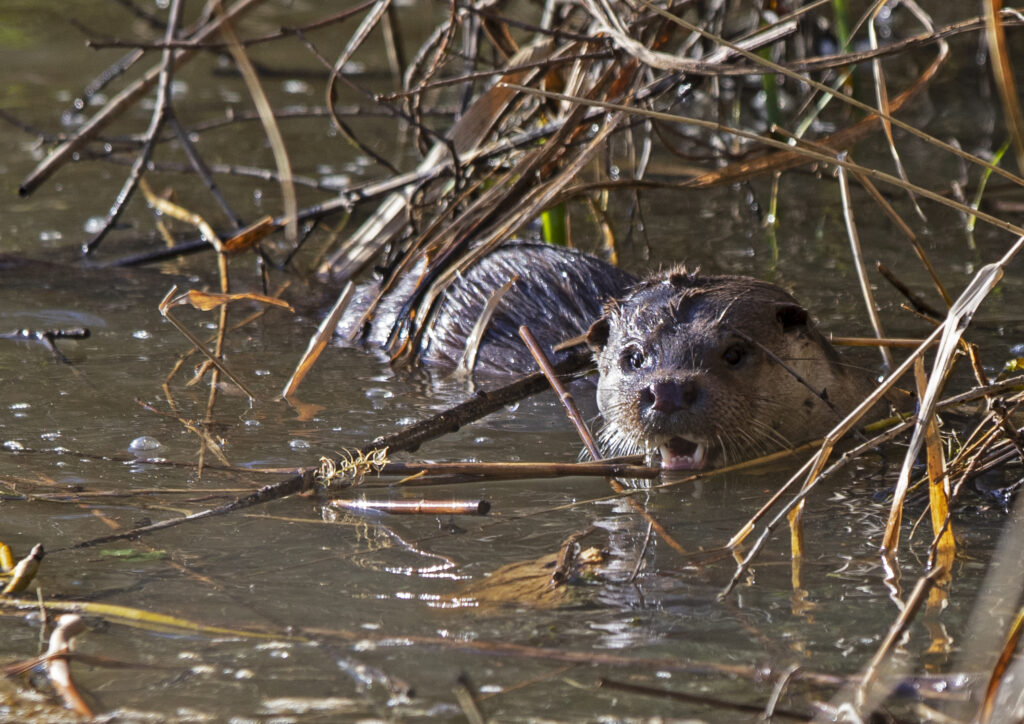
It’s always an effort to emerge in the mornings, particularly when it’s cold and wet. This day was both, clad in a freezing fog that apparently liked the town so much that it stayed all day. Spectral trees faded into the background and the moisture gathered  on my eyelashes as I walked until I was blinking tears. The footpath gradually faded into grey, lit by streetlamps that from a distance seemed to be globes of light hanging unsupported in the air. It wasn’t a day where I had high expectations of seeing anything, let alone any wildlife: even the usual dog-walkers seemed absent. My wife and I walked down the path, crossed under the main road, and emerged out near to the small curved weir that holds back the lake’s waters. Across the lake, grey water faded into grey sky, as if some slovenly painter had forgotten to add a horizon. A small movement caught my eye, and there it was. A crisp wake, as though a sharp knife was cleaving the water in two, was spearing out from the bank, b purposeful and powerful, a torpedo fired aimed towards one of the small islands that dot the lake. I was pretty sure what it was the second that I saw it, but then it dove into the water, a long, slick back arching gracefully downwards, followed by a small flip of a powerful tail. I was less than a quarter-mile from my home, watching a wild otter.

I have been privileged to see otters many times. I have watched a mother otter groom her kitt’s fur just yards from me, and once saw an entire family group of five otters at the same time. This distant glimpse was, in many ways, nothing special for me. But it was special for me, because this otter was on my doorstep. I have lived near this lake for almost thirty years, and watched it gradually transform from bulldozed mud and optimistic saplings into a habitat, punctuation in a chapter of houses and more houses  and more houses that is still being written. This is my space, my community, my local patch. My otter.

And there it is. Not the answer to all of the woes that face the natural world in our far from sufficient husbandry, but perhaps one of the many tools we will need to fix it. I cared about this otter because it was, in its own way, part of my community. A neighbour, of sorts. Perhaps if we could all feel that way, the world might become, in a small way, a better place.

Oh my. I think I’m a birder

For many years, there’s been a regular occurrence when I’ve been out walking. Someone has spotted my camera and said “Oh, you’re looking for birds, are you?” and I’ve had to explain that, like Russel from the Disney film ‘Up’, I’m actually a “friend to aaaaaaallll nature”, and not – most definitely not – a birder. I felt that the birder market was, to put it mildly, a bit overcrowded. Sadly, some of the birders I met were also unfriendly and showed little sign of caring about wildlife beyond getting a tick on a patch list. I was better off out of it.

But yesterday I met a woman near a gate in central Oxford. It was the gate to Port Meadow, a large grassy field that had substantially flooded in recent rains. It was my second visit to the site in a week, driving a sixty mile round trip each time, and I’d got up at six in the morning so that I could finish my day’s work in time to race there. I’d used my last two pound coins in the parking meter, and as I got out of my car it started to rain.

As I hefted my camera with a long lens on a tripod, the woman asked me what I was doing there.

“I’m looking for a duck”, I replied.

Understandably, she gave me a guarded look, the sort of look you give someone when you first suspect that they may be just a teensy, tiny bit deranged. The vast, 300-acre flooded expanse of Port Meadow behind me was teeming with literally hundreds of ducks and geese.

“What duck?” she asked.

“A Garganey”, I replied. I held my hands fourteen inches apart. “It’s about that big, and it looks almost exactly like most of the other ducks out there”.

“Is it rare?” she asked.

“Well, there’s only one of them out there,” I replied, adding “and even that one may have gone by now.”

Two hours later, the sun had finally gone for good behind a bank of thick grey cloud. I was standing in the flooded meadow, the water halfway up my wellies, and the water inside my wellies starting to rise from the pelting horizontal rain that had soaked the windward side of me and was trickling down my trousers, inside and out.  I’d looked carefully at duck after duck after duck after duck, assessing head streaks and the precise boldness of wings patterns, but the Garganey had indeed gone. I started my twenty-minute long, sodden walk back to my car, and halfway  there realised that at some point the waterproof cover had blown off my rucksack and that was now sodden, too. It was getting dark, I was bone-weary, and the cover was camouflage pattern so I had no chance whatsoever of finding it. But even so, I found myself debating whether it was worth trying to come back again at the weekend. And that’s when it hit me, so hard that I actually stopped in my tracks.

I was a birder.

Somehow, over the previous few months, an interest in seeing different species of bird had seeped into my bones. I’m still passionately interested in butterflies and dragonflies and snakes and mammals and plants, but somehow, the piece of the jigsaw that had always been missing had turned up. I realised that I now liked birds enough to travel miles and experience considerable discomfort to see them, something that has always been the case for me with the rest of Britain’s flora and fauna, but was never the case with birds. Now it is. I am a birder.

I still haven’t seen a Garganey, but tomorrow I’m supposed to be laying flooring in the main bedroom and instead of planning it I’m wondering if I can nip out around dawn to find a Ring Ouzel that’s been reported on a nearby hill. I’m definitely a birder now, but how long I get to live as one may depend entirely on how long my wife’s already badly stretched patience lasts…

The last wings of Autumn

A few weeks ago I posted (“A case of premature exclamation”) about another failure in my years-long search for the Common Hawker dragonfly.  I have driven many hundreds of miles and devoted a great many hours to the search and come up empty handed. But last week my wife and I went for a short week’s break to Northumberland, in the lands right next to the Scottish border. It’s a place we have both wanted to visit for some time, and it didn’t disappoint. It’s a stunningly beautiful landscape, full of castles, rolling hills and lovely coastal views.

As part of our visit, my wife with her usual patience agreed to com with me on a quick trip in search of the Common Hawker. We drove to Kielder water, the largest artificial lake in the UK, turned our backs on it, and slogged up the sides of the gentle valley that surrounds it. Remember, this is our only holiday in this very stressful year, we only have four days,  it’s early October and the previous day it had been cold and drizzly. It was also blowing a lively gale as the leading edges of the first named storm of the year starting to arrive. But rather than browsing antique shops or having a nice meal, my wife and I were climbing up a hillside that quickly turned into bog. We saw nothing – and unusually, I do mean nothing. Not a bird, not an animal, not an insect. We trudged on and on,  and the conversation started to droop, although the views were absolutely stunning. Eventually we reached our target, a deep pool the colour of stewed tea surrounded by a boardwalk of plastic planks topped with chicken wire. On one side, the depths gave way to shallows with mats of pond weed and reeds, and the whole site was surrounded by marshy ground and bracken. It was ideal dragonfly habitat, but there was not a dragonfly in sight.

I always knew it was going to be the longest of long shots. We were beyond the end of the normal flight season for the Common Hawker, which peaks in July and August and  tends to vanish around the third week in September. It had been cold and wet, and dragonflies like the sun. Weeks earlier, the pool would have been alive with the sound of clattering dragonfly wings, but all I could hear now was the keening of the wind through a nearby stand of pines. It was my wife’s idea to stop and eat lunch. The location was peaceful, we hadn’t seen another living soul, and it was well past lunchtime. I apologised to her for dragging her through the bog on another wild goose chase, but my wife, ever pragmatic and patient just said we should wait a while and see if anything turned up while we were eating.

And to my astonishment, it did.

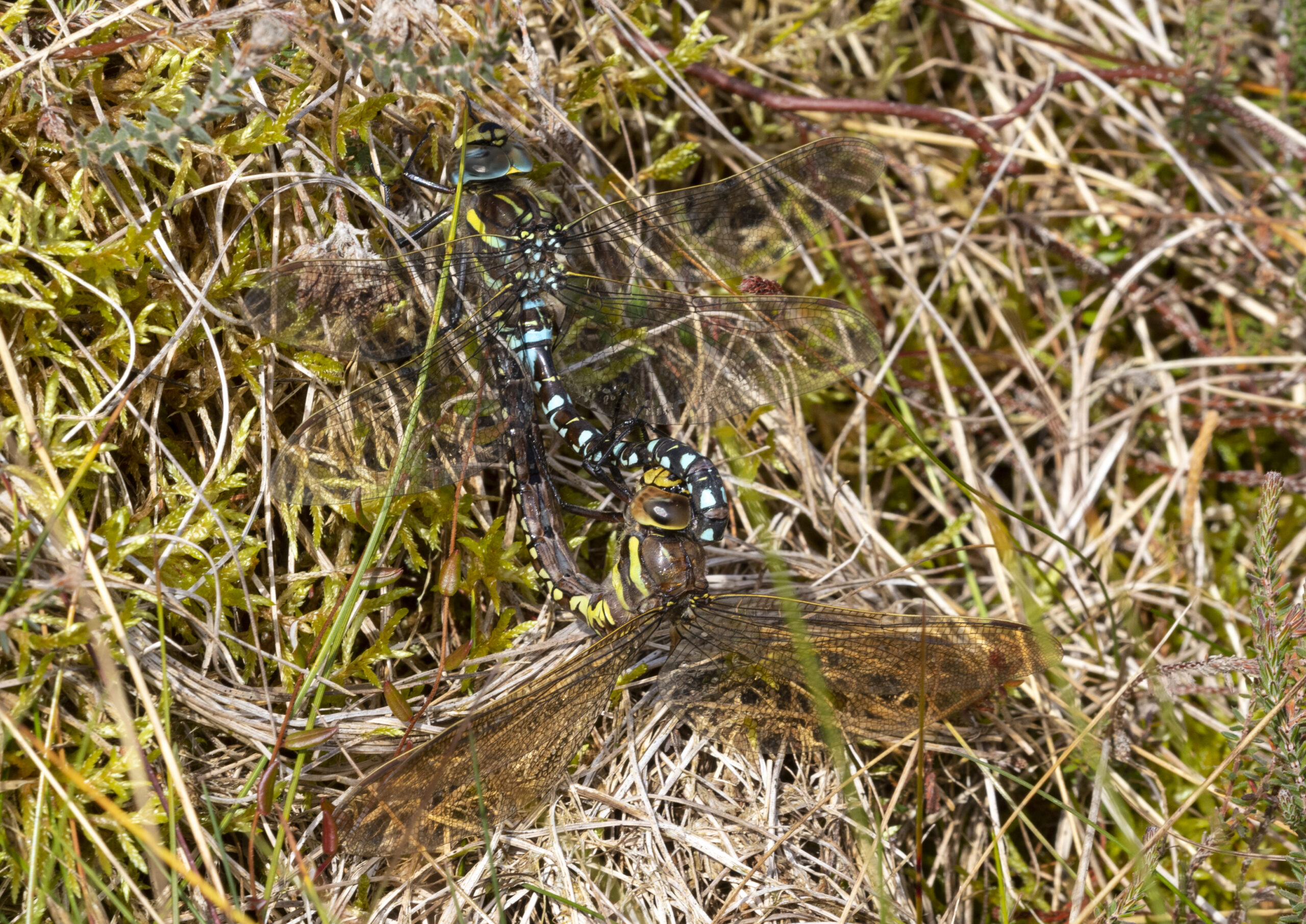
Twenty minutes later, the sun had brought the temperature up a little, and I saw a dragonfly on the pond. As always, I never saw how it got there – it just materialised. One moment there wasn’t a dragonfly, the next moment there was. Then there were two, and being dragonflies they immediately started fighting. I took a string of photos as the distant pair on the far side of the pond clattered into the water. And then, still locked together, they rose from the pond and disappeared behind a large,  brown and desiccated heather on the far side of the pool. I shouldered my camera and went to look for them. At first I missed them and walked right past them. Then I found them, low down amongst some grassy stems above a bed of sphagnum moss, and understood why they hadn’t immediately flown away when I neared them. They hadn’t been fighting. They were mating. I later looked at my photos and realised that the male had seized the female and dunked her in the peaty water, staining her normally clear wings brown. Holding a female underwater until she gives in is sadly a common tactic of male dragonflies who want to mate with a reluctant female. The two dragonflies hung together, the tip of her abdomen touching the place just below his thorax where a dragonfly’s penis lives. The wings each had a golden “costa” or leading edge of the wings. He had narrow shoulder stripes, she had none, and both had orangey-brown wing spots and eyes that…

Hang on. Yellow costa and orange wing spots?  I looked closer.

Eyes that are almost fused together – check. A noticeable waist on the male – check. Oh Lordy, Lordy. It seems that Common Hawkers are like busses: you wait three years for one and then two come along together.

So ladies and gentlemen, with more pleasure than I can possibly convey, I finally give you: the Common Hawker.

common hawkers mating

common hawkers matingWhat do you mean it looks like all the other dragonflies… ?


A short haul flight during lockdown that few people noticed

I went to Brighton yesterday. Why not? It was a sunny if windy day, one of a run of days of nice summery weather that would have been really appreciated during summer but was rather more annoying now that the schools have gone back. But if you live in the UK, wonky weather is the deal you sign up to.

But surprisingly for a 3-hour drive (lorry fire on the M25) to a seaside town, I wasn’t heading to the beach. I was heading to some hilly ground to the East of the town, to meet an old friend. I could seas the sea quite clearly, and it did look inviting until I reminded myself that this was September in Britain and the sea probably had pack ice floating in it (I may be exaggerating a touch).  So why was I here? I had come to try and see an insect, a butterfly, that might just be one of those European migrants trying to set up home in the UK, the difference here being that we don’t have warships trying to stop them. It’s the long-tailed blue butterfly.

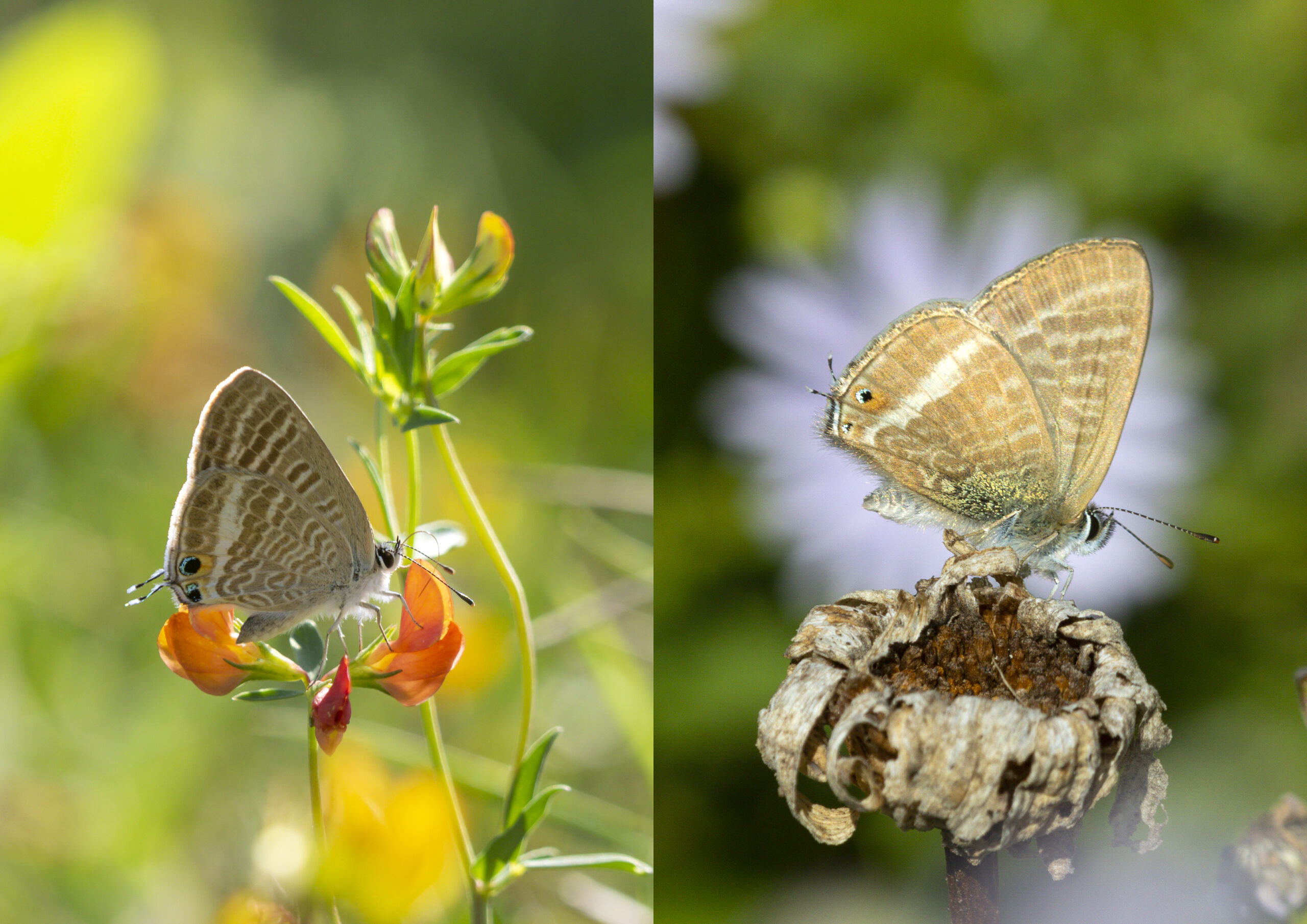
I’ve seen the long-tailed blue butterfly before. In the carefreee, covid-free halcyon days of 2018, I jetted off to Minorca on holiday. Being the kind of person I am, it didn’t take many days of lying on a beach before my feet got twitchy and I set off inland with a camera hunting for wildlife. In the back of a town centre development near Cala Galdana, I found a patch of ground that had been bulldozed to make way for some building work that hadn’t happened. On  the back of the rubble-strewn site, some everlasting sweet peas had bloomed. And on the sweet peas, I found the long-tailed blue, butterfly sometimes called the “pea blue”. It’s a striking butterfly, with underwings chased in fine repeated fawn and white lines, like a doodle you would make on a boring phone call. The upperwings of the male are a deep, violet blue, but it is name for two short “tails” that project back from each wing, accompanied on the underside by two glittery eye-dots. What are they for? Nobody knows for sure, but it’s possible that they are a defence mechanism, a handy, disposable part of the butterfly’s wing that a pursuing predator can catch while the rest of the butterfly escapes. Or it may just be what counts as really sexy in butterfly world.

I arrived a a spot on the hills where the same everlasting sweet pes grows wild. There were perhaps a dozen plants, most finished for the year and faded, but one of which bore a fresh, neon pink bloom. Surprisingly, this plant seemed to hold no attraction for any butterflies at all, but on a nearby stand of faded blooms, I came face-to-face with my holiday romance. Nearly eight hundred miles and at least three countries away from where I’d last seen one, this was actually no foreign butterfly. Clean and crisp, this butterfly hadn’t flown the Channel: it’s parents had. The long-tailed blue can fly huge distances, crossing mountain ranges, and a hop across the Channel was nothing to it. It’s a born invader as remarkably, it can complete its entire life cycle, going from egg to caterpillar to chrysalis to butterfly in as little as four weeks in good weather. This long-tail was  born here, on this Brighton hillside, as British as I am. The test now will be whether any of these new citizens’ eggs will survive our winters to emerge next year. If they do, Britain will have acquired two more “native” species of butterfly in a single year.

So here are two long-tailed blues, in phots taken 800 miles apart. Can you tell the Spaniard from the Brit?

long tailed blues


A case of premature exclamation

For over a year now, I have been searching for a particular dragonfly. Irritatingly, its name – the “common hawker” -suggests it is easily found, but that couldn’t be further from the truth,and it’s actually quite scarce in the south of the UK. It’s a lover of pools which have acidic water, the kind that you find in pine forests and peat bogs, and those are in short supply near where I live. So I have travelled hundreds of miles to places offering the right habitat to try and find it. I have walked miles in the acidic bog areas of Somerset and the New Forest. I have been bitten and scratched, got water inside my welly, and seen… well, a brief glimpse of one would be a charitable answer, because I’m not even sure that the one I saw was a Common Hawker.

So this year, after lockdown ended, I had another go. I went to a place in Somerset with the delightful name of “Priddy Mineries” where the dragonfly has been seen. In fact, it’s was seen there about twenty minutes after  I left the site, empty-handed, last year.  Conditions weren’t ideal, as the leading edge of a storm front was crossing over, and it was very windy, and fairly overcast, conditions which are anathema to most dragonflies. But needs must, so off I went, driving along roads that were starting to become familiar, I’ve been to Priddy so often looking for things that turned out not to be there.

Now don’t get me wrong, Priddy is a fantastic place for wildlife of all stripes, and well worth a visit. But it’s not so pleasing when you’ve gone to find a particular insect and never seen it. I joined a few other dragonfly enthusiast at one of the prime dragonfly pools  (known as “odo-nutters”, after the family name for dragonflies, “Odonata”) and we watched and waited. One of my companions cheerfully informed me that he’d photographed one just the day before, right where I was standing. Of course, it had been sunnier then. And less windy.

After an hour or two, I decided to walk the nearby stands of bracken that were sheltered from the winds by tall pines. I found a dragonfly there – the black darter – that is uncommon if not rare. And then I saw it.

Zipping expertly in and out of the trees, up and down, like a ping-pong ball on the speakers at a Led Zeppelin concert, was a medium-sized dragonfly. It had the right kind of patter. It was in the right place. And then – miracle of miracles – it settled, something that Common Hawkers rarely do. It had settled on a piece of old heather, which Common Hawkers do on those rare occasions when they stop flying. Serendipity. Everything was coming together. But wait: what was this? It had settled right next to another that I hadn’t spotted. Male and female, side by side. An uncut diamond lying by the side of the road. A huge nugget found with the first strike of the shovel. The kind of story Odonutters tell each other on dark nights over a bottle of Fanta. I screamed aloud. I danced the kind of jig people with two replacement knees dance – a kind of rolling sideways shuffle, if you’re interested -and told passing strangers. I took photo after photo after photo until I couldn’t think of any more photos to take. I went home buzzing.

When I got home and looked at my pictures. They were lovely images of a two dragonflies side by side. Except they weren’t the Common Hawker. They were a pair of males of the almost-identical Migrant Hawker, far more common in the South. In my excitement, I’d made the classic error of all wildlife-watchers: seeing what I’d expected to see. It’s a mistake I’ve made before and will doubtless make again, but it was particularly galling this time.

I couldn’t face returning to Priddy, and the Common Hawker flight season ended before I could go anywhere else to look for it. Like so much of our wildlife, from the ephemeral butterflies and dragonflies to the migrant birds that visit us for a while and then leave, I would have to wait for another year for a chance to see it. So here to keep you entertained, is a nice shot of two Migrant Hawkers. I hope you enjoy it, because it’s all you’re getting until Summer 2021

Migrant hawkers

Migrant hawkers. Pah

The art of anal appendages

I never dreamt that ‘anal appendages’ would become a part of my life. I mean, who would? And yet somehow, they have become something I not only talk about, but carefully examine.

When I started my long, slow love affair with the natural word, it was all about seeing and photographing living things that are easily accessible – things like great spotted woodpeckers, buzzards and bank voles. Over time, I developed good fieldcraft skills, and as I’ve done so I’ve gradually discovered species that are more challenging to see, getting up close and personal with kingfishers and hares, badgers and owls. But becoming more proficient creates its own problem. Once you have seen the easy-to-see species, the ones that are left are, by definition, not so easy. The job just gets harder and harder.

Largely as a result of habitat needs, but all too often as a result of being wiped out in all but a few locations, our wildlife is not spread evenly around the country. You can’t see an animal that doesn’t live where you do without travelling, and so, like many before me, I’ve gradually started clocking up the miles, ranging the length and breadth of the country to try and see rare or unusual species. One of the families[1] of creatures that I like are the Odonata, the dragonflies and damselflies. These winged marvels date from 300 million years ago, long before the dinosaurs, and those millions of years of evolution were certainly not wasted. If your body plan doesn’t alter significantly in 300 million years of endless kill-or-be-killed competition, then you know that it’s a pretty good design. Able to lift off vertically and hover, Odonata can also fly backwards, forwards, sideways and even upside-down, something even the most advanced modern aircraft still struggle to replicate. Their compound eyes, each with thousands of hexagonal light receptors, wrap around the sides of their heads, allowing them to see in front of them, above them, and behind them at the same time. These brilliantly coloured eyes are part of a target tracking system the envy of a guided missile destroyer, which allows them to pick out a single gnat in a cloud of them and snatch it unerringly out of the sky before eating it with some of the first teeth seen in nature. They succeed in catching prey in 95% of their hunts, which means that they are actually the world’s deadliest animal – compare this to a hunting success rate of just 25% in lions or 5% in tigers.  Even the great white shark, another ancestral species who has spent millions of years getting it right, only manages to make a kill in 50% of its hunts.

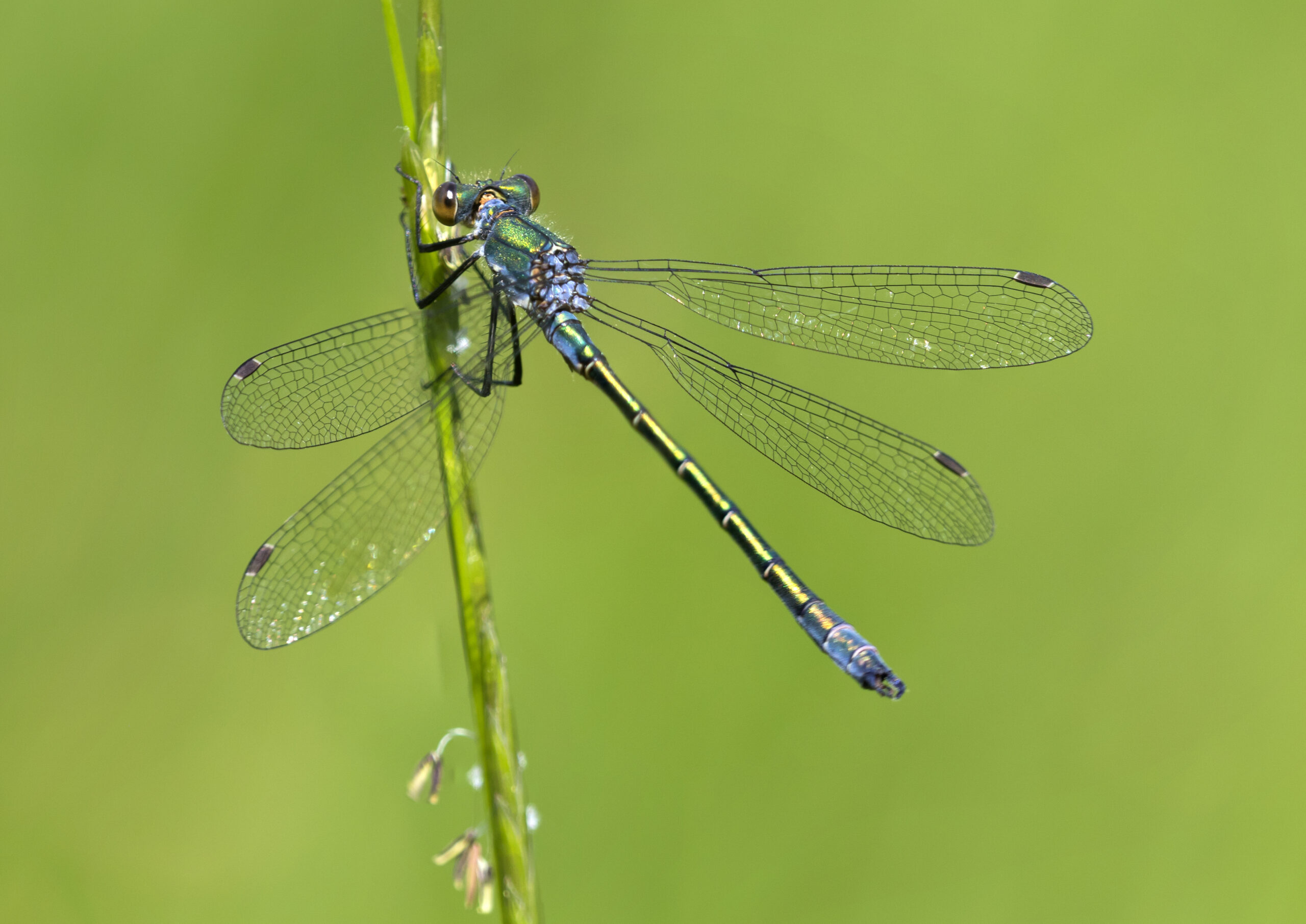
The scarce emerald damselfly

The scarce emerald damselfly

The problem for the damselfly-spotter is that many of our damselflies can look very similar indeed.  Identifying what you’re looking at takes experience, practice, the help of experts and a very good guidebook or two (I have about five). Colour plays a large part, but unfortunately many Odonata change colour – the blue-tailed damselfly, for example, starts off life as pale lemony colour, and matures quickly into a medium blue colour (for the males) or pale blue, orange, purple, pink or green for the females. So to definitively identify some damselflies, you need to start looking at small (and I do mean small – these are not big insects) details. There are the colour spots towards the ends of the wings called “Pterostigmata” (literally “wing marks”) whose colour and shape can help separate, say, a common emerald damselfly from a southern emerald. Then there is the patterning on some of the segments, where a “U” shape may mean a variable damselfly while a cup shape may point to an azure damselfly. And then there are… anal appendages.

Shaped like your finger when you beckon someone, a damselfly’s anal appendages are sometimes called “claspers”. They occur only on the male, and are tiny, perhaps two millimetres long, but if you want (for example)  to tell your genuinely rare “scarce emerald” from the much more abundant “common emerald”, there’s literally no substitute for comparing these. Their purpose is to grab a female damselfly around the neck during mating. Like the docking mechanism on a space shuttle, their design is specific to the shape of the female’s neck, which is why, for some very similar species, they can be the only way to be sure that the small insect in front of you is the one you’ve just driven 150 miles to see. The sight of damselfly enthusiasts peering closely at magnified images of anal appendages is far more common that you would ever have believed.

anal appendages of the scarce emerald damselfly

The anal appendages of the male scarce emerald damselfly, The inner pair are perhaps a millimetre long, and it is the exact shape of the flattened tips of these that is diagnostic of this species. Who knew?

So there you have it. Anal appendages: just one more wonderful part of nature you probably never knew existed.


[1] Just so nobody shouts at me – biologists class Odonata as an ‘order’, which is strictly speaking a branch of the tree of life above ‘family’.

Page 3 of 8

Powered by WordPress & Theme by Anders Norén