Steve Deeley

Naturalist. Nature writer. Nature photographer.

Deep in the grass sward, nothing rustled.

It was, to put it mildly, not the most promising start to a day’s nature-hunting. It was the night the clocks went back, and they seemed  to go back to the times of Noah. The rain overnight and into the late morning had been biblical, so thick and dense that it seemed like fog, erasing the view more than a few feet in front. I set off when it slackened slightly with every expectation of returning home, and nearly did so at the first roundabout, just yards from my front door. It had never flooded before in the thirty years we’d lived here, but it had flooded now, and I drove carefully through four inches of water.

Fortunately my destination was in the hills above Swindon, and following a local farmer who was kindly using his bale-picker to bulldoze the fallen tree-limbs off the road, I reached the nondescript wooden hut almost on time. I was in the middle of open arable fields now shorn of their crops and reduced to stubble waiting for ploughing and seeding. But it wasn’t the field I was here for, but the field margins, the six-foot strips of long, straggly grass now flopped over and pummelled by the rain, interspersed with stands of brambles. It was here, if things went well, I would find evidence of one of Britain’s smallest and most elusive mammals: the harvest mouse.

Harvest mice are small in the way that Mount Everest is big. They are so small that you could fit two, tails and all, end to end across the flat of your hand. They are so small they you would need two or three to balance a Jaffa cake on a pair of scales. Their Latin name is ‘Micromys minutus’, or  ‘really incredibly small mouse’ with a bit of freedom in the translation. We’re talking world-class titchiness here.

For most of the year, harvest mice live in small nests of woven grass and move though the sward and thickets of brambles and hedges. They are the proud owners of Britain’s only prehensile tails, which in the manner of an monkey’s tail they can use to grasp and grip things, handy for snaring that nearby grass leaf and using your very limited bodyweight to pull it towards you so that you can clamber over. They are fairly omnivorous, happy to eat seeds, nuts, vegetation and small insects: since they have to eat a third of their bodyweight every day just to stay alive, they can’t afford to be fussy. And here’s the thing about harvest mice: practically everything we know about them, we’ve learned from captive animals. You almost never see them in the wild. I attended an online lecture from a harvest mouse expert who has spent forty years studying them in the wild. He’s seen one. From behind. As it was running away.

In the wild, harvest mice are  well-hidden deep inside the grass sward. By the time you’ve walked up to the spot and parted the grass, they are somewhere else. We can live trap them, but even that can be challenge. So a lot of what we know about populations comes from finding their nests. By late October, the harvest mice have stopped breeding and descended nearer to the ground, where they will build new nests and share the runs of mice and  voles. Their old nests, golf-ball sized bachelor pads and tennis-ball sized nursery nests, stay abandoned in the sward. And it was these that I was here to find. Guided by Wiltshire’s County Recorder for mammals, I set off in the company of a family and another hardy soul who had braved the downpour to get to the hunt. And it seemed our diligence was being recognised as the clouds vanished, the sun broke out, and we emerged into a beautiful Autumn day.

As we had been warned would happen, it was the children who found the first nest. Harvest mice make their nests from living grass that they split carefully and weave together, so that it becomes, in effect, part of the tussock, firmly anchored inside. They have no extrance holes: the mice just push their way in and out. It was almost eighty metres into our examination of a 100 metre length of bramble-filled grass before I found my first and only nest of the day. Once they are recorded, they are discarded, so I brought mine home. It’s an engineering miracle, wrought by a creature that could happily sit on my thumb.


harvest mouse nest

harvest mouse nest

harvest mouse nest

harvest mouse nest in detail
A difficult day in the office

I took a very difficult decision today.

There’s hoopoe, a rare bird that I’ve always wanted to see, showing well in Warwickshire. People have been posting stunning photos of it. I’m free today, and I have both the time and money to go and see it.  But I’m not going. The decision is agonising, but it’s the right one. Because I can’t sit here and moan about the lack of political action at COP26, I can’t feel helpless and hopeless about the bus-crash-in-slow-motion that our planet is on, and then calmly take my car on a 180 mile round trip just to see one bird, not matter how rare and pretty.

Change isn’t about big politics and leaders, it’s about small domestic decisions taken by each and every one of us. I’m still going to travel to see the things for the books I write. But I imagined myself explaining to my great-great-grandchildren why the hoopoe justified killing the planet just a little bit more. Or more immediately, explaining to the Maldive islanders why it was worth the loss of their homes. My not going is only a small contribution. But there are seven billion of us, and seven billion small contributions might just add up to one big change.

The hoopoe will be gone soon, back to Africa. It may be fanciful, but I hope that by not seeing a hoopoe today, I’m helping to make sure that my descendants still can in the future.

A not-so-quiet invasion

I am standing in a meadow, far from the noise of traffic and people, and in the breeze the tall willows that border the field flicker and clatter their leaves for me, the sound of a distant waterfall where there is no water.  Two branches of beech, grown too closely together, bang an erratic accompaniment to the steady bagpipe drone of hoverflies visiting the early blackberries. The soft heads of the grasses, the timothy and Yorkshire fog, whisper to each other as the wind ruffles them. But there is another sound that is louder than all of them. I am a giant towering over a fervent landscape full of the constant susurration of crickets and grasshoppers. Slightly delayed by the poor weather this summer, mating season is in full swing, and the grasses abound with singing males.

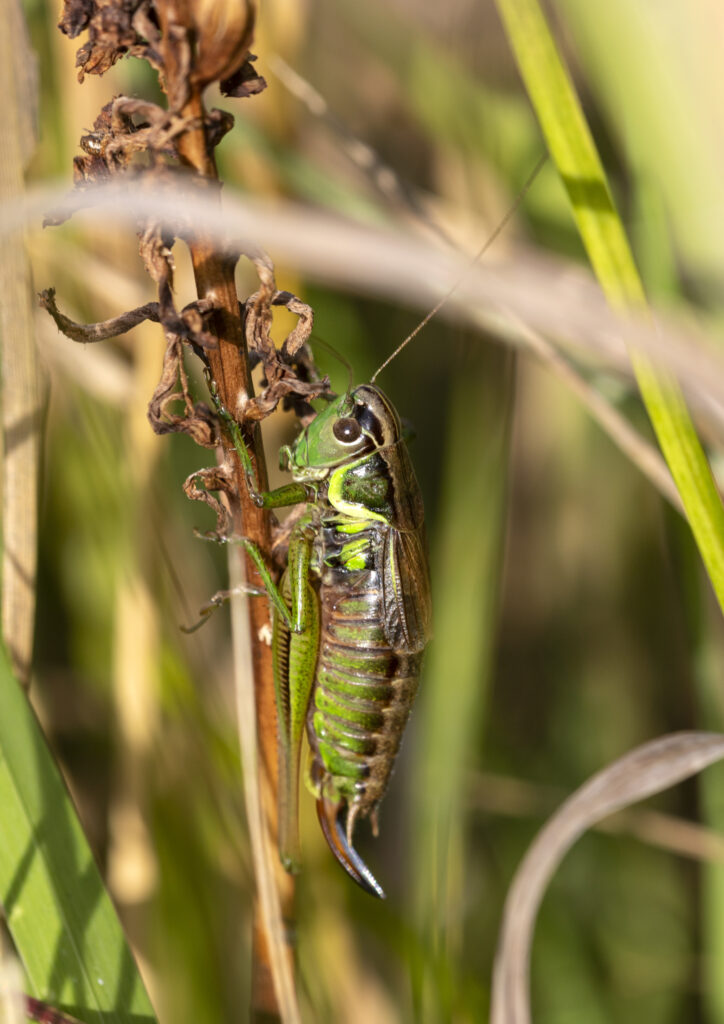
Shy friends, they fade into silence when I approach, so that I walk in a bubble of quiet amidst a sea of hissing and scratching. But then a stalk near my foot quivers as something large lands on it. It was a jump, not a flight, and I kneel to see a Roesel’s bush cricket. It’s a male, resplendent in green and yellow-spotted livery. Like almost all Roesel’s, he is short-winged and flightless, and makes his slow, steady way down a stem of grass like a vertical tightrope-walker, his objective a male dark bush cricket sitting on a leaf below. They meet, and their encounter is delicate, tentative and brief: a flick of their absurdly long antennae, and both realise that a mistake has been made. The dark bush-cricket remains unmoved, while the Roesel’s retreats back up a nearby stalk to try again. It will probably succeed, as Roesel’s are on the march, spreading steadily out from the southeast, already reaching North Yorkshire and the west of Wales.  In the nearby grasses, hundreds of others continue to call, so I sit still in the sun and for a time enjoy the almost deafening quiet of the countryside.

Rosel's bush cricket

Rosel’s bush cricket

Where jets once thundered and women protested, wildlife now thrives

Greenham common, Berkshire.

I am standing in a thousand acres of a habitat that is rarer than rainforest. To my left and right, as far as the eye can see, it is a green carpet of rough grass awash with colour – the mauve of bell heather and the delicate pink of ling, stands of bramble heavy with berries but still flowering white and pink, and impenetrable swathes of gorse. The flowers are long gone from the common gorse, but dwarf gorse, its smaller cousin, thrives here and is at its peak now, the stunted shrubs awash with bright yellow flowers.

Their existence here is little short of a miracle. Sixty years ago, American B-47 bombers thundered down a runway exactly where I am standing. Forty years ago, women arrived here and started peacefully protesting the presence of nuclear cruise missiles on the base. Now the airbase has been erased, and in its place dry heathland, one of our most precious habitats, has erupted. Instead of protest songs, all I can hear are birds: a bubbling fair of swallows sideslip and twist through azure skies that once held warplanes;  a stonechat scolds me with the sound that names it, a clack  like two hard pebbles struck together. Greenfinches chatter together. And what I mistake at first for a skylark is actually a woodlark, its rarer cousin, whose song is – forgive me – even sweeter.

But it is here at my feet that I find what I came here for. Barely visible in the grass are short grey-green stems wrapped with a spiral of tiny flowers, each snow-white bloom perhaps 3mm across with a green lip. It’s the year’s last orchid: the ‘autumn lady’s tresses’, named for the way the twisting flowers resembles a braid of hair. Greenham has one of the largest populations in the country of these diminutive plants. It’s a fitting tribute, perhaps, to those women who truly helped to turn this place from war to peace.

Autumn lady's tresses

Autumn lady’s tresses

It’s not quite cricket

I watch as two invaders to our shores play a deadly game

It is one of those September afternoons that you always hope for: a bright, warm sun traversing low in a sky of faded blue, adorned with suds of grey-white cloud, and a gusting breeze.  A narrow path leads me between stands of bramble to an open area of long grass, and almost at once I see it, low down between the stems. It is hard to miss.

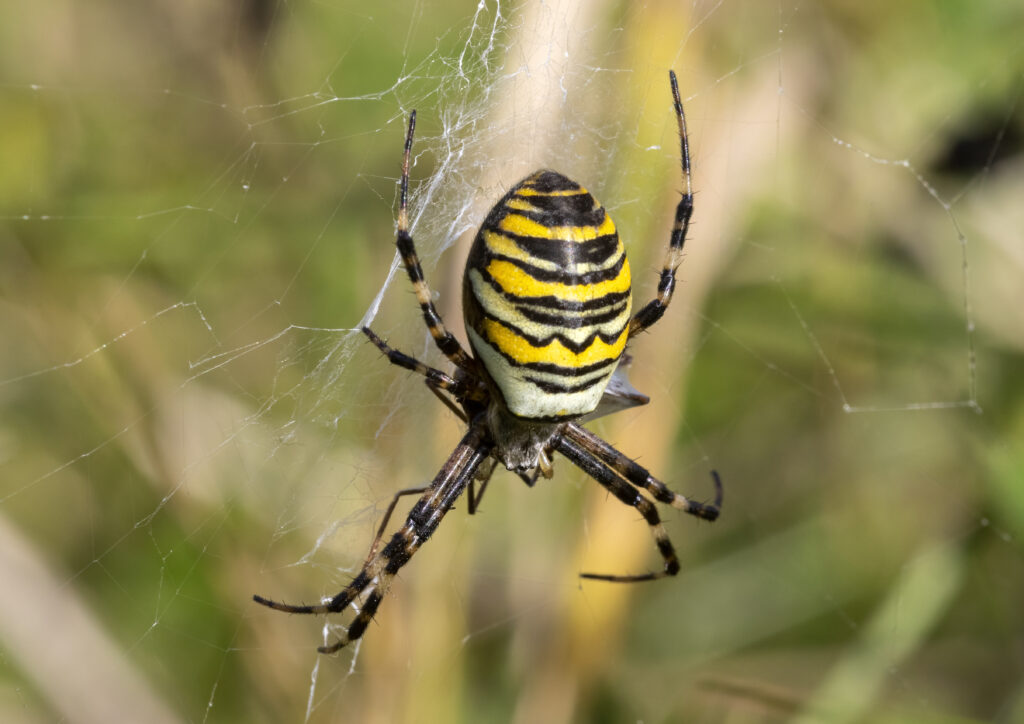
It is enormous, a living artwork of bold ripples of black, white and custard-yellow, with eight zebra-striped legs. A wasp spider, sitting in the centre of its orb web, slowly demolishing what look like the remains of a grasshopper. The dazzling body is perhaps two centimetres long, the legs as much again, which tells me that this is a female approaching her resplendent autumn best (the males are far smaller, and much harder to find – perhaps because the female often eats the male after sex. That’s going out with a bang in every sense). In just a few weeks she will be gone, leaving behind an egg sac the size and shape of a poppy seed head.  Her offspring will join their companions in heading northwards, a few miles each year, in a slow but steady invasion of Britain driven in part by our warming climate.

Wasp Spider

Female Wasp Spider

Ten feet away I see another female. She’s alert, as the stems around her web tremble. She shifts slightly, adjusting a leg to better feel the vibrations of her potential prey. It is a Roesel’s bush cricket, a similar size to her, climbing a nearby stem. It, too is a female, clad in black and lime green armour, with huge industrial-looking hind legs and wings too small to fly with. The Roesel’s is another invader making its way North, and as they occupy the same habitat, this game of cat and mouse is played out between them every year.

Rosel's bush cricket

Rosel’s bush cricket

The cricket seems to sense the danger and halts, before a kick of those hind legs fires it away into the undergrowth. The wasp spider is unmoved. The grass is alive with craneflies, the daddy-long-legs of my childhood, so her next meal will not be long in coming.

Finally, some good news

Ravensroost wood, Wiltshire.

For all the effort that I put into it, I can never get successional flowering to work in my garden. Yet here in the woodland, it happens automagically; not just seasonally, but from year to year as well. This time last year, it was the hemp agrimonies that dominated, their clusters of pink-purple flowers festooned with nectaring hoverflies and the occasional white-letter hairstreak butterfly dropping in from the wych elms behind. This year, the hemp agrimony is muted, still to come into its own, and the banks on either side of the track are instead a confection; candyfloss clouds of creamy meadowsweet, interspersed with sharp, columnar spikes of purple loosestrife, and cheerful punctuations of ragwort. In North Wiltshire’s continuing drought, the faint pink of the dog rose has overtaken the bramble, whose flowers and fruits are shrivelled and unpromising.

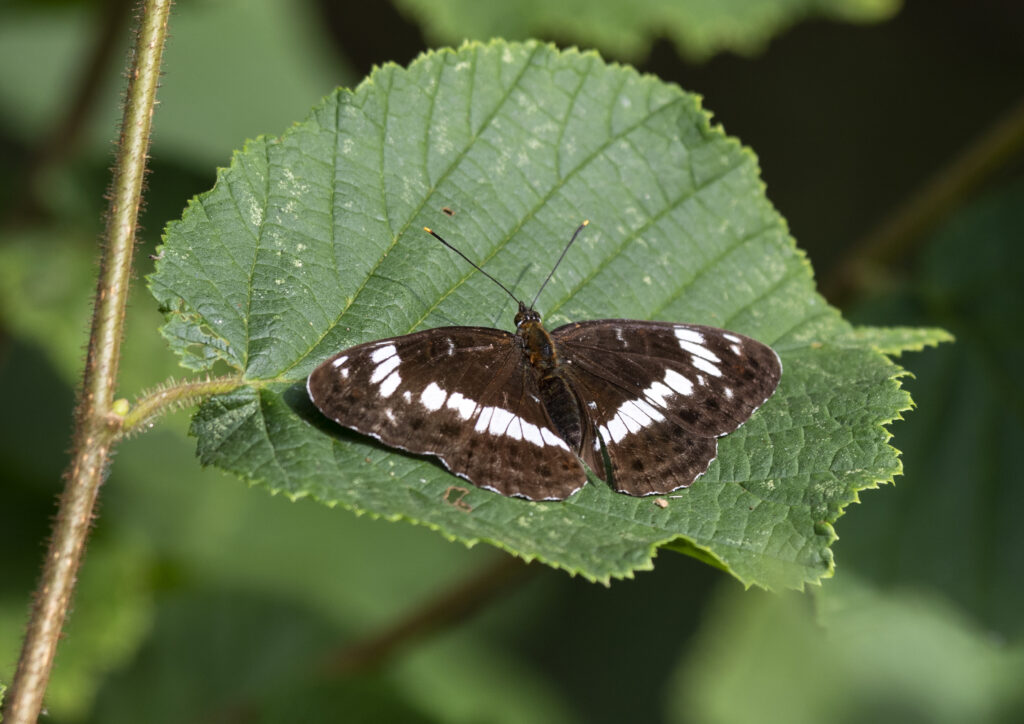
I am five minutes in before I see the first of the butterflies that I am seeking. Resting in the deep gloom on the edge of a coppiced hazel, the wobbly white line curving across its wings stands out against the velvety blackness of the rest of it. This is a strait-laced, no-nonsense Victorian butterfly, without frivolity or gaiety, and I am relieved to see it, as there were fears that it was dying out in this woodland. As a child, I never understood that the white admiral was a woodland butterfly, a shade lover, and I sought it in vain in the sunlit meadows where its cousin the red admiral flies. Elusive, and ephemeral, it only occasionally stops to display its monochrome beauty. You rarely see more than one or two at a time, but just yards further on, I see another. And another. I count seventeen in all,  a record number, driven by the lack of bramble flowers to hunt for nectar anywhere they can find it. For once, they are competing in numbers with the dazzling orange flashes of the silver-washed fritillaries that also abound here. The fritillaries will be glinting in shafts of sunlight well into August, long after the white admirals are gone; then they too will fade and leave it to the second broods of yellow brimstones and common blues to see the woodlands into winter. Already the next generation of white admirals are starting their journey, the spiky geodesic domes of their eggs laid on honeysuckle leaves, and I wonder what colours they will see when they emerge next year.

white admiral

white admiral

One for sorrow

It was one for sorrow, two for joy in the rhyme of my childhood. It went as far as ten, but never reached thirty-five, so now I’m unsure of my fate.

I’ve walked just five minutes from my home, to search for damselflies in the series of small pools that are part of an optimistic flood relief scheme created alongside a local housing estate. As I arrive, the flock of magpies, more than I have ever seen in one place before, take to the air shrieking defiance, making the sky flicker. Between ‘gulp’, ‘tiding’, charm, and ‘littering’, some of the many collective nouns for them, I choose ‘mischief’: they are clearly up to something.

Ringed by grassy banks filled with teasle and thistle, punctuated by ragwort and fleabane, the damselfly ponds graduate slowly, the deeper areas of water filled with reed mace and phragmite, the shallows with water mint and hard rush, the glistening mud by the fat yellow fingers of bird’s foot trefoil. I slowly circumnavigate each of them, and the mud between speaks to me. It’s a palimpsest, a recorder of travels. Here, twin almond slots incise the ground, the marks of roe deer that came here in the night to drink. There, the smaller, daintier, ballerina hooves of Muntjac, spaced out with speedy flight, are intercut with the spear-shaped tracks of a following fox. And last, cutting through all, a deep indentation of four claws and a “D” shaped pad: one of this morning’s dogwalkers had paws to clean.

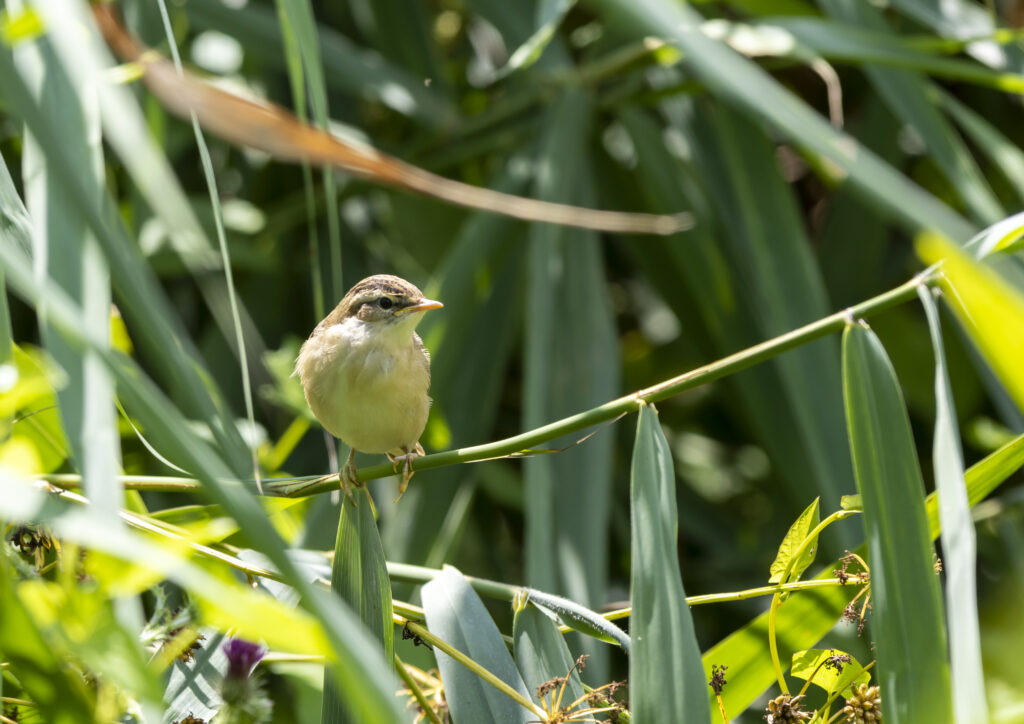
There are no damselflies, which is puzzling. I wonder if I have left it too late in the day, if it is too cloudy or cool for them to fly. But I can hear a rustling within the reeds, a clatter of wings, and glimpse movement. I assemble it from its parts: a glimpse of creamy chest and sparrow-like back, a pale leg, and finally a dark-capped head with a cream ‘supercilium’ or stripe above its eye. It’s a sedge warbler, a juvenile, recently fledged. And there is a second, and a third, moving clumsily through the stems, hunting for insects near the water line. This explains the paucity of damselflies, and perhaps also the gathering of magpies, inveterate takers of other birds’ young. The fledgling warblers will stay here for a few more weeks to fatten up, before winging their way to sub-Saharan Africa, to Senegal or Ethiopia, sometimes in one prodigious, unbroken, four-day flight.

fledgling sedge warbler

fledgling sedge warbler

And so, I turn to the task before me: “thirty-five for feeling alive”, maybe?


A matter of determination

Ravensroost wood, Wiltshire

Inevitably, it rained. In the summer that has been no summer, on the day of the Wimbledon and European Cup final, the wood sat brooding and silent, caught in a long exhale, even the birds subdued into near silence. There was a tension to the air, a sense of sense of expectation, and I had barely set foot past the gate when the rain began. Desultory stuff, an unambitious but persistent drizzle, the grasses bowing before me, and eventually even the meadowsweet slowly bending in despair. Pattered hazel leaves shrugged it off, while the hemp agrimony, made of sterner stuff, pretended not to notice. I walked on, passing a sole ringlet butterfly, wings closed, its body carefully aligned to the shelter of the leaf above, and a scarlet tiger moth, whose red and black hindwings were carefully shuttered under black forewings, daubed in gold and white, that seemed impervious to the rain.

In the near-silence, it was the hum that I noticed at first. A steady tone, like a distant motorbike that never seemed to get nearer or further away. Tramping up the sodden track, the empty woodlands slowly came to life with darting, soaring shapes. I had thought to seek shelter from the rain in the old wooden shooting hut that sits in the centre of the wood. More lodge than hut, roofed with wooden shingles bent and curled with age, and walled with wooden boards decorated with stripes of split ash branches, it has crumbled and been repaired so often that its age is indeterminate, but is at least a century. But I was not the only one seeking shelter within it. Between two lines of ash, the hut was alive with honeybees, and they filled the air with the sound and movement of ceaseless industry. I tracked one as it flew, circling like an airliner waiting to land, before dropping swiftly down and into a small gap between the underlying boards of the wall. I stepped forwards, and was engulfed in a living cloud that swirled around me and before me, buffeted occasionally, but never stung. Inside the hut, I had expected to find walls glistening with dripped honey but found instead a giant poster put up by the wildlife trust, extolling all of the species you could find in the woodland on drier days, but unfairly making no mention of the bees.

As I left the hut to return home, SW19 and Wembley were still bathed in sunshine and hope, but the rain had hardened into a downpour, a foreboding of the dampened spirits that were to come. The bees, indifferent to weather and dreams alike, flew on.


wild bee hive in cabin walls

wild bee hive in cabin walls

The ripple effect

A few days ago in Wales, persons unknown took a boat to an island in the centre of  the llyn brenig reservoir in Wales and used a chainsaw to fell a new platform erected to encourage Ospreys to breed. The Ospreys, an IUCN red list bird and highly protected in the UK,  had in fact just started to breed, and had laid their first egg when their home was destroyed.

At the time of writing, the culprits are unknown. But clearly some people feared the impact the Ospreys would have on their locality. That might be local landowners  wrongly believing that the Ospreys would eat livestock, or local fishermen, rightly believing that the Ospreys will eat fish.

But here’s the thing. The llyn brenig reservoir his 4km long by 1.5 wide. At typical fishery stocking densities, that’s enough space for 39,000 large carp. Depending on the size, a pair of ospreys feeding two young will need around 5-7 fish per day. In the five months or so that they stay in the UK, that’s a haul of perhaps a thousand fish. Whatever is taken will be replaced within a couple of years. So the Ospreys will make a dent of perhaps 10% of the fish stocks.

Compare this to the Horn Mill trout far. Predated by Ospreys, the Farm netted all but one of their pools, and turned the remaining pool into an Osprey attraction. Photographers now pay to photograph wild ospreys as they take trout from the farm.  It’s a profitable venture for Horn Mill, and profitable for the Ospreys, too.

And so we have two approaches to wildlife conservation. One which, with a little imagination, lets both sides thrive. The other which profits nobody, especially not the morons with midnight chainsaws. See if you can work out which is best.

Flowers that glow in the darkness

Following the path inwards seems unnatural, a step away from light and safety. As the dense canopy of the oaks closes overhead, the ranks of rosebay willowherb and hemp agrimony that line the woodland’s bright outer edges slowly cede ground to bramble and nettle, which in turn fade out as I enter its dark heart, home to little more than spindly grasses and seedling hawthorns who cling on, hoping for a giant above to shed a bough and give them their chance in the sun. The soil, though, is moist, rich and fertile; and the air is filled with a peaty organic scent as the skeletal remains of last year’s leaf mould slowly become next year’s humus.

It is here, where little else grows, that I find this woodland’s dark secret. The flowers remind me strongly of the tropical orchids my father used to grow in his greenhouse, yet their pale, muted beauty seems somehow apt, befitting a plant that never ventures out into the sun.  A dozen violet helleborines are dotted around the woodland floor, each perhaps 45 centimetres tall, and bearing a single, stout spike laden with forty or more flowers. The sepals and petals are a light, spring green, and the pale pink-white lip, shaped like a pair of cupped hands holds nectar, to attract the wasps which are its main pollinator.

Named after the purplish base to its stem, the violet helleborine has a trick that enables it to survive in this dark and unlit place where others fail. The plants here are mixotrophic. For perhaps an hour each evening the low sun flickers across them, and they use their chlorophyll to make their own food, but for the rest of the day they become parasitic, tapping into the mycorrhizal fungal networks of these ancient oaks to steal sustenance from them.

The wood grows darker as the rain arrives, pattering on the canopy above me. As I head back to the light, I glance back. Legends to come to life as the flowers become woodland sprites, seeming to float unsupported in the air.

Page 1 of 8

Powered by WordPress & Theme by Anders Norén