Naturalist. Nature writer. Nature photographer.

Category: Mammals

Armchair conservation

There’s a certain smugness involved when you can say that you’ve actively contributed to the recovery of a threatened species. Most conservation measures involve plain hard work – laying hedges, trimming encroaching bushes, digging out invasive plants. Mine involved finding a chair and a good book. It’s the easiest contribution to nature conservation I’ve ever made.

 There’s nothing like being stuck indoors much of the time to help you see the jobs you’ve been putting off for years. I’ve been busily focussed on removing 25-year-old wallpaper, and in consequence I’ve rather let my small garden go. I had always intended to do this, as a nod to the honeybee and the other animals and insects which welcome a touch of un-manicured wilderness, but it’s gone further than planned. Bindweed and brambles have taken hold beneath unpruned roses, and I appear to be growing dandelion as a cash crop. The wee mad Victorian in me wants to pull it all up and restore order, but there’s a growing beauty in its wildness, as the seed heads of unmown grasses start to resemble a field of barley in the breeze.

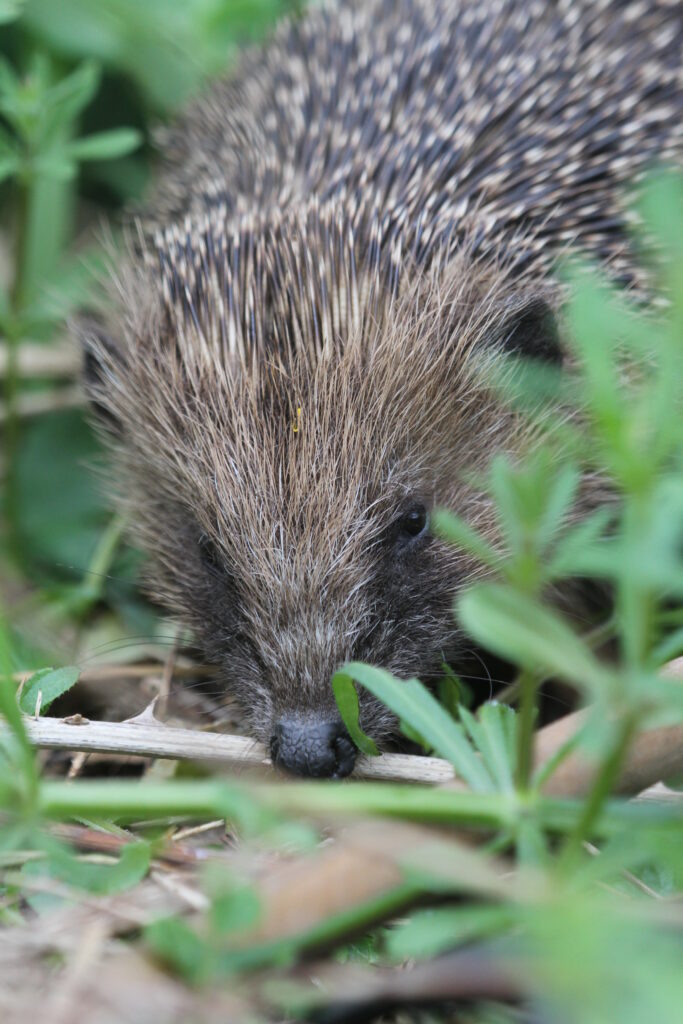
 Last night, I was woken by a sound like someone repeatedly whispering “work”.  I thought it was a cat, but wobbly torchlight revealed instead two hedgehogs circling each other. It’s the start of a mating dance that can (and did)  last several hours. The Germans have a delightful word for it:  an ‘igelkarussel’.  Hedgehog populations are in steep decline, and in July last year it was officially classed as vulnerable to extinction. It seems that my laziness has inadvertently given this pair exactly what they need: plentiful slugs and snails (we haven’t used slug pellets for years) and mounds of rotting vegetation to hibernate in over winter. Now somewhere in my garden, in just over a month, a desperately-needed batch of hoglets will be born.

 All of which means, of course, that I can’t start mowing now. Can anyone recommend a good book?


hedgehog

The hedgehog. Now, unbelievably, endangered


The danger of complacency

On Friday this week my wife and I went on our usual lockdown walk, following a path along a local stream. It’s a path I must have walked hundreds, if not thousands, of times. It’s easy to become complacent about your local patch, to assume that you have seen all there is to see, to overlook the gradual change as environments age, trees grow taller, bushes grow thicker, and the ground beds down under layers of bramble and rotting leaves. But the lesson that you should never presume that you have seen it all was brought home to me as we walked alongside this small stream, bounded on one side by houses and on the other by the slowly maturing woodland that was planted on top of a reclaimed tip.

My attention was first caught by an alarm call from a bluetit, a constant “dit-dit-dit” sound. The small bird was sitting on the uppermost stems  of willow branch that had broken and bridged the stream. And as I watched, the cause of its alarm appeared. Something long and thin and brown moving rapidly down the branch towards the ground. At first, I thought it was a young watervole, because I know they live in waterways in the area, and have been known to climb trees to get vegetation. But this animal was too long and thin, too pointed of the face, and moved rapidly, unlike the water vole’s more sedate scuttle. It was a weasel. Even though I had my camera with me, before I could begin to lift its the weasel vanished underneath a chunk of branch and disappeared into the undergrowth. I waited patiently, desperate to see it again, but that’s been my experience of weasels to date: you see them once, and you never see them again. I’ve been privileged to see weasels a number of times, but is always been an accidental encounter like this one. Even when I knew where a weasel nest was, and haunted the space for hours, watching from a distance through binoculars, they contrived to wait until I had gone before moving.

From its size, I believe this was a juvenile weasel. They have been seen on the old tip, and it makes me wonder if this one is setting out into the world to make a life of its own, crossing the stream in search of a new territory to establish. For once, this blogger doesn’t have a photo, but that doesn’t matter. I stood yards from houses in an urban housing estate, and watched a wild weasel, and if that isn’t something worth writing about, I don’t know what is. And so, every time I walk past this part of the stream again, I will be watching just that little bit more carefully for the faint flicker of a tale or rustle in the undergrowth – and perhaps now I will be watching all of my walk just that little bit more carefully for the things that I never expect to see. Of such experiences are naturalists made.

A tale of the unexpected

For weeks now, my wife and I have taken to walking every morning before we start work, not so much from a lockdown “permitted daily exercise” perspective as from a lockdown “stomach needs resizing” one. We walk a few different routes, but my favourite is down to our local lake. I like it because if we get a nice sunrise the waters reflect it, which is always cheering when all that the rest of the day holds is work. But mainly I like it because there is the chance to spot some wildlife. In my relentless drive to see the rare and exotic away from my home, I’ve tended to overlook the value of the space around my home, on the borders of a spreading housing estate. The folly of that has been slowly brought home to me over the last few weeks. Several lockdown walks have brought my wife and I  close encounters with a Kingfisher, often as a dazzlingly blue rocket streaking along barely a wing’s length above the water, but on one morning walk recently, we strolled down to the edge of the lake to look at it, only to be surprised by the Kingfisher as he plopped down from a branch just a few feet away, and hurtled off bearing a small, wriggling fish in his beak.  On another walk, we treated to a furious display of indignant piping as a pair of Kingfishers, cruelly out of sight around the curve of a thick bush, battled for ownership of the lake’s prime fishing. One friend, who has watched them for years and can identify them individually by bent feathers and broken beak-tips, told me that the fighting  pair were Father and Son. The Father is more than four years old. That’s far from a record for  Kingfisher, but is twice the average two-year lifespan. The following day’s walk we saw no sign of Kingfisher, but a Little Egret and a Grey Wagtail occupied the small stream that feeds the lake. A day later, a buzzard scraped the low, grey sky overhead. But two days later came a sighting that made me literally dance a little jig of joy, like a kid who just got his dream present at Christmas.

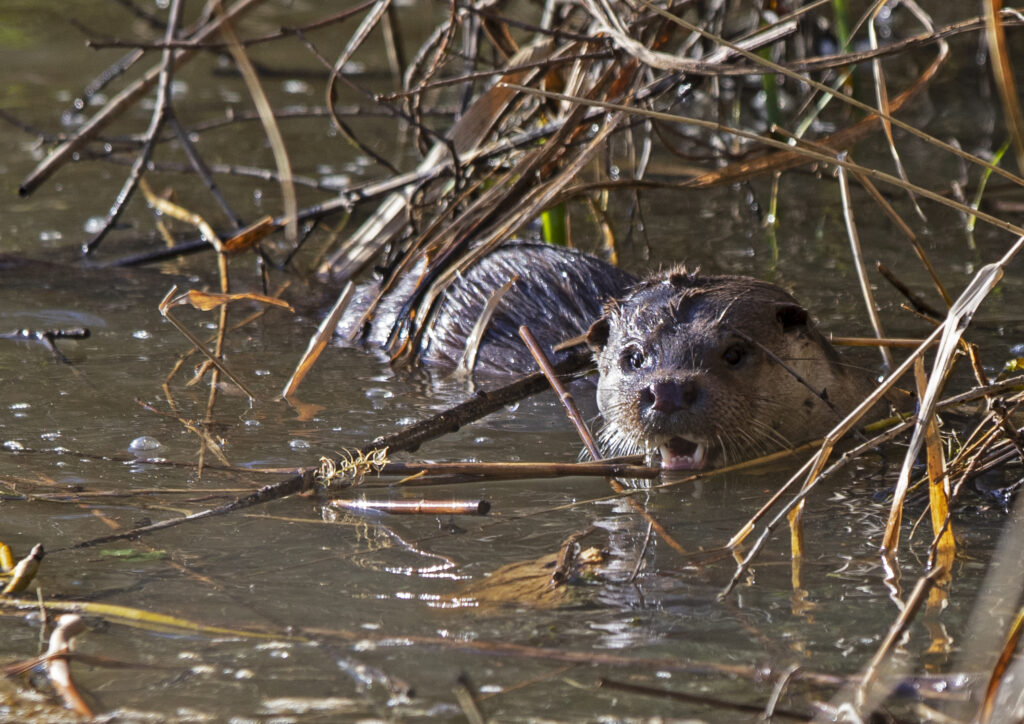
It’s always an effort to emerge in the mornings, particularly when it’s cold and wet. This day was both, clad in a freezing fog that apparently liked the town so much that it stayed all day. Spectral trees faded into the background and the moisture gathered  on my eyelashes as I walked until I was blinking tears. The footpath gradually faded into grey, lit by streetlamps that from a distance seemed to be globes of light hanging unsupported in the air. It wasn’t a day where I had high expectations of seeing anything, let alone any wildlife: even the usual dog-walkers seemed absent. My wife and I walked down the path, crossed under the main road, and emerged out near to the small curved weir that holds back the lake’s waters. Across the lake, grey water faded into grey sky, as if some slovenly painter had forgotten to add a horizon. A small movement caught my eye, and there it was. A crisp wake, as though a sharp knife was cleaving the water in two, was spearing out from the bank, b purposeful and powerful, a torpedo fired aimed towards one of the small islands that dot the lake. I was pretty sure what it was the second that I saw it, but then it dove into the water, a long, slick back arching gracefully downwards, followed by a small flip of a powerful tail. I was less than a quarter-mile from my home, watching a wild otter.

I have been privileged to see otters many times. I have watched a mother otter groom her kitt’s fur just yards from me, and once saw an entire family group of five otters at the same time. This distant glimpse was, in many ways, nothing special for me. But it was special for me, because this otter was on my doorstep. I have lived near this lake for almost thirty years, and watched it gradually transform from bulldozed mud and optimistic saplings into a habitat, punctuation in a chapter of houses and more houses  and more houses that is still being written. This is my space, my community, my local patch. My otter.

And there it is. Not the answer to all of the woes that face the natural world in our far from sufficient husbandry, but perhaps one of the many tools we will need to fix it. I cared about this otter because it was, in its own way, part of my community. A neighbour, of sorts. Perhaps if we could all feel that way, the world might become, in a small way, a better place.
Powered by WordPress & Theme by Anders Norén