It’s just after dawn on a freezing cold April morning, and at the side of the track I’m standing on, the flailed edge of a grove of coppiced hazel has formed a deep, jumbled jackstraw layer of faded brown stems and splintered sticks. It’s a common sight in nature reserves at this time of year, yet from within it I am hearing a sound that seems utterly alien to the British countryside.
It starts familiarly, like the high trilling of a wren, but then changes into a slowly rising scale of deep, bouncing ‘boings’ and an astonishingly loud machine-gun ‘dadadada’. It is a tropical sound, and I can imagine a large, brightly coloured bird with exotic tail feathers singing it in the depths of the jungle. Yet it comes from a bird lightly larger than a robin, with a rufous back and cream-grey chest, which is so British that it even features in our songs. It is part of our culture, but these days most people have never heard it. It’s the nightingale.
Three months earlier, the song would not have been out of place. The nightingale I am hearing would have been five thousand kilometres away in equatorial Guinea. It is a male, and has arrived here within this last week to defend a breeding territory with its astonishing voice. And it is not alone: I can hear another competing male a hundred or so yards away.
Several hours spent watching, and I am convinced that nightingales are also ventriloquists. The sound is so loud at times that the bird must be close enough to touch, yet the only time I see it is when a pair of males rise and fly around me in a raucous, bad-tempered territorial dispute. Nightingales have a well-earned reputation for being elusive, singing in deep cover and rarely being seen. But in the few weeks, before the hazel groves erupt into their large, dancing leaves, I still have a chance, so I’m going to try again. But even if I never photograph this fast-declining, red list bird, the early morning start will be worth it. In the midst of lockdown I can close my eyes on a small patch of English woodland, feel the heat of the sun on my back and hear the sound of the tropics.
I know how to make a sound: a groan, an “ooooh”. If I take a roomful of people and say one word, it always happens. Shall we try?
Adders
See?
I spent last Saturday watching adders. These small-to-medium sized snakes are wrongly billed* as Britain’s only venomous snake, but are certainly the only one with a bite that can hurt humans. And “hurt” is the right word here. An adder bite can be painful – a bee sting is often used as a comparison. If you are unfortunate enough to be allergic to the venom then (just as with a bee sting) things can get more serious. But in the last century, only 14 people have died from adder bites, as opposed to Africa, where eleven thousand people die every year from snakebite. In fact, you are sixty times more likely to die from a bee or wasp sting than an adder bite. The few bites we have every year in this country are usually the result of accident or outright stupidity, like the man who found a cold, torpid adder one morning and picked it up, putting it in a tin. Later that day, after things had warmed up, he shook the tin, then put his hand in it to get the adder out. Guess what? It bit him. So a reasonable amount of perspective is that adders are, on balance, harmless. Treat them with respect and you’re very unlikely to have a problem. In fact, you’re very unlikely to see an adder. They are exquisitely sensitive animals, feeling the vibrations of footsteps on the ground and disappearing before you can get near enough. Only a cold adder moves sluggishly: like all reptiles they need to bask to bring their body temperature enough to function. A cold adder can’t move quickly. Indeed, it can’t even digest its prey. A warm adder is zippy enough, but they tend to rely on their superb camouflage as a first line of defence, disappearing into undergrowth only when that isn’t enough.
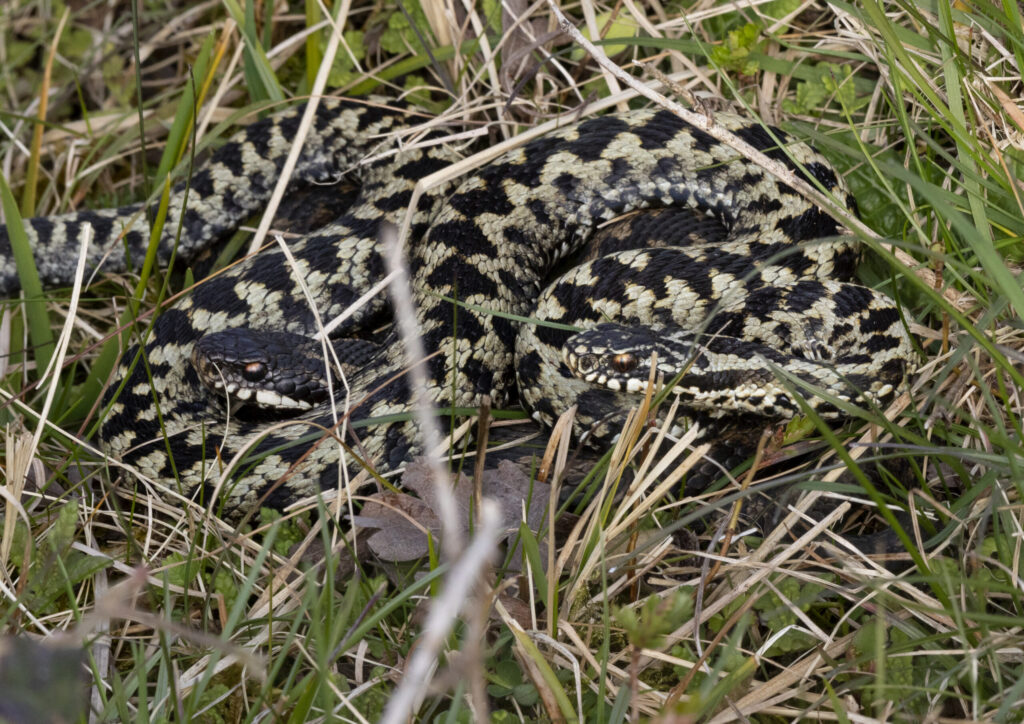
two male adders guarding a (just visible) female
I’d gone to a site where I’ve seen adders before, in fact I was hoping to see a particular adder I’d seen there before: a melanistic or “black” adder. I find adders in a range of habitats. One place I know is wet and waterlogged, with mounds of decomposing logs; but this place is a more typical habitat It’s an old quarry, whose spoil heaps of fractured rock have been covered over with grass and moss and tangled stands of gorse and bramble. Near the top of a hill, it is open and sunny. I saw my first adder within moments of arrival, a large brown female showing the characteristic pattern down her back of black linked diamonds on a brown background(or if you look at her in the negative, as it were, a pattern of brown zig-zags bordered in black). She was coiled at the base of a bracken stem and was simply the biggest adder I’ve ever seen – perhaps two feet or more in length. I watched her using binoculars, knowing that any closer approach would see her slide off into the centre of the bramble and out of sight. There was a second female about six feet away, coiled into the base of a tussock of grass. For adult adders, colour and size are pretty reliable indicators of gender: males are smaller and usually a silvery-grey colour with the black diamonds, females much larger and generally brown. But juvenile adders all routinely look like females, and even on the older snakes, the body and zig-zag colour isn’t definitive
Further up the slope was a small, stunted gorse bush, perhaps two feet high. And coiled at its base was a male adder. It was newly shed, its scales glistening as if recently polished. At this time of years, the male adders shed their skins- and then they fight. If you are a venomous snake, then the annual ritual of fighting to see who is strongest and so should mate with the female, is a little tricky. Venom takes time to work, and if both male adders in a fight managed to envenomate each other, there would pretty soon be no more adders. So instead the adders fight by wrestling. It’s called “the dance of the adders”, but the term is misleading. If posturing doesn’t work, the two males adders will fight by rearing up, with each trying to push the other down using their body strength. The fight may last for several minutes with the adders moving quickly through the grass alongside each other. Even though it happens every year, I’ve never seen it. I though on this occasion my luck was in, as the male adder suddenly took off after another. The two snakes zipped very quickly along side by side – but the second snake wasn’t a male: it was a female, and the mal wasn’t about to leave her side if there was a chance of mating. To do so would have ruined his chances and opened the door to another male. Indeed, not long after, with both adders deep inside a grass tussock, I caught a glimpse of the pulsing movements in the male adder’s body as the pair copulated.
adder pair
The mating pair, just after the event – the male on top, the female below
Wrestling is a neat adaptation for adders, a way of selecting the fittest and strongest males without ending the species. Yet you have to remember that it is, in a way, a completely voluntary exercise. There is nothing stopping competing adders from biting each other. Doing so is more like a social taboo. Nobody has taught adders not to bite each other: it is an instinct, but one so strong that it overrides ever other. Even if it means that the losing snake may not mate that year, it will not bite its rival.
If only humans were so civilised.
*grass snakes are venomous, too. But their venom isn’t dangerous to humans and their fangs are placed so that it is hard for them to bite people. What they will do is slime you with an anal secretion that smells just as bad as you think it does. And after rescuing a female grass snake trapped in some pond netting, I can tell you it takes weeks to wash off, too.
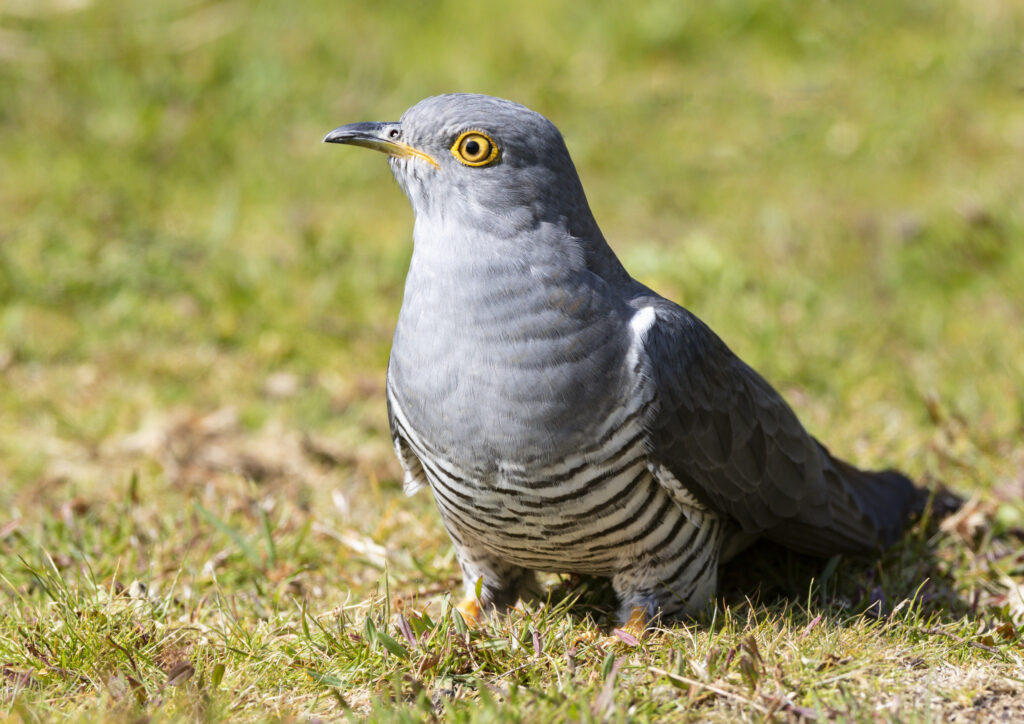
Yesterday, I heard a cuckoo for the first time this Spring. Which was hardly surprising, because it was sat about fifteen feet away from me at the time. This was no captive bird, however: this was a truly wild bird, newly arrived from Africa.
Colin, as he is known, is undoubtedly the UK’s most famous cuckoo. He has been arriving at the same site in Surrey for years. Estimates wary: some say he has been here for seven years, some say four. Either way, Colin is a methuselah, an old bird in cuckoo terms who is still flying the four thousand miles from the Ivory coast in sub-Saharan Africa, back to Surrey each year to woo the ladies. He is, if I may say so, looking particularly fine for a bird that must be absolutely knackerred. Colin has become a firm favourite because he willingly trades up close encounters for offerings of live mealworms that his army of fans are all too willing to provide. Like a movie start of old, Colin preens and poses for the camera, before guzzling down so many mealworms that it’s hard to see how he gets into the air again. He then heads off to a distant tract of woodland to start calling to the ladies.
We don’t know if Colin is successful. He’s never been seen in the company of a female, and certainly never brought one back to face the cameras. Perhaps he is simply too old for all that now, or perhaps like many celebrities he doesn’t want his private life papped. If he isn’t breeding, that would be a tragedy, because we need all the cuckoos we can get. When I was a child, the call of the cuckoo would be heard regularly, but numbers have dropped by half in just the last 20 years. The reasons aren’t clear, but the impact of climate change on their crossing of the Sahara is one likely culprit. Cuckoos come here to breed, so inevitably the decline in numbers here is a decline in the numbers who are breeding. In fact, the Cuckoo only says “cuckoo” here: it is a mating call and not something the cuckoo says when overwintering down in Africa. Colin is the first cuckoo I have heard this year and given his age, this may be the last time I hear him. The tragedy is that there may soon come a time when the call of the cuckoo is something that our children will never hear at all.
If you’re trying to remember it, the headline is from the lyrics to the hymn “Amazing Grace”. As a hymn, it extolls the power of restoration. I have a growing discomfort with the nature conservation movement, who all too often equate “conservation” with “management”. Mankind has all but eradicated many species from this country, and it seems a little ironic that we always believe that nature can only ever recover with our help, even though it was often our ignorance of a species and their specific needs that drove them towards extinction in the first place. Personally, I sit in the “build it and they will come” camp, believing that all nature needs is for us to stop interfering. In that way, I’m an advocate for rewilding, the principle of letting large areas of landscape revert to their natural habitat. That does require one caveat, though – humankind has been interfering in the natural landscape of this country for so long that many of our species have adapted to work around mankind in the same way that adapt to any other natural disaster – by evolving. In some cases, species are now dependent on our management of the environment. But yesterday, on the hottest day of the year so far, I went to see a species that proves it doesn’t always need to be that way.
In a sheltered cove in Portland, a slight onshore breeze kept reminding me that it was still March, not July. I was here because this cove has a wealth of Elm trees. In the 1960, Dutch Elm Disease was imported from Holland and rapidly spread across the country, killing more than 90% of our Elm trees. This loss contributed to a native British butterfly, the Large Tortoiseshell, going extinct in Britain – some say in the 1970s, but there is evidence that some populations may have clung on until the 1990s. Whoever is right, by the turn of the millennium, the large tortoiseshell was gone.
Through the next two decades, odd Large Tortoiseshells would be found, blow-ins from Northern Europe where it sill survives, albeit in reducing populations. And then, two years ago, eggs were found in the very cove I was visiting. A second visit showed caterpillar damage. And the following Sumer, fresh adults were seen. That pattern was repeated last year. The Large Tortoiseshell overwinters as adults, being seen on the wing between February and April. The adults then die, before the next generation take to the wing in June. The butterflies I was seeking were those who had been born here, and had overwintered here, as had their parents. British natives, in fact, making the Large Tortoiseshell now officially Britain’s rarest native butterfly.
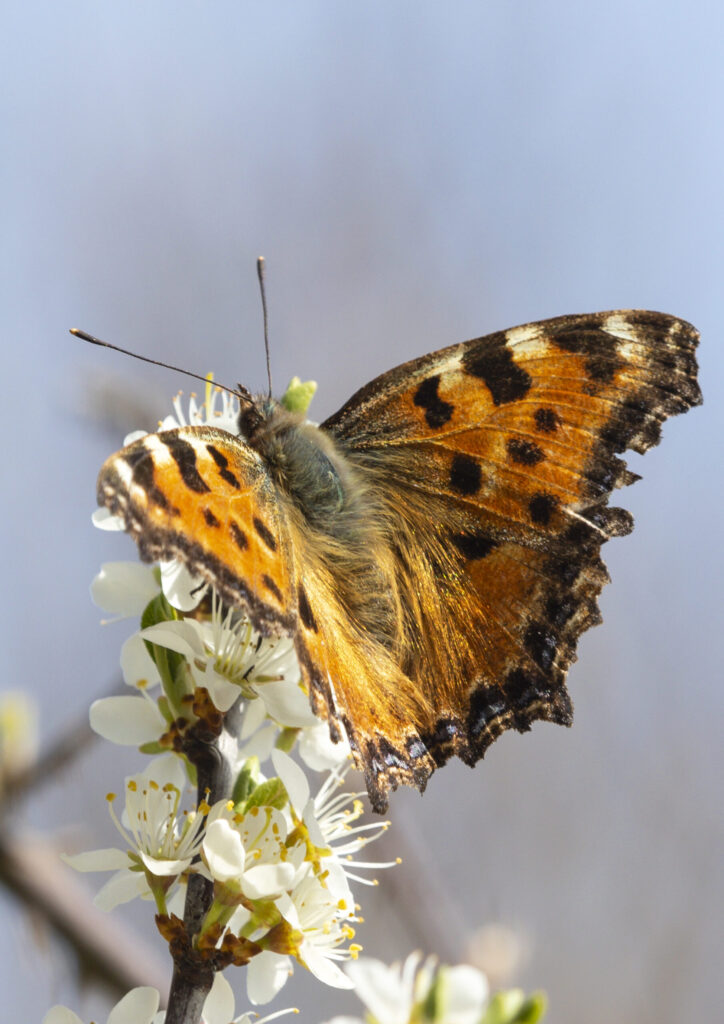
The Large Tortoiseshell looks a lot like a familiar butterfly, the Small Tortoiseshell. It a paler orange, and perhaps 30% bigger, with slightly different markings. The sad irony is that just as the Large Tortoiseshell is returning from extinction, its smaller cousin seems to be heading towards it, with numbers dropping significantly. Since the 1970s, the population of the Small Tortoiseshell, a butterfly which was common when I was a child, has dropped by 75%. So I had a clear example of what I was looking for in my mind, as I patrolled the cliffs and buildings of the cover looking for this Lazarus of butterflies.
It took six hours of patience before I was finally rewarded. A large butterfly dropped from the sky and started feeding on the pale pink-white flowers of Blackthorn. This was an end-of-year, rummage-sale butterfly, with tattered and torn wings – but it was unquestionably a Large Tortoiseshell. And in a way, I quite liked the fact that it was battered. This was a battle-scarred veteran, a survivor, one of the leading platoon of returning army, coming to recapture the home that is rightfully theirs, a butterfly that is fighting to reclaim the land its ancestors once called home.
So to the butterfly I saw, and the others that will be born here this coming summer, I say: welcome back,
On Friday this week my wife and I went on our usual lockdown walk, following a path along a local stream. It’s a path I must have walked hundreds, if not thousands, of times. It’s easy to become complacent about your local patch, to assume that you have seen all there is to see, to overlook the gradual change as environments age, trees grow taller, bushes grow thicker, and the ground beds down under layers of bramble and rotting leaves. But the lesson that you should never presume that you have seen it all was brought home to me as we walked alongside this small stream, bounded on one side by houses and on the other by the slowly maturing woodland that was planted on top of a reclaimed tip.
My attention was first caught by an alarm call from a bluetit, a constant “dit-dit-dit” sound. The small bird was sitting on the uppermost stems of willow branch that had broken and bridged the stream. And as I watched, the cause of its alarm appeared. Something long and thin and brown moving rapidly down the branch towards the ground. At first, I thought it was a young watervole, because I know they live in waterways in the area, and have been known to climb trees to get vegetation. But this animal was too long and thin, too pointed of the face, and moved rapidly, unlike the water vole’s more sedate scuttle. It was a weasel. Even though I had my camera with me, before I could begin to lift its the weasel vanished underneath a chunk of branch and disappeared into the undergrowth. I waited patiently, desperate to see it again, but that’s been my experience of weasels to date: you see them once, and you never see them again. I’ve been privileged to see weasels a number of times, but is always been an accidental encounter like this one. Even when I knew where a weasel nest was, and haunted the space for hours, watching from a distance through binoculars, they contrived to wait until I had gone before moving.
From its size, I believe this was a juvenile weasel. They have been seen on the old tip, and it makes me wonder if this one is setting out into the world to make a life of its own, crossing the stream in search of a new territory to establish. For once, this blogger doesn’t have a photo, but that doesn’t matter. I stood yards from houses in an urban housing estate, and watched a wild weasel, and if that isn’t something worth writing about, I don’t know what is. And so, every time I walk past this part of the stream again, I will be watching just that little bit more carefully for the faint flicker of a tale or rustle in the undergrowth – and perhaps now I will be watching all of my walk just that little bit more carefully for the things that I never expect to see. Of such experiences are naturalists made.