Naturalist. Nature writer. Nature photographer.

Category: insects

A not-so-quiet invasion

I am standing in a meadow, far from the noise of traffic and people, and in the breeze the tall willows that border the field flicker and clatter their leaves for me, the sound of a distant waterfall where there is no water.  Two branches of beech, grown too closely together, bang an erratic accompaniment to the steady bagpipe drone of hoverflies visiting the early blackberries. The soft heads of the grasses, the timothy and Yorkshire fog, whisper to each other as the wind ruffles them. But there is another sound that is louder than all of them. I am a giant towering over a fervent landscape full of the constant susurration of crickets and grasshoppers. Slightly delayed by the poor weather this summer, mating season is in full swing, and the grasses abound with singing males.

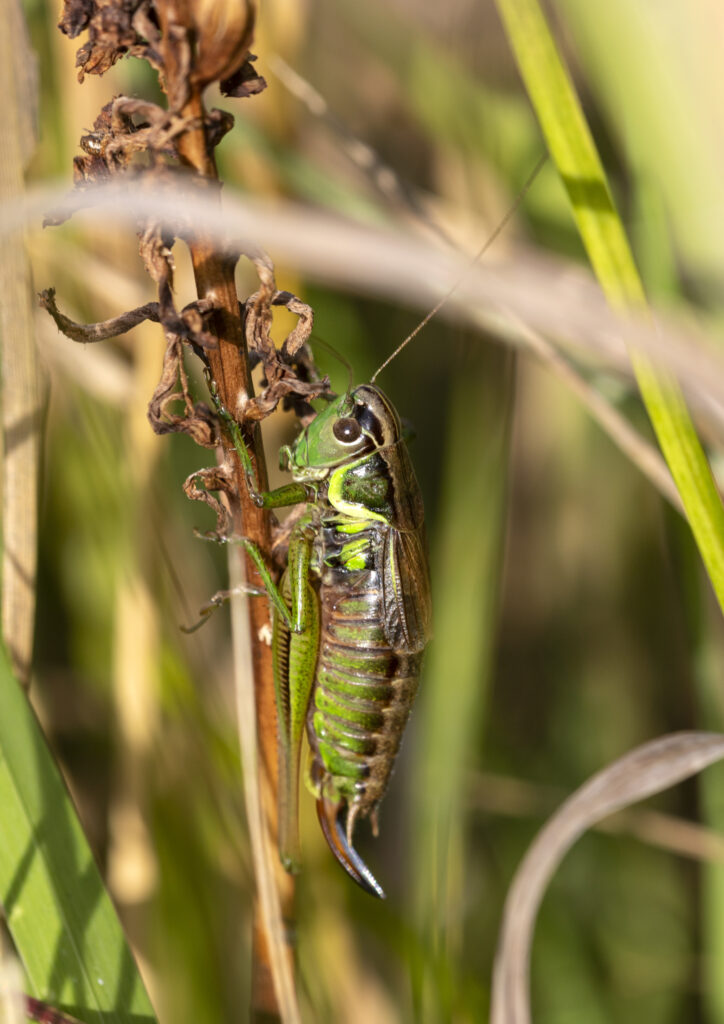
Shy friends, they fade into silence when I approach, so that I walk in a bubble of quiet amidst a sea of hissing and scratching. But then a stalk near my foot quivers as something large lands on it. It was a jump, not a flight, and I kneel to see a Roesel’s bush cricket. It’s a male, resplendent in green and yellow-spotted livery. Like almost all Roesel’s, he is short-winged and flightless, and makes his slow, steady way down a stem of grass like a vertical tightrope-walker, his objective a male dark bush cricket sitting on a leaf below. They meet, and their encounter is delicate, tentative and brief: a flick of their absurdly long antennae, and both realise that a mistake has been made. The dark bush-cricket remains unmoved, while the Roesel’s retreats back up a nearby stalk to try again. It will probably succeed, as Roesel’s are on the march, spreading steadily out from the southeast, already reaching North Yorkshire and the west of Wales.  In the nearby grasses, hundreds of others continue to call, so I sit still in the sun and for a time enjoy the almost deafening quiet of the countryside.
Rosel's bush cricket

Rosel’s bush cricket

It’s not quite cricket

I watch as two invaders to our shores play a deadly game

It is one of those September afternoons that you always hope for: a bright, warm sun traversing low in a sky of faded blue, adorned with suds of grey-white cloud, and a gusting breeze.  A narrow path leads me between stands of bramble to an open area of long grass, and almost at once I see it, low down between the stems. It is hard to miss.

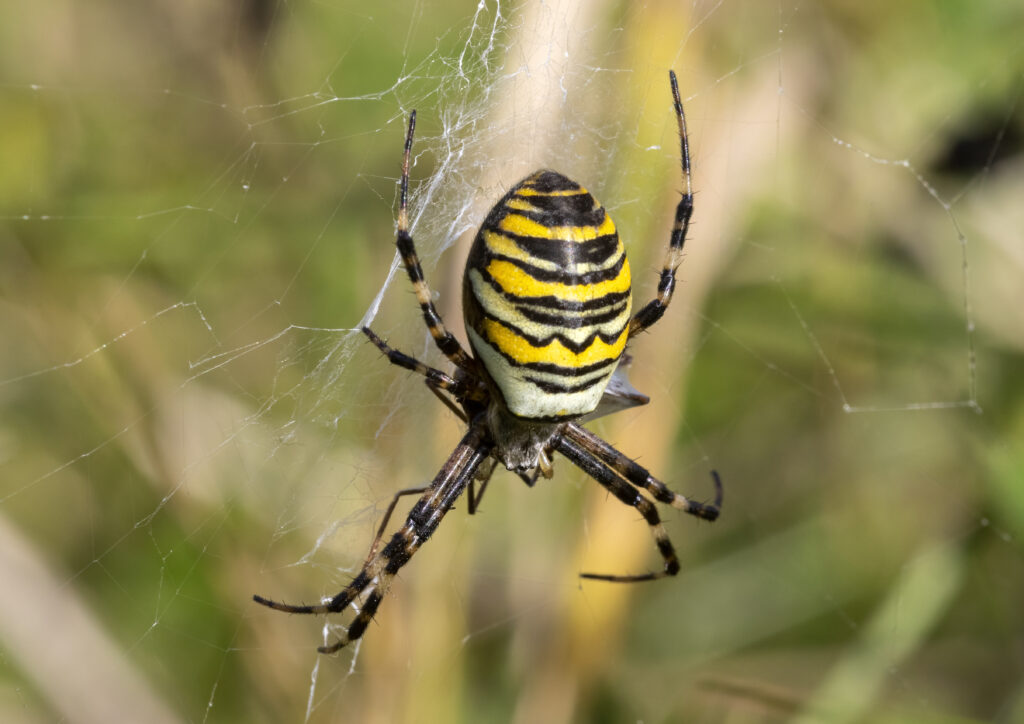
It is enormous, a living artwork of bold ripples of black, white and custard-yellow, with eight zebra-striped legs. A wasp spider, sitting in the centre of its orb web, slowly demolishing what look like the remains of a grasshopper. The dazzling body is perhaps two centimetres long, the legs as much again, which tells me that this is a female approaching her resplendent autumn best (the males are far smaller, and much harder to find – perhaps because the female often eats the male after sex. That’s going out with a bang in every sense). In just a few weeks she will be gone, leaving behind an egg sac the size and shape of a poppy seed head.  Her offspring will join their companions in heading northwards, a few miles each year, in a slow but steady invasion of Britain driven in part by our warming climate.

Wasp Spider

Female Wasp Spider

Ten feet away I see another female. She’s alert, as the stems around her web tremble. She shifts slightly, adjusting a leg to better feel the vibrations of her potential prey. It is a Roesel’s bush cricket, a similar size to her, climbing a nearby stem. It, too is a female, clad in black and lime green armour, with huge industrial-looking hind legs and wings too small to fly with. The Roesel’s is another invader making its way North, and as they occupy the same habitat, this game of cat and mouse is played out between them every year.

Rosel's bush cricket

Rosel’s bush cricket

The cricket seems to sense the danger and halts, before a kick of those hind legs fires it away into the undergrowth. The wasp spider is unmoved. The grass is alive with craneflies, the daddy-long-legs of my childhood, so her next meal will not be long in coming.

A matter of determination

Ravensroost wood, Wiltshire

Inevitably, it rained. In the summer that has been no summer, on the day of the Wimbledon and European Cup final, the wood sat brooding and silent, caught in a long exhale, even the birds subdued into near silence. There was a tension to the air, a sense of sense of expectation, and I had barely set foot past the gate when the rain began. Desultory stuff, an unambitious but persistent drizzle, the grasses bowing before me, and eventually even the meadowsweet slowly bending in despair. Pattered hazel leaves shrugged it off, while the hemp agrimony, made of sterner stuff, pretended not to notice. I walked on, passing a sole ringlet butterfly, wings closed, its body carefully aligned to the shelter of the leaf above, and a scarlet tiger moth, whose red and black hindwings were carefully shuttered under black forewings, daubed in gold and white, that seemed impervious to the rain.

In the near-silence, it was the hum that I noticed at first. A steady tone, like a distant motorbike that never seemed to get nearer or further away. Tramping up the sodden track, the empty woodlands slowly came to life with darting, soaring shapes. I had thought to seek shelter from the rain in the old wooden shooting hut that sits in the centre of the wood. More lodge than hut, roofed with wooden shingles bent and curled with age, and walled with wooden boards decorated with stripes of split ash branches, it has crumbled and been repaired so often that its age is indeterminate, but is at least a century. But I was not the only one seeking shelter within it. Between two lines of ash, the hut was alive with honeybees, and they filled the air with the sound and movement of ceaseless industry. I tracked one as it flew, circling like an airliner waiting to land, before dropping swiftly down and into a small gap between the underlying boards of the wall. I stepped forwards, and was engulfed in a living cloud that swirled around me and before me, buffeted occasionally, but never stung. Inside the hut, I had expected to find walls glistening with dripped honey but found instead a giant poster put up by the wildlife trust, extolling all of the species you could find in the woodland on drier days, but unfairly making no mention of the bees.

As I left the hut to return home, SW19 and Wembley were still bathed in sunshine and hope, but the rain had hardened into a downpour, a foreboding of the dampened spirits that were to come. The bees, indifferent to weather and dreams alike, flew on.


wild bee hive in cabin walls

wild bee hive in cabin walls

Powered by WordPress & Theme by Anders Norén