Naturalist. Nature writer. Nature photographer.

Category: butterflies

Finally, some good news

Ravensroost wood, Wiltshire.

For all the effort that I put into it, I can never get successional flowering to work in my garden. Yet here in the woodland, it happens automagically; not just seasonally, but from year to year as well. This time last year, it was the hemp agrimonies that dominated, their clusters of pink-purple flowers festooned with nectaring hoverflies and the occasional white-letter hairstreak butterfly dropping in from the wych elms behind. This year, the hemp agrimony is muted, still to come into its own, and the banks on either side of the track are instead a confection; candyfloss clouds of creamy meadowsweet, interspersed with sharp, columnar spikes of purple loosestrife, and cheerful punctuations of ragwort. In North Wiltshire’s continuing drought, the faint pink of the dog rose has overtaken the bramble, whose flowers and fruits are shrivelled and unpromising.

I am five minutes in before I see the first of the butterflies that I am seeking. Resting in the deep gloom on the edge of a coppiced hazel, the wobbly white line curving across its wings stands out against the velvety blackness of the rest of it. This is a strait-laced, no-nonsense Victorian butterfly, without frivolity or gaiety, and I am relieved to see it, as there were fears that it was dying out in this woodland. As a child, I never understood that the white admiral was a woodland butterfly, a shade lover, and I sought it in vain in the sunlit meadows where its cousin the red admiral flies. Elusive, and ephemeral, it only occasionally stops to display its monochrome beauty. You rarely see more than one or two at a time, but just yards further on, I see another. And another. I count seventeen in all,  a record number, driven by the lack of bramble flowers to hunt for nectar anywhere they can find it. For once, they are competing in numbers with the dazzling orange flashes of the silver-washed fritillaries that also abound here. The fritillaries will be glinting in shafts of sunlight well into August, long after the white admirals are gone; then they too will fade and leave it to the second broods of yellow brimstones and common blues to see the woodlands into winter. Already the next generation of white admirals are starting their journey, the spiky geodesic domes of their eggs laid on honeysuckle leaves, and I wonder what colours they will see when they emerge next year.
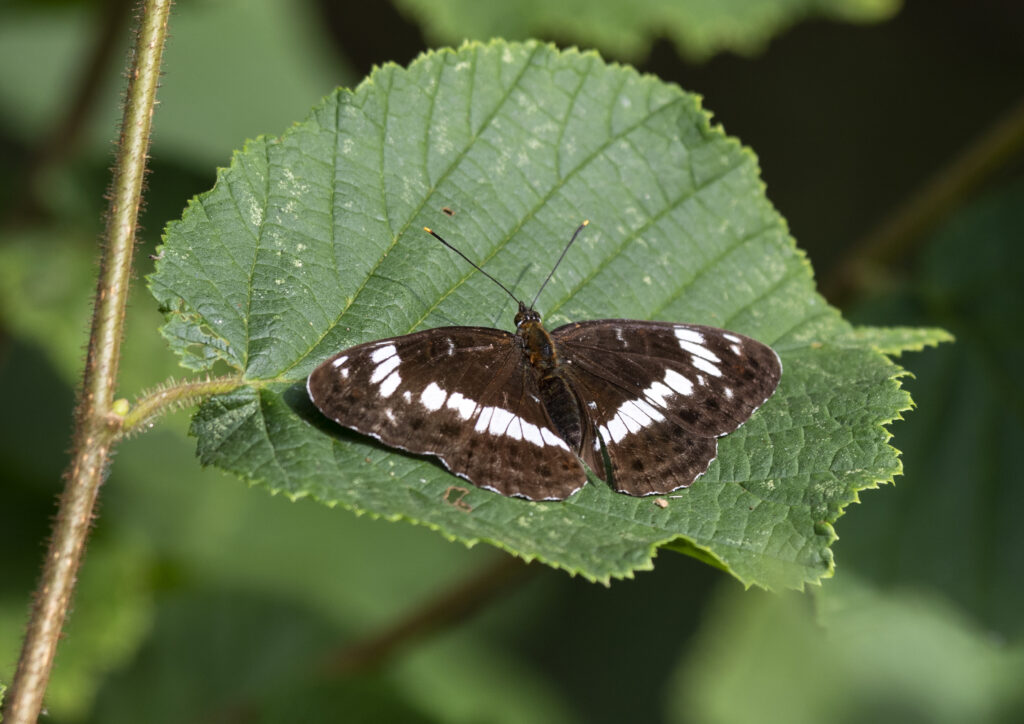
white admiral
white admiral

Hot sex in a Gloucestershire woodland

The glade smells of baking ground and dried bracken, cut with the faint sweetness of end-of-year-sale bluebells. Their last few nodding heads are just visible between the unfurling green shepherd’s crooks of new ferns, and the squat purple flowers of bugle. Spindly birches cast ripples of dappled shade across the ground, but in this glade, surrounded on all sides by taller, more mature forest, the heat of this beautifully sunny day is trapped. It is uncomfortably warm.

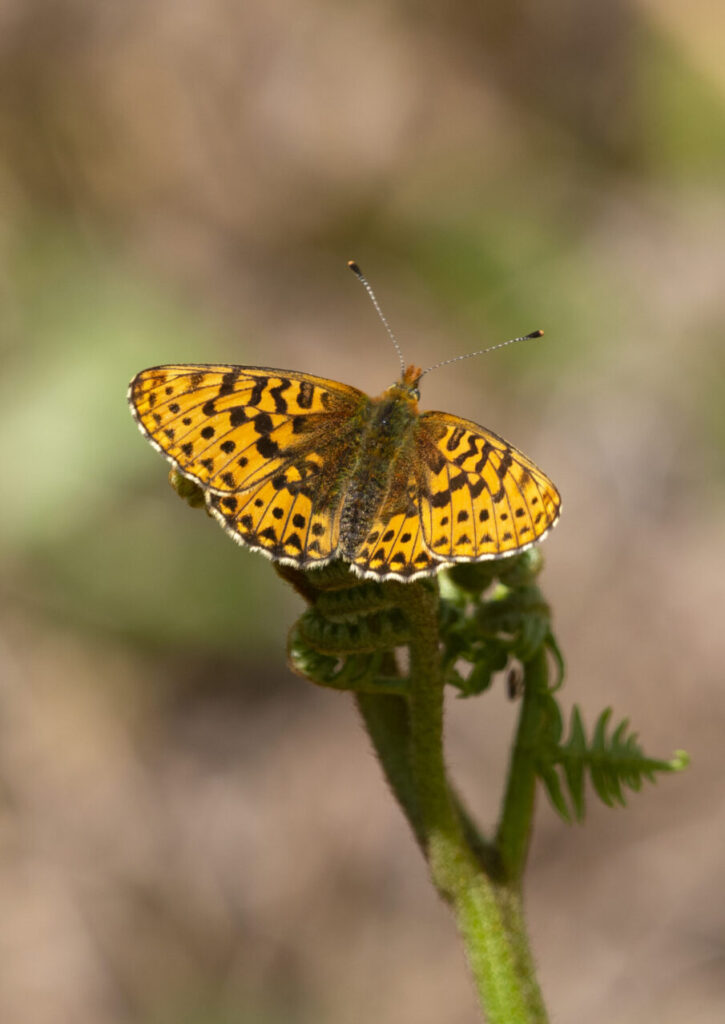
 As I stand and watch, sweat beading on my forehead, I finally spot the movement I have been looking for. It is a butterfly, flying low to the ground, moving unpredictably from spot to spot like a pinball in play. In flight it looks orange, but occasionally it pauses, wings still fluttering, and I can glimpse a spattering of dark brown markings on its upper wings, as if someone has flicked a paintbrush at it. It’s one of our most endangered butterflies, although that is a strongly competed title these days. It’s named after the silver-white patches on its underwings which gleam like pearls when caught in the right light:  the pearl-bordered fritillary.

 I turn, and see butterfly after butterfly, all in constant motion. Occasionally, just occasionally, one will stop for a few seconds at a bugle flower to fuel up, like a motorway driver grabbing a quick latte, before taking to the air again. It’s a peaceful, bucolic scene, except that it has a darker undertone: every butterfly I can see is male, and their flight is not random. They are following invisible pheromone trails and will investigate anything – a dried bramble leaf gets particular attention – that is the right shade of orange. Such is the competition here that the males hatch first, then spend their time desperately seeking newly hatched females that they can mate with before the female’s wings are dried out and she can fly away.  I am witness to an orgy.

 In the end the heat is too much, and I move to cooler, shadier woodland nearby. The relentless, desperate males fly on.

pearl-bordered fritillary

pearl-bordered fritillary

I once was lost but now am found

If you’re trying to remember it, the headline is from the lyrics to the hymn “Amazing Grace”. As a hymn, it extolls the power of restoration. I have a growing discomfort with the nature conservation movement, who all too often equate “conservation” with “management”. Mankind has all but eradicated many species from this country, and it seems a little ironic that we always believe that  nature can only ever recover with our help, even though it was often our ignorance of a species and their specific needs that drove them towards extinction in the first place. Personally, I sit in the “build it and they will come” camp, believing that all nature needs is for us to stop interfering. In that way, I’m an advocate for rewilding, the principle of letting large areas of landscape revert to their natural habitat.  That does require one caveat, though – humankind has been interfering in the natural landscape of this country for so long that many of our species have adapted to work around mankind in the same way that adapt to any other natural disaster – by evolving. In some cases, species are now dependent on our management of the environment. But yesterday, on the hottest day of the year so far, I went to see a species that proves it doesn’t always need to be that way.

In a sheltered cove in Portland, a slight onshore breeze kept reminding me that it was still March, not July. I was here because this cove has a wealth of Elm trees. In the 1960, Dutch Elm Disease was imported from Holland and rapidly spread across the country, killing more than 90% of our Elm trees. This loss contributed to a native British butterfly, the Large Tortoiseshell, going extinct in Britain – some say in the 1970s, but there is evidence that some populations may have clung on until the 1990s. Whoever is right, by the turn of the millennium, the large tortoiseshell was gone.

Through the next two decades, odd Large Tortoiseshells would be found, blow-ins from Northern Europe where it sill survives, albeit in reducing populations. And then, two years ago, eggs were found in the very cove I was visiting. A second visit showed caterpillar damage. And the following Sumer, fresh adults were seen. That pattern was repeated last year. The Large Tortoiseshell overwinters as adults, being seen on the wing between February and April. The adults then die, before the next generation take to the wing in June.  The butterflies I was seeking were those who had been born here, and had overwintered here, as had their parents. British natives, in fact, making the Large Tortoiseshell now officially Britain’s rarest native butterfly.

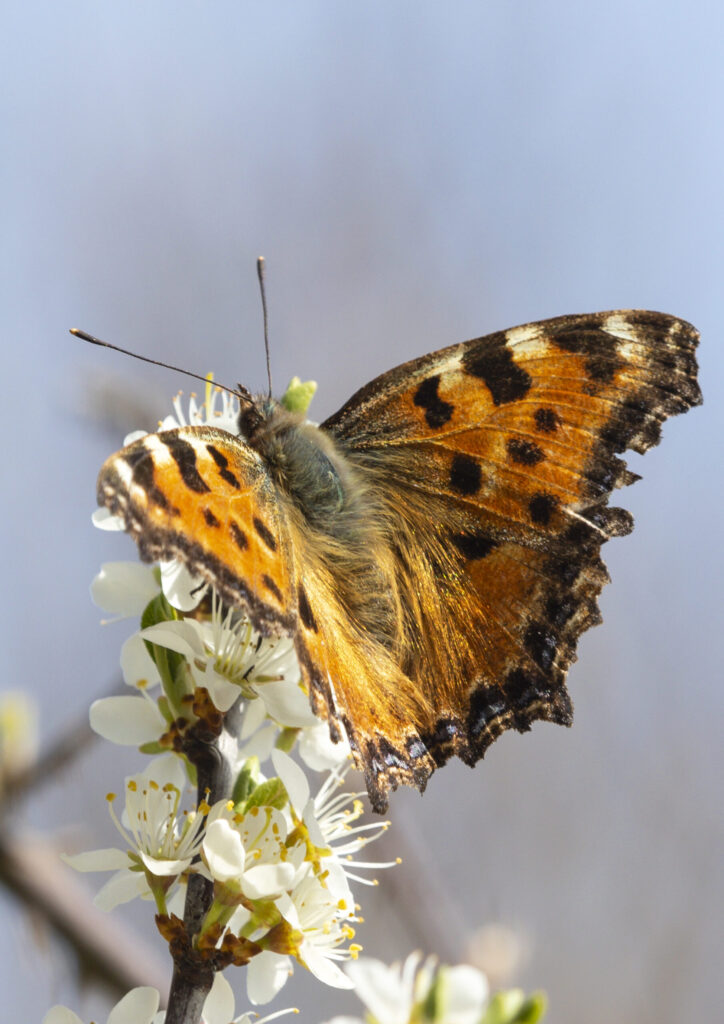
The Large Tortoiseshell looks a lot like a familiar butterfly, the Small Tortoiseshell. It a paler orange, and perhaps 30% bigger, with slightly different markings. The sad irony is that just as the Large Tortoiseshell is returning from extinction, its smaller cousin seems to be heading towards it, with numbers dropping significantly. Since the 1970s, the population of the Small Tortoiseshell, a butterfly which was common when I was a child,  has dropped by 75%. So I had a clear example of what I was looking for in my mind, as I patrolled the cliffs and buildings of the cover looking for this Lazarus of butterflies.

It took six hours of patience before I was finally rewarded. A large butterfly dropped from the sky and started feeding on the pale pink-white flowers of Blackthorn. This was an end-of-year, rummage-sale butterfly, with tattered and torn wings – but it was unquestionably a Large Tortoiseshell. And in a way, I quite liked the fact that it was battered. This was a battle-scarred veteran, a survivor, one of  the leading platoon of returning army, coming to recapture the home that is rightfully theirs,  a butterfly that is fighting to reclaim the land its ancestors once called home.

So to the butterfly I saw, and the others that will be born here this coming summer, I say: welcome back,

Large Tortoiseshell butterfly

Large Tortoiseshell butterfly

Powered by WordPress & Theme by Anders Norén