Naturalist. Nature writer. Nature photographer.

Month: July 2020

The master of illusion

One of the things I loved about the Harry Potter books was Harry’s invisibility cloak.  I really liked the idea of being able to sit somewhere and have the world pass me me by without anyone or anything knowing that I was there. But while Harry’s cloak is fictional, the power of invisibility is all too real. Camouflage is a pattern which breaks up the shape and outline of something, making it harder to see. I use it myself quite often. Wearing camouflage clothing that makes me look more like a bush and less like a human being, means that wildlife will often come much closer to me than it would otherwise.  On a few occasions, even people have walked right past me, unaware that I am there.

But in the no-rules contest-to-the-death that is the reality of life for every living thing except humans, invisibility can be literally a matter of life and death. Take the grayling butterfly, for example. Like all butterflies, it’s high on the snack list for a vast range of predators, everything from the familiar sparrow and bluetit to  sophisticated aerial hunters like dragonflies and flycatchers (who contrary to their name, will happily take butterflies as well). The grayling likes places with grey rocks, or areas of heathland, those spaces of patchy gorse and low-growing heather, typically dotted with stunted birches or stands of pines. Heathland is typically littered with the  bleached and weathered remnants of old bits of heather. It’s a background that is naturally confusing, full of random lines, making shapes hard to see. The grayling butterfly has a cryptic  camouflage on its closed wings that makes it blend almost perfectly in with its background. There’s a grayling in the shot below, which was taken on Greenham Common. It’s actually easier to see in this shot than in most of the ones I took.
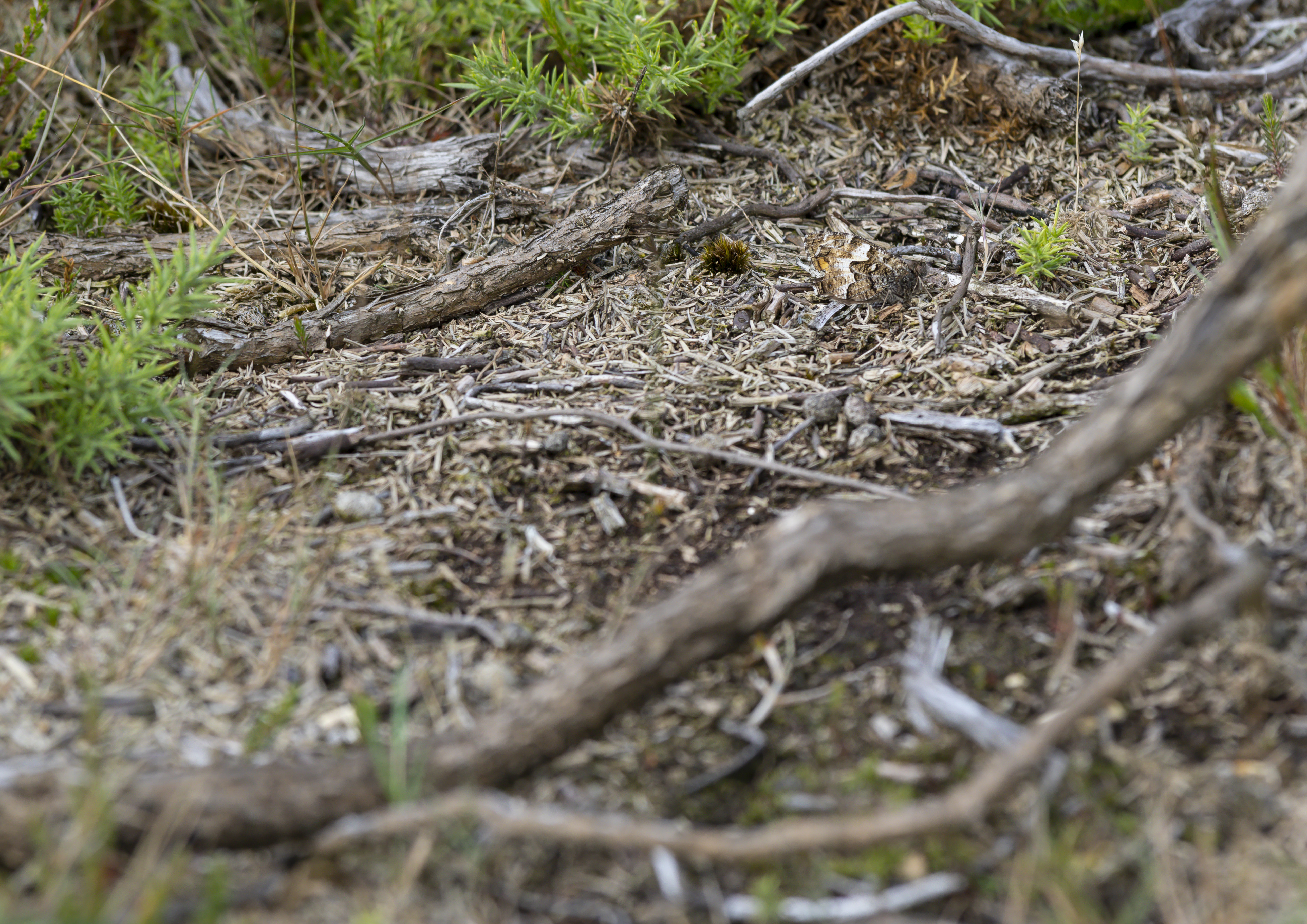
Spot the Grayling!

Spot the Grayling!

For prey species, evolution ruthlessly weeds out weak or ineffective camouflage. If you get seen, you get eaten, so those species which rely on camouflage as their only means of defence can be extremely hard to see.  Which means it was a privilege recently to manage to see – in every sense  – a bird that I have long wanted to see, one which takes this art of camouflage to a whole new level. It’s the Bird Who Is Not There. It’s the nightjar.

Like the grayling, the nightjar likes heathland, or clear felled areas of pine forest. It’s a ground-nester, so very much at risk from foxes and other predators. But the nightjar has developed camouflage so stunningly perfect that even its eyelids are painted – it will typically watch you with its eyes almost completely closed, in the way I used to watch horror films as a kid. From above, it looks exactly like  a pile of old heather or dried leaves. From the side it’s a bit of stick, or a growth on a tree branch. I have had the experience with adders, whose camouflage is orders of magnitude more rudimentary, of looking at them, looking away, and then not being able to find them again. With the nightjar, I looked away, looked back, and would have bet my life that there was no bird there at all.
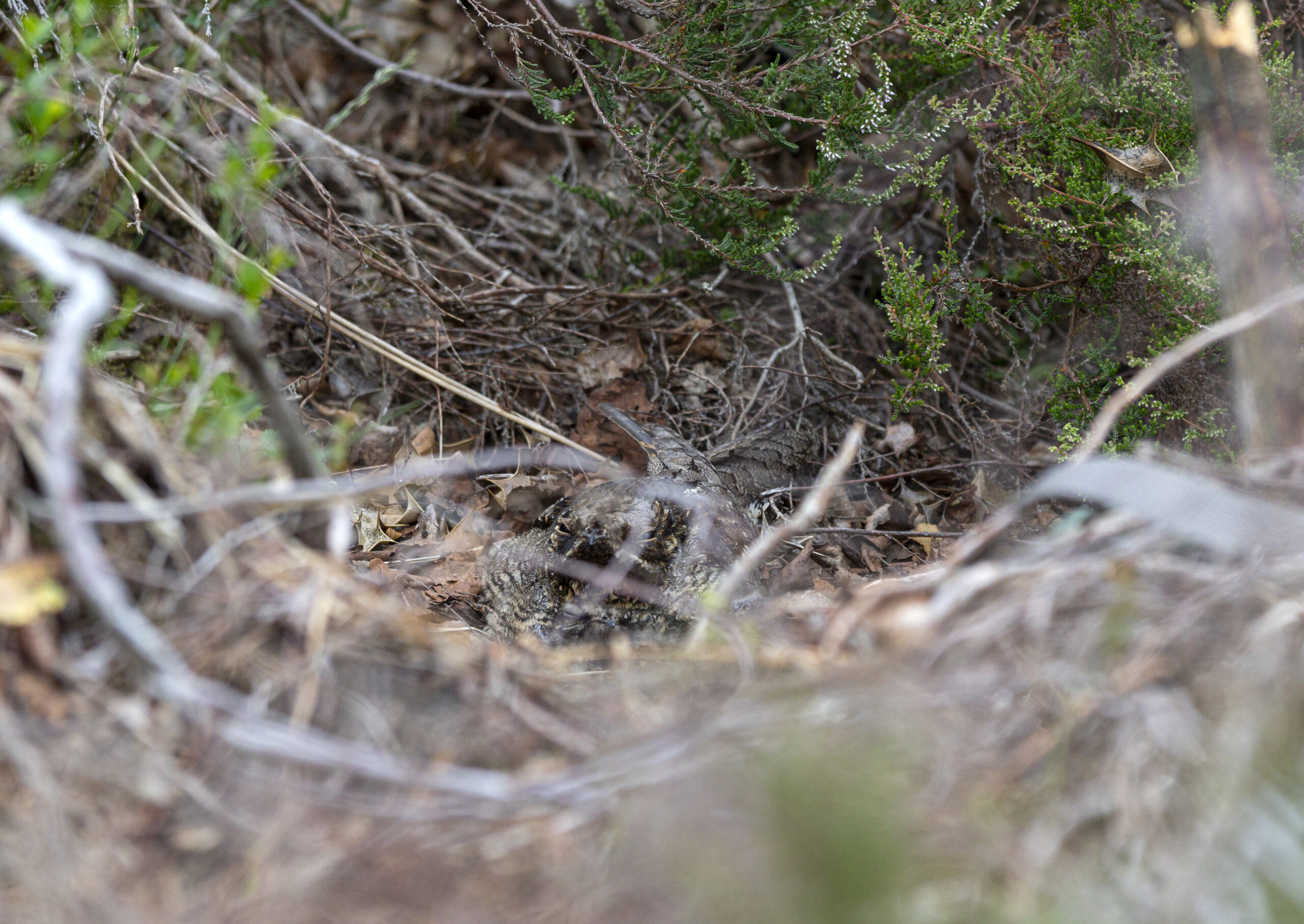
nesting nightjar

nesting nightjar

I could only see this particular bird because it had nested on some brown leaves which didn’t completely match its camouflage. I could sense that there was something there, some mismatch in the landscape, but it took me almost five minutes of looking before I finally understood that I was looking at a bird. Even then I got it the wrong way around, mistaking wing for head until the nightjar slightly opened one eye. I managed a quick photo, above, before retreating out of sight and checking to make sure that the bird had not been disturbed by my brief visit. Trust me, the photo makes the nightjar a whole lot easier to see than it is when you are simply walking through heathland. I could have walked over it without ever knowing it was there.

The nightjar is an unconventional bird in other ways as well. Its ‘song’ (usually only the male sings) is a fast, two-tone purring sound, like a cross between a contented cat and a Geiger counter in the centre of  Chernobyl.  It’s semi-nocturnal, hunting during late dusk and early dawn, right on the borders of night. It hunts for  insects, which it catches either by flying low over vegetation like a bat, or by launching, flycatcher-like, from its perch to grab them from the air. A ruthlessly efficient hunter, it does not normally need to hunt for long before retreating back its roost or nest. It is also improbably long-winged, so much so that on the ground its wings are crossed behind its back like an impatient tail-coated waiter (you can make them out in the photo), while in the air it has the shape of a kestrel with a thinner body. Like swallows, nightjars drink and bathe on the wing, and like swallows they migrate back to sub-Sarahan Africa after their three-month UK breeding season ends in August (swallows stay longer, but are perhaps at less risk of being trodden on).

So there you have it. The nightjar, a bird better camouflaged than an army sniper, that flies at night like an owl, sings like a radiation detector, hunts like a bat, looks like a kestrel and breeds like a swallow. I suspect it comes to the UK not because of our plentiful supply of insects, but because of our renowned love of the weird and eccentric.

Much later that day, I stood  on a woodland track as the last dregs of the light drained from the western sky. I heard a “kwi”call, like the opening notes of the call of a female Tawny Owl, which is the flight call of the Nightjar. Moments later a shape appeared,  nothing more than a silhouette against the blue-grey darkness. It was a male nightjar. Unafraid of me, it approached and circled me, no more than fifteen feet above my head, calling all the time. And then, as suddenly as it had appeared, it vanished again, disappearing silently into the darkness. The true master of illusion.


PS – and is if to prove my point, a friend who read the blog said “You do realise that you can clearly see a nightjar chick in the photo, don’t you?” I magnified the image, which I must have looked at a hundred times by now – and they were right. There, just below the female’s head, you can clearly see a chick. And I hadn’t spotted it.
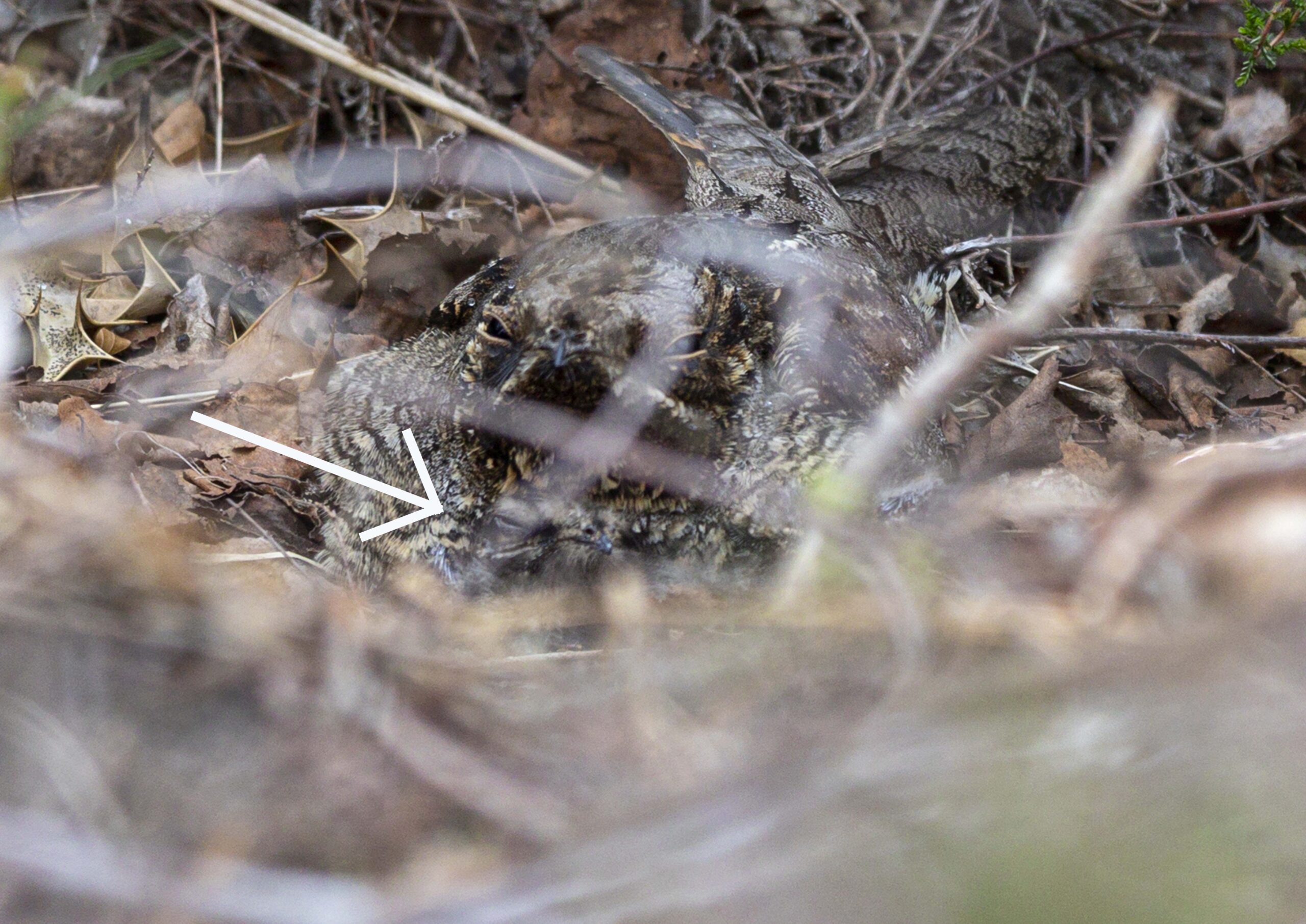
nesting nightjar detail
nesting nightjar detail


A case of mistaken identity?

I was at the Gloucestershire Wildlife Trust’s Coombe Hill reserve yesterday. It’s a top spot for Dragonflies, but unfortunately it seemed to lack the Whinchat  I’d hoped to see – or at least, they weren’t anywhere near the bits of the reserve I was. I’d had a close view of a beautiful sedge warbler singing, watched as a spotted flycatcher fed its young in the branches of a downed tree, and watched a bevy of green sandpiper being ever so slightly overawed by the arrival of a grey heron. They didn’t fly off, but did noticeable shuffle sideways to make room.

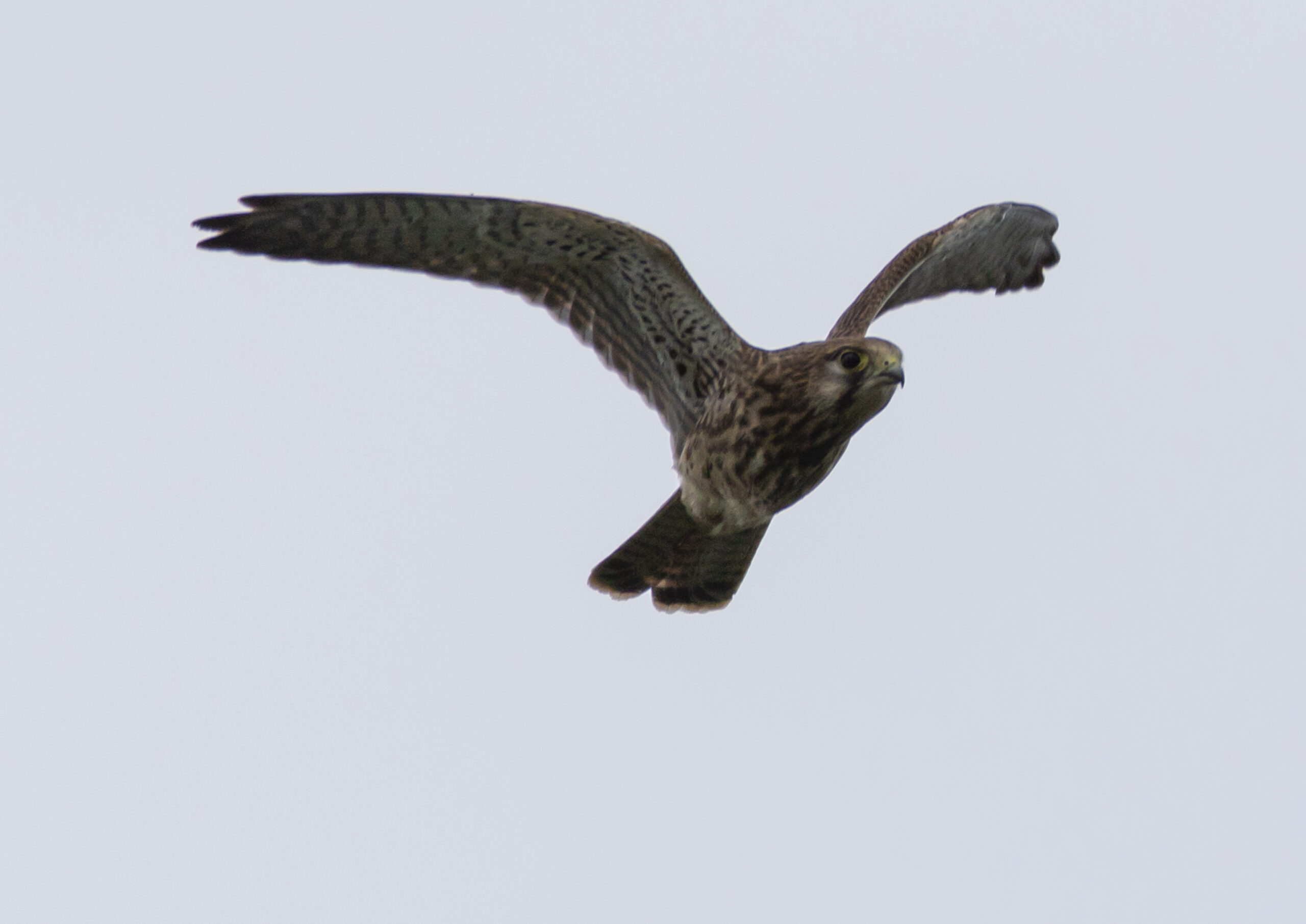
But the day’s best bit came just as I was leaving. It was early evening, and a clutch of swifts was circling, making the most of the small insects that rise into the air as evening starts to fall. But then they started mobbing another bird, flying alongside it en masse and diving at it. Now I have seen birds mobbed by others many times. I’ve watched red kites attacked by crows, fearful because the kites will eat their eggs and chicks. I’ve witched a kestrel attacked by peregrines to force it to release its prey. But I have never seen the serene swift do anything other than fly dazzling aerobatics looking for prey. The bird that had attracted their attention was a fairly large bird of prey. At first I thought it was a hobby, attracted by the plentiful dragonflies that are its main food. Perhaps the swifts had seen it taking things in the air and saw it as a threat? But as it got closer, I could see that it wasn’t a hobby. It was such a large bird that I thought it might be a peregrine. That would explain the swifts mobbing it, because a peregrine eats small birds and wouldn’t object to a meal of swift if it could catch such an aerobatic bird. But then the raptor flew right over my head, about thirty feet up. It wasn’t a hobby, or a peregrine. It was the largest female kestrel that I have ever seen. Female kestrels are larger than the males, but even so this bird was half as big again as any I’ve ever seen before.

I’ve wondered for many hours why swifts should mob a kestrel, a bird known much more as a hunter of small, ground-based prey. But then the penny dropped: this bird was so big that I thought it was a peregrine. Perhaps the swifts made the same mistake? Could this simply be a case of mistaken identity?

one very large kestrel

one very large kestrel


Not so tough, after all

This last week I went on a  trip to Cumbria, in search of “Britain’s only alpine butterfly”, the Mountain Ringlet.  This small butterfly is adapted for the colder, harsher climates at altitude, having a hairy body and wings, and flies in tiny colonies at altitudes (in England) from 350m upwards. It can be remarkably hard to see because each colony flies only for a few days, the timing o which varies, and it only flies in still, sunny weather – a rarity at these altitudes.

So it was with much more hope than expectation that I set off up Irton Fell, part of a range of high hills in Cumbria, and home to three known colonies. The day before (indeed, most of the week before) had been one of dark skies and torrential rain. Any extant ringlets would have been hard pushed to fly at all. But the morning had dawned fair and hot, so I set off. The climb to the sites was relatively easy – a steep walk, rather than a scramble over scree or a real climb, although it did involve walking uphill through a small stream at one point. The weather on the Cumbrian mountains can change quickly and without warning, and I was depressed at the number of people I saw walking without any safety precautions at all – a couple in light summer clothes without so much as a bottle of water, let alone rain gear or the means to find their way if the mists came down.

At the first site, I found ringlets immediately. But not the mountain kind – this was the regular ringlet butterfly, along with many meadows browns. Despite its name, the mountain ringlet actually looks more like a small meadow brown. This led to many excited chases, followed by the crushing disappointment when the butterfly turned out to be something other than a mountain ringlet.  I carried on uphill to a second site, where I saw the same thing. And finally I climbed to the stunning location known as Greathall Gill. At aroud 1200 feet, this was the highest colony and likely to emerge slightly later in the year than the others. Greathall Gill is an impressive scar, a knife slash down the otherwise stable Wasdale granite, the sides puckered and resembling the gills of a fish – which is not where the name comes from: “gill” just means “gorge”. Here. against the flow of a strong wind, I searched for mountain ringlet in a colony described as “large”. For half an hour, I saw nothing. And then a small movement among the grasses. A small butterfly, about the right size, was flying strongly against the breeze. I ran after it. It zigged and zagged, as if determined not to let me get a close look at it. And then it stopped.

Not the rare mountain ringlet, but rather a small heath, a common butterfly much more at home (as its name suggests) on a sea-level heathland than high up in the fells. And then to add insult to injury, a second butterfly passed me. This was a red admiral, also far, far from its normal home. I was even passed by a large hawker dragonfly, which flew past me and plummeted over the edge of Greyhall Gill wit the carefree abandon of those that can fly.

I never did see the mountain ringlet. Soon after the red admiral appeared, the clouds came over and the drizzle returned. The couple in summer clothing passed me, heading quickly downwards thankfully safe, but looking rather cold.

Perhaps the small heath and red admiral were blown up the fells by the strong winds. But whatever the cause, they seemed quite happy to be flitting around up there, while “Britain’s only alpine butterfly” was conspicuously absent. Despite all of its special equipment for surviving the cold, it turned out to be a bit of wimp. Not so tough, after all.


Powered by WordPress & Theme by Anders Norén