Naturalist. Nature writer. Nature photographer.

Category: Birds

One for sorrow

It was one for sorrow, two for joy in the rhyme of my childhood. It went as far as ten, but never reached thirty-five, so now I’m unsure of my fate.

I’ve walked just five minutes from my home, to search for damselflies in the series of small pools that are part of an optimistic flood relief scheme created alongside a local housing estate. As I arrive, the flock of magpies, more than I have ever seen in one place before, take to the air shrieking defiance, making the sky flicker. Between ‘gulp’, ‘tiding’, charm, and ‘littering’, some of the many collective nouns for them, I choose ‘mischief’: they are clearly up to something.

Ringed by grassy banks filled with teasle and thistle, punctuated by ragwort and fleabane, the damselfly ponds graduate slowly, the deeper areas of water filled with reed mace and phragmite, the shallows with water mint and hard rush, the glistening mud by the fat yellow fingers of bird’s foot trefoil. I slowly circumnavigate each of them, and the mud between speaks to me. It’s a palimpsest, a recorder of travels. Here, twin almond slots incise the ground, the marks of roe deer that came here in the night to drink. There, the smaller, daintier, ballerina hooves of Muntjac, spaced out with speedy flight, are intercut with the spear-shaped tracks of a following fox. And last, cutting through all, a deep indentation of four claws and a “D” shaped pad: one of this morning’s dogwalkers had paws to clean.

There are no damselflies, which is puzzling. I wonder if I have left it too late in the day, if it is too cloudy or cool for them to fly. But I can hear a rustling within the reeds, a clatter of wings, and glimpse movement. I assemble it from its parts: a glimpse of creamy chest and sparrow-like back, a pale leg, and finally a dark-capped head with a cream ‘supercilium’ or stripe above its eye. It’s a sedge warbler, a juvenile, recently fledged. And there is a second, and a third, moving clumsily through the stems, hunting for insects near the water line. This explains the paucity of damselflies, and perhaps also the gathering of magpies, inveterate takers of other birds’ young. The fledgling warblers will stay here for a few more weeks to fatten up, before winging their way to sub-Saharan Africa, to Senegal or Ethiopia, sometimes in one prodigious, unbroken, four-day flight.
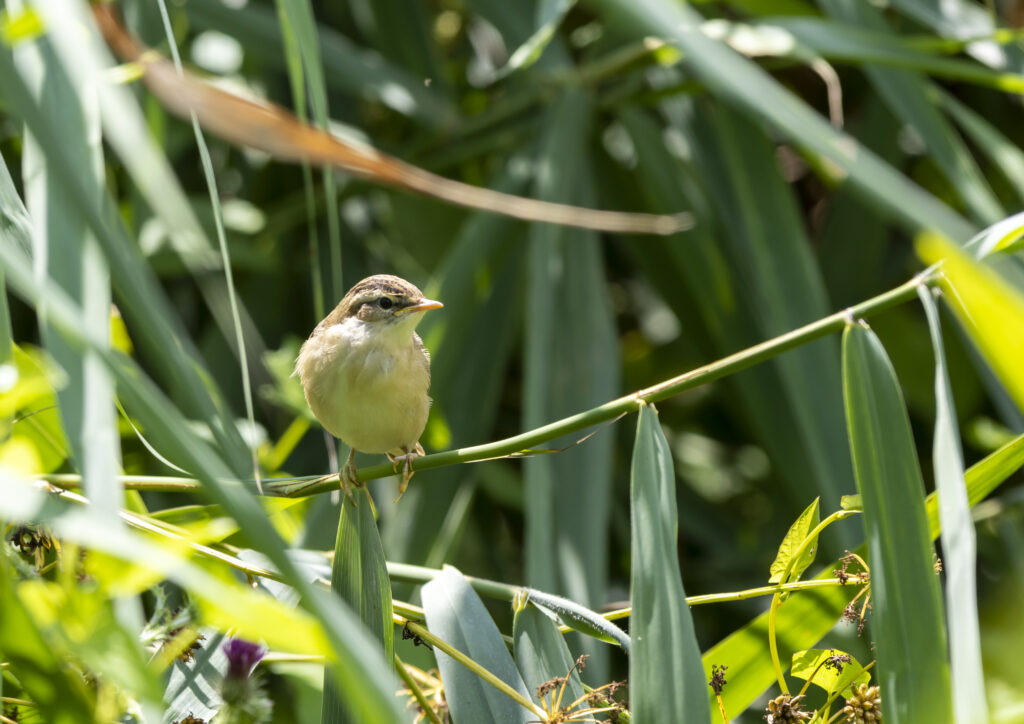
fledgling sedge warbler

fledgling sedge warbler

And so, I turn to the task before me: “thirty-five for feeling alive”, maybe?
 

The long echo of the curlew

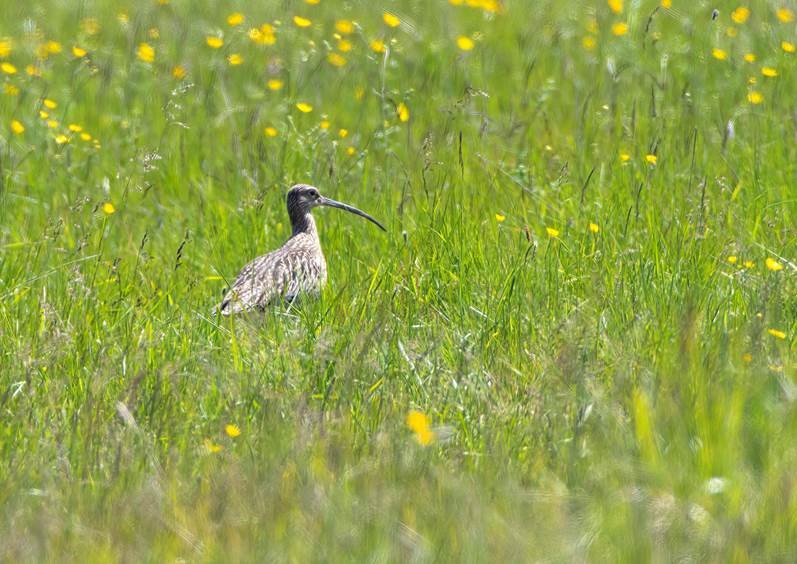
I hear it long before I see it. A high bubbling call, that loops up in pitch like a referee with one of those old-fashioned pea-whistles getting increasingly annoyed. It’s a song of desolation and loneliness, a haunting sound that I associate with moors and estuaries, with vast skies and open spaces. It’s the call of a curlew.

It makes me pause. Seventy years before, Blakehill Farm would have throbbed to the sound of wartime Dakotas taking to the skies. Now it’s a nature reserve, home in winter to short-eared owls, and in the summer to whinchat, yellowhammer, corn bunting, and the skylarks who even now englobe me in sound, warbling as they parachute slowly back down from an achingly bright sky into the waving sea of grass that surrounds me. But curlew is a new sound for me here. It calls again, and even the skylarks seem to pause to admire it.

Through the wobbly heat-haze I spot it, a hundred yard ahead of me. A pheasant-sized bird in mottled camouflage of cream and chocolate, with a long neck, and an absurdly long, gently curving bill, fully two-thirds of the length of its body, which is uses to probe soft ground for invertebrates. It walks unhurriedly, fading in and out of the long grass stems, probing the soil left and right, a hunting tiger. I am so astonished by the encounter that I don’t spot the second bird at first. The curlew population nationally has dropped 80% in fifty years, and I realise that I am now looking at twenty percent of North Wiltshire’s curlews, a breeding pair, a small hope for the future.

The curlew fade away in the haze as if I had imagined them, a metaphor for their species, but then I hear that call again. It sweeps out, over the expanse of grass and the unending sky, demanding to be heard. If nothing else, the curlew won’t go quietly into the night.

curlew
curlew

A tropical holiday during lockdown

It’s just after dawn on a freezing cold April morning, and at the side of the track I’m standing on,  the flailed edge of a grove of coppiced hazel has formed a deep, jumbled jackstraw layer of faded brown stems and splintered sticks. It’s a common sight in nature reserves at this time of year, yet from within it I am hearing a sound that seems utterly alien to the British countryside.

It starts familiarly, like the high trilling of a wren, but then changes into a slowly rising scale of deep, bouncing ‘boings’ and an astonishingly loud machine-gun ‘dadadada’. It is a tropical sound, and I can imagine a large, brightly coloured bird with  exotic tail feathers singing it in the depths of the jungle. Yet it comes from a bird lightly larger than a robin, with a rufous back and cream-grey chest,  which is so British that it even features in our songs. It is part of our culture, but these days most people have never heard it. It’s the nightingale.

Three months earlier, the song would not have been  out of place. The nightingale I am hearing would have been five thousand kilometres away in equatorial Guinea. It is a male, and has arrived here within this last week to defend a breeding territory with its astonishing voice. And it is not alone: I can hear another competing male a hundred or so yards away.

Several hours spent watching, and I am convinced that nightingales are also ventriloquists. The sound is so loud at times that the bird must be close enough to touch, yet the only time I see it is when a pair of males rise and fly around me in a raucous, bad-tempered territorial dispute. Nightingales have a well-earned reputation for being elusive, singing in deep cover and rarely being seen. But in the few weeks, before the hazel groves erupt into their large, dancing leaves, I still have a chance, so I’m going to try again. But even if I never photograph this fast-declining, red list bird, the early morning start will be worth it. In the midst of lockdown I can close my eyes on a small patch of English  woodland, feel the heat of the sun on my back and hear the sound of the tropics.

Foreign holidays? Who needs them?

And the first shall be last

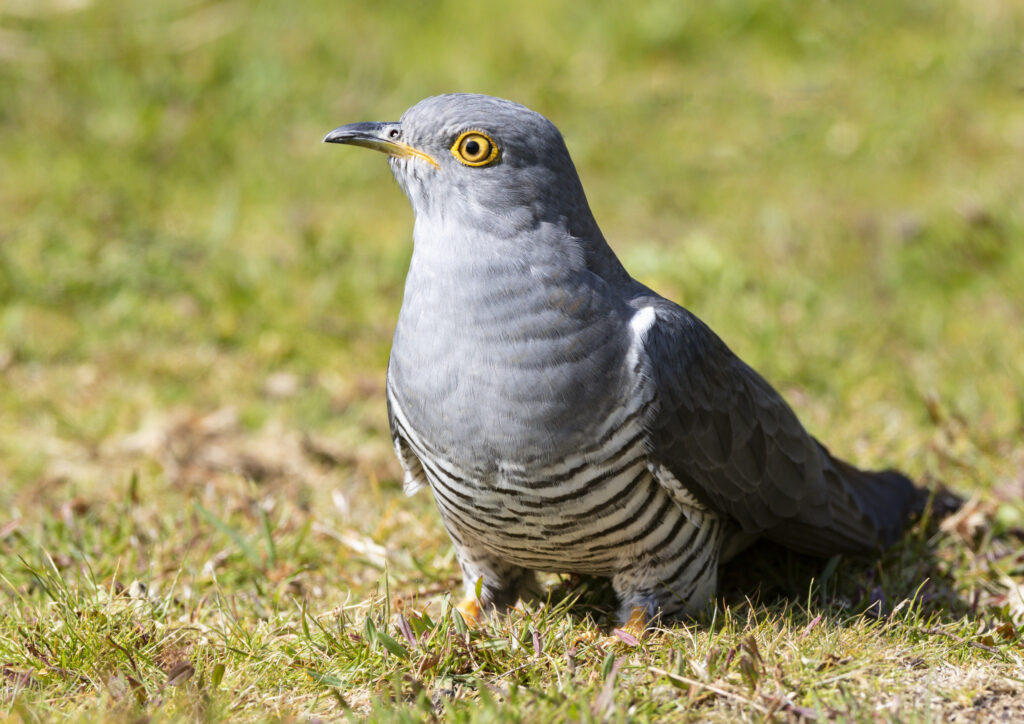
Yesterday, I heard a cuckoo for the first time this Spring. Which was hardly surprising, because it was sat about fifteen feet away from me at the time. This was no captive bird, however: this was a truly wild bird, newly arrived from Africa.

Colin, as he is known, is undoubtedly the UK’s most famous cuckoo. He has been arriving at the same site in Surrey for years. Estimates wary: some say he has been here for seven years, some say four. Either way, Colin is a methuselah, an old bird in cuckoo terms who is still flying the four thousand miles from the Ivory coast in sub-Saharan Africa, back to Surrey each year to woo the ladies. He is, if I may say so, looking particularly fine for a bird that must be absolutely knackerred.  Colin has become a firm favourite because he willingly trades up close encounters for offerings of live mealworms that his army of fans are all too willing to provide. Like a movie start of old, Colin preens and poses for the camera, before guzzling down so many mealworms that it’s hard to see how he gets into the air again. He then heads off to a distant tract of woodland to start calling to the ladies.

We don’t know if Colin is successful. He’s never been seen in the company of a female, and certainly never brought one back to face the cameras. Perhaps he is simply too old for all that now, or perhaps like many celebrities he doesn’t want his private life papped.  If he isn’t breeding, that would be a tragedy, because we need all the cuckoos we can get. When I was a child, the call of the cuckoo would be heard regularly, but numbers have dropped by half in just the last 20 years. The reasons aren’t clear, but the impact of climate change on their crossing of the Sahara is one likely culprit. Cuckoos come here to breed, so inevitably the decline in  numbers here is a decline in the numbers who are breeding. In fact, the Cuckoo only says “cuckoo” here: it is a mating call and not something the cuckoo says when overwintering down in Africa.  Colin is the first cuckoo I have heard this year and given his age, this may be the last time I hear him. The tragedy is that there may soon come a time when the call of the cuckoo is something that our children will never hear at all.

Colin the Cuckoo

Colin the Cuckoo

The God of small things

A break in walking and blogging due to the pressures of a family illness and several weeks of interminably grey weather saw me champing at the bit to get out of doors again. Now don’t get me wrong: I like a bit of  bad weather. I’m a fan of the Scandinavian edict that there is no such thing as the wrong weather, just the wrong clothing. But grey weather, that kind that floats an almost invisible drizzle in the air day after day just seems to sap the fun out of life. So I was delighted this morning to find a light dusting of snow on the ground when I pulled the curtains back. Light snow is an almost perfect weather condition in my book. It’s bright and cheery, with all of the reflected brightness and cleanliness of a snowfall, whilst having none of the wheel-spinning, train-delaying, sock-soaking, frost-biting coldness that a deep snowfall brings.  It allows the small child in me to engage fully, without the sombre adult in me tutting somewhere in the background. I even got to engage the four-wheel-drive setting on my car. It probably wasn’t needed, but as I specifically bought a four wheel drive vehicle after the “beast from the East” in 2018, there was a sense that I could finally turn to my wife and say “See! I told you needed it!” Man the Smug, the next evolutionary step after Homo Purchase Indecision.

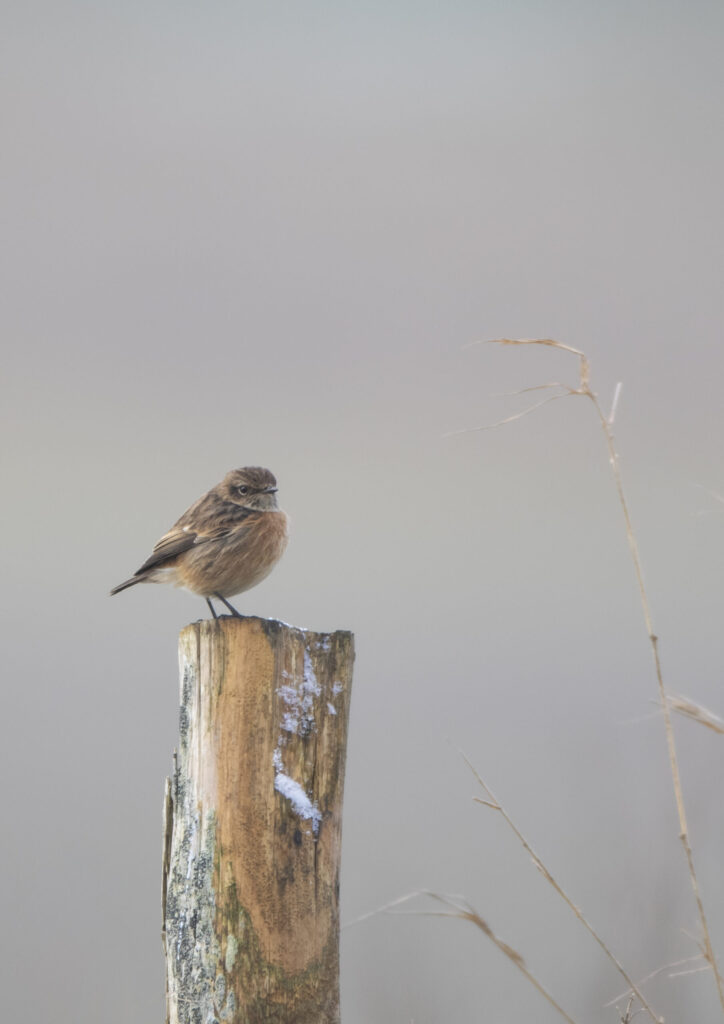
This morning I went up to Barbury Castle.  It sits high up on the Wiltshire Ridgeway,  and its elevation means that it frequently gets a little more snow than we do lower down. On this day, it made the difference between the light dusting of icing sugar in my back garden, and the demented-baker-throwing-flour-around that appeared as I arrived at the Castle. I was hoping to get a photograph of a Stonechat, a small bird looks very much like a Robin: it’s a similar size, and has a similar red breast, although nowhere near as intense and deep a red as that of a Robin. I was really hoping to get a photograph of a Stonechat on something covered in snow, thinking it would make a nice image for next year’s Christmas card. Stonechats often perch on fence posts, so I went to a spot where I knew Stonechats frequently hang around which was adorned with snow-covered fence posts, and waited. And waited. The sun came out. A million dogwalkers, part of the . And then, perhaps an hour after I first arrived, a beautiful female stonechat finally turned up. In the manner of Stonechats, she hopped down to the ground to forage between the bent-over stems of bleached grasses, each accompanied by a miniature snowdrift on its leeward side, then hopped back up to the fence line. Ground, fence wire. Ground, fence wire. She diligently hopped her way along a hundred yards of fence without ever once stopping on a snowy fence post. I had also left my gloves behind in my rush this morning, so my hands were freezing and I was fed up. I I was just about to scream when a passing couple asked me if I’d seen anything good today.

“Not a …”

I stopped. It was  beautiful sunny morning. I was outside. The cold wind that was making my hands ache was also reminding that I was alive and well and able to see this day.  I had watched a bird which, while not rare or endangered, is still one that few people would recognise. There was snow on the ground, and people were out enjoying themselves. Perhaps it was time to remind myself to value the small things in life, the small pleasures that we can so easily take for granted, like health, and wildlife, and blue skies and sun shining on snow.

Half an hour later, most of the snow had gone, but my stonechat found a small puddle of it on top of a post and stood in it. A pair of red kites drifted over the escarpment, startling a hare, which lolloped off downhill at breakneck speed, disappearing into a woodland a quarter-mile away. A kestrel lofted, wings slowly beating until it dropped unseen on something small, one life exchanged for another. I met (at a very respectful distance) a friend I hadn’t seen for months. I watched an unexpected flock of linnets – now that is a rare bird – dance over me. Eventually the skies darkened, sleet started to fall,  and I turned for home, but not before I said a prayer of thanks for the God of small things, of small mercies and small successes and small kindnesses and, yes, even small birds.

stonechat

stonechat

Powered by WordPress & Theme by Anders Norén