Naturalist. Nature writer. Nature photographer.

Month: July 2019

In search of the Skomer vole – again

I care more about elephants than I do about pigeons. As a naturalist that feels wrong, but it’s a fact. It’s a natural tendency to be more interested in the things that are exotic than those which we see every day. Elephants bring images of far-off lands. They are unusual, something outside the run of the everyday.

But not every rare or exotic animal lives far away. For several years now I’ve been tracking down an animal which lives only on one small, isolated island. Not Madagascar, but Skomer, a small island off the West coast of Wales. It’s managed by the wildlife trusts, and most people go there for the utterly adorable puffins. At Skomer, you can get closer to puffins than pretty much anywhere else on Earth. Lie down and they will stand on you.

But Skomer is also home to the Skomer vole. This close relative of the bank vole lives on Skomer,  and nowhere else in the world. Think about that for a minute. This vole lives there, and only there. It’s a unique species, larger than a bank vole and a deep russet colour. It’s not endangered, but is unique. The only place you can see it is Skomer, and that involves a boat trip.

For five years I’ve been trying to get a good photo of the Skomer vole. I’ve heard squeaks. I’ve seen rustles in the undergrowth and occasionally the tip of a tail or the top of an ear. But there are a lot of other species and places int e world so I made my mind up that this was going to be my last attempt. I had four days on the island and I devoted them to trying to find it. I succeeded, but never in front of my camera. At one point, I had a pair of voles fighting in front of me – but never where my camera was pointing.  Skomer voles move fast. It’s an article of faith amongst those who have studied the vole that it freezes when faced with danger. But that doesn’t make sense, does it? And when I explored that myth – and it is a myth – it seems to be based on the fact that when captured for research purposes, voles stay in the hand and don’t run off. But a vole on the ground, free to move? They run faster than any other vole I’ve ever seen.

The thing about Skomer is that there are no land predators. No snakes, no foxes, no stoats, rats or weasels. Skomer voles have grown up in a world dominated by brutally efficient aerial predators. Great black-backed gulls, short-eared owls, kites and others are all quite happy to eat them. I had thought that this would make the voles happy to ignore me- as a land-based threat – as long as they were under cover and protected from aerial assault. But it doesn’t. The voles are well aware that only deep, thick cover – deep inside brambles or under a thick layer of vegetation – will do. And so they scurry at speed from one safe place to another, and after days of slowly peering through gaps in the bracken that covers much of the island, I slowly realised that if I could see them, so could a predator.

And so, after five years, I gave up. It was the last day of what I had decided would be my last visit. The boat was arriving shortly. But I wandered into a location near the residence where overnight guests stay. And there, for a few minutes, the vole appeared. It scurried madly, but at least it reappeared in the same place a few times, and I finally managed the shot below. But the really telling thing was that as soon as the dawn chorus started, and the gulls started calling, the vole vanished and did not re-emerge.

And so, reader, I give you the Skomer vole. From this angle it looks exactly like any other vole. But this, I’m afraid, is the only picture you’re going to get.

Probably.
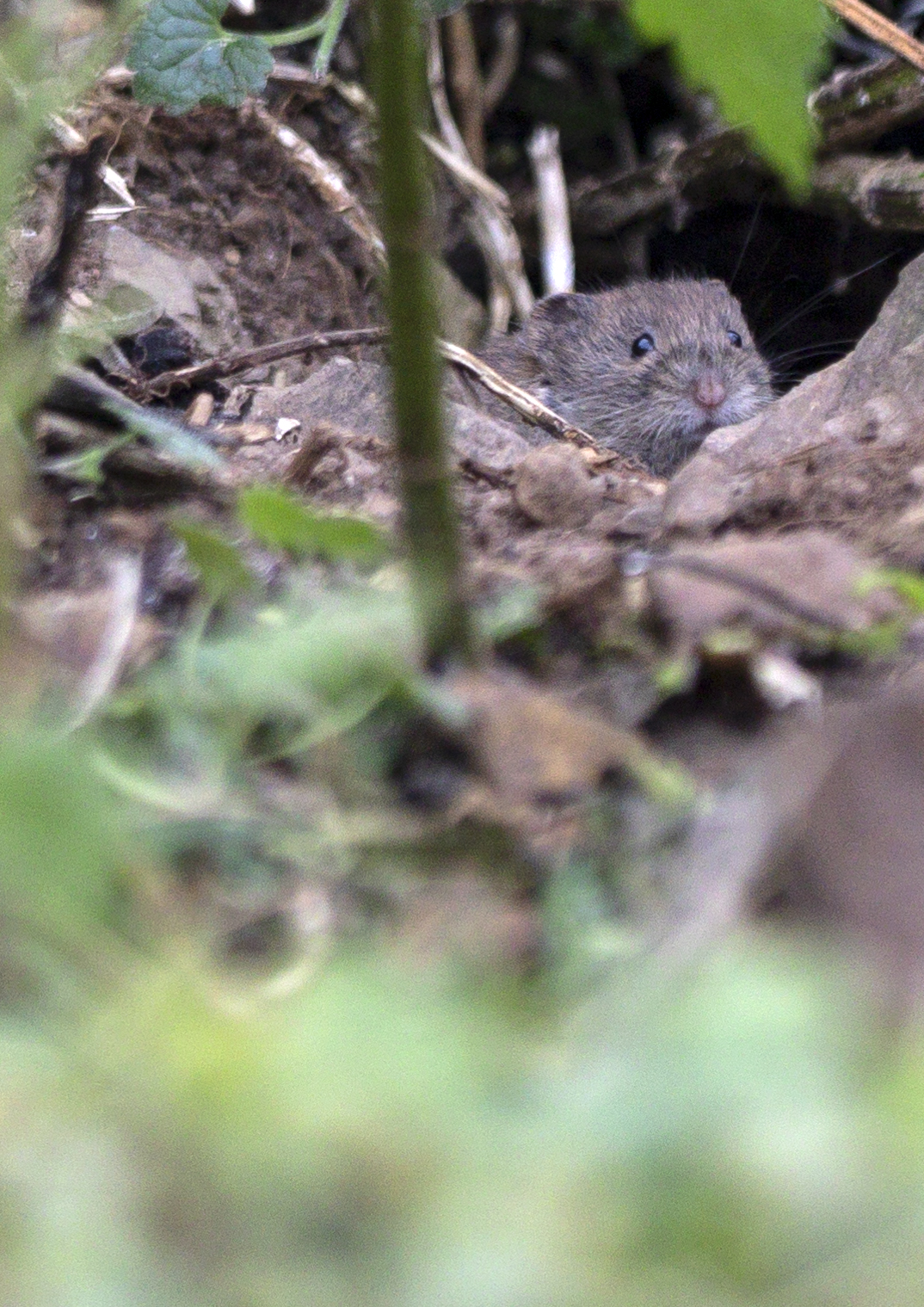
Skomer Vole

Skomer Vole – at last

Now you see me….

Today I went to Greenham Common, the former Cold War airbase that was the subject of much controversy in the 1990s when US forces stored nuclear-tipped cruise missiles there. The weapons have long since gone, and after the US withdrew, the base was returned to nature. Where once giant bombers thundered down concrete runways, rare gorse heathland now flourishes, Linnets and Dartford Warblers sing, Adders and Common Lizards bask, and one particular butterfly, the Grayling (no relation to the fish) makes its home.

The Grayling is normally a coastal butterfly these days, and inland populations are rare. It is also one of my personal last 7 UK native butterflies to see. Since I live in North Wiltshire, which is about as far as from the sea as you can get in the UK, finding a population that doesn’t involve a 2-hour drive was most welcome.

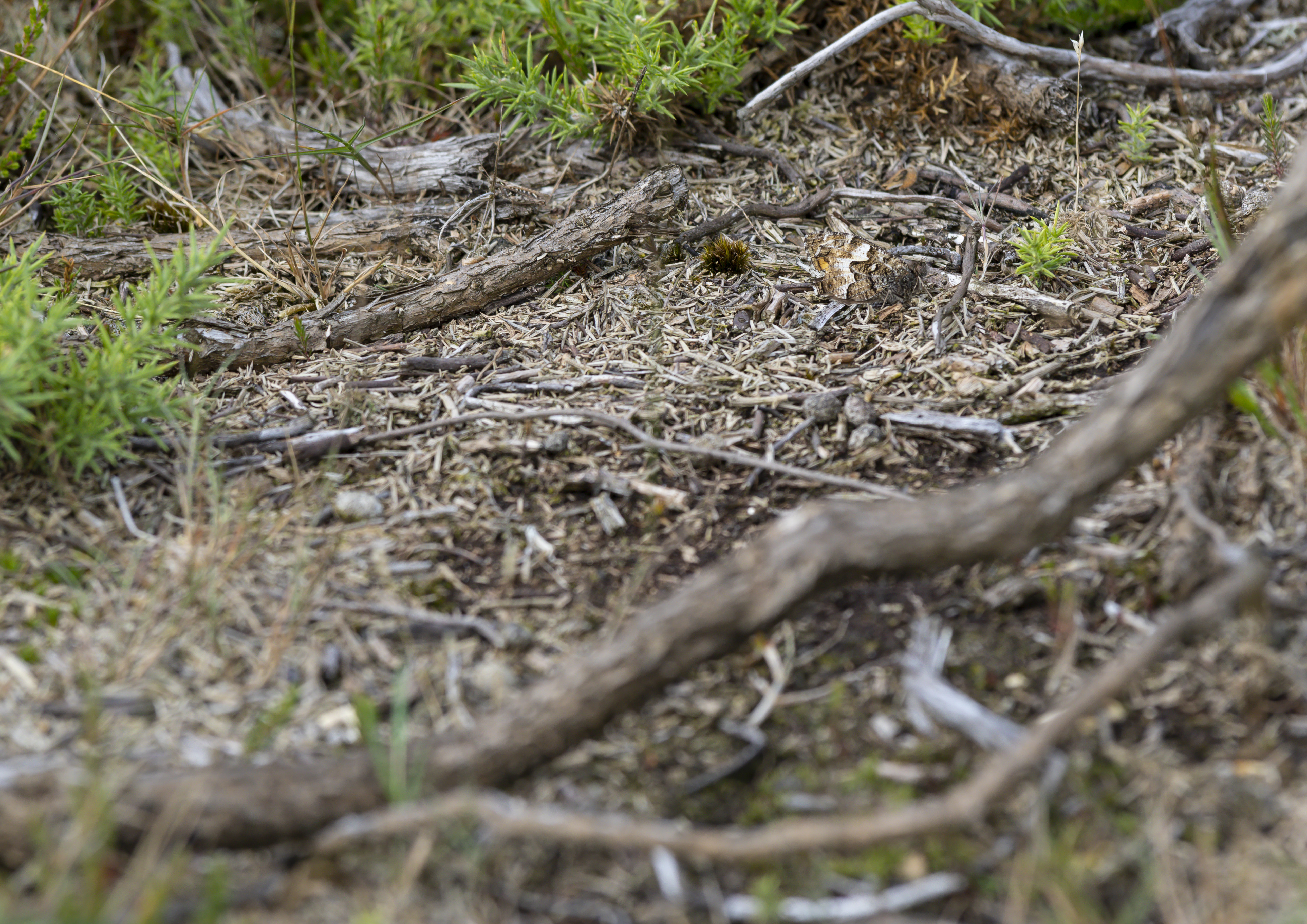
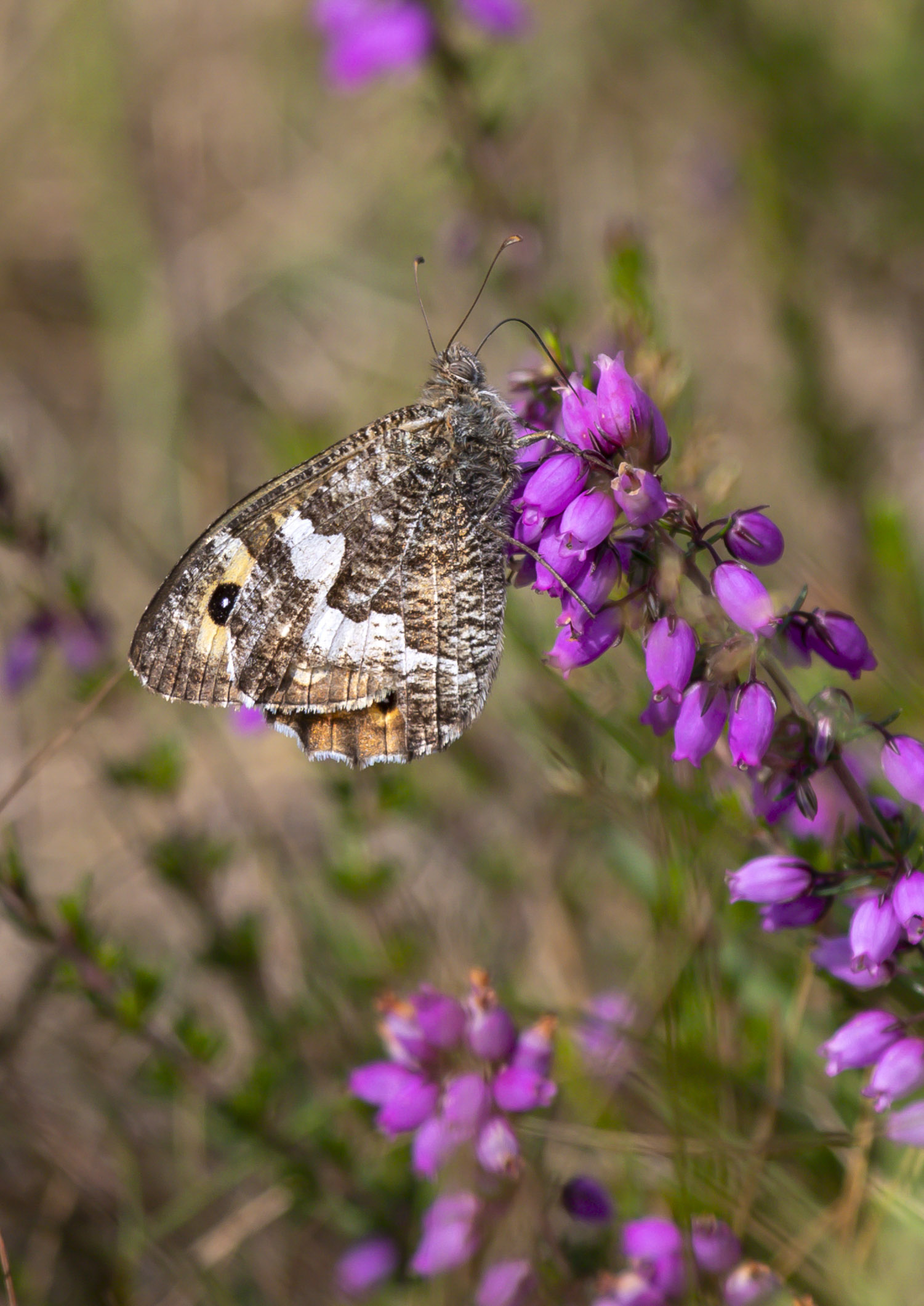
I found the Grayling, and it immediately replaced the Adder as winner of my personal best camouflage in a land animal award. It is superbly camouflaged, and as such is relatively happy for you to get close as long as it feels it is well-matched to its background. I found the butterfly at Greenham not by looking for it, but by looking for the colour grey. At one point the runways have given way to patches of heather, and the dried stalks of old heather plants litter the ground. These are a mixture of greys, and it is against these that the Greyling likes to hide. Take a look at the photo below and you’ll see what I mean.

Spot the Grayling!

Spot the Grayling!

There is actually a Grayling butterfly in this shot. Its towards the top right. You can only see it at all because its wing is damaged and the brown upper side is showing through. The Graylign is a butterfly which almost never shows its upperwing, which is a light brown colour. It has come to rely so strongly on its camouflage that it only ever settles with its wings shut, showing a broken grey pattern.

Greyling nectaring on heather

Greyling nectaring on heather

The Greyling is the only other creature which, like the Adder, I’ve looked at, looked away for a second, and then not been able to see when I looked back again. Several times I thought the butterfly I was watching has flown off, only to realise it was still exactly where I had left it. I was often staring right at it, but could only see it when it moved.

Greenham Common was once home to highly camouflaged bunkers and aircraft. In a sense, the Grayling is carrying that tradition on – albeit on a much, much smaller scale.

The real story of the evolution of the damselfly

It was a rainy day, and God’s kids were bored.  God had a lot of work to see to, so he rooted around the house to see what he could find, and came up with a packet of cocktail sticks, a tube of glue  and a watercolour paint set he had left over from working on the rainbow. He told his kids to entertain themselves and see what they could come up with he was working. And that, I am absolutely sure, is the only possible explanation for how damselflies came into being. Because no process as brutally selective as evolution could possibly have come up with them. The damselfly comes in red. Oh – and yellow and pink and green, and orange and purple and blue. And to ruin the song lyric, white and metallic green shades as well. Their eyes can be brown or blue or red or yellow or green, independent (seemingly) of their body colour. And to really drive anyone trying to identify them insane, they change colour as well. Newly-hatched damselflies (known as “tenerals”) frequently start off one colour and change to another. Females will sometimes start in one colour, then change colour to match the male.

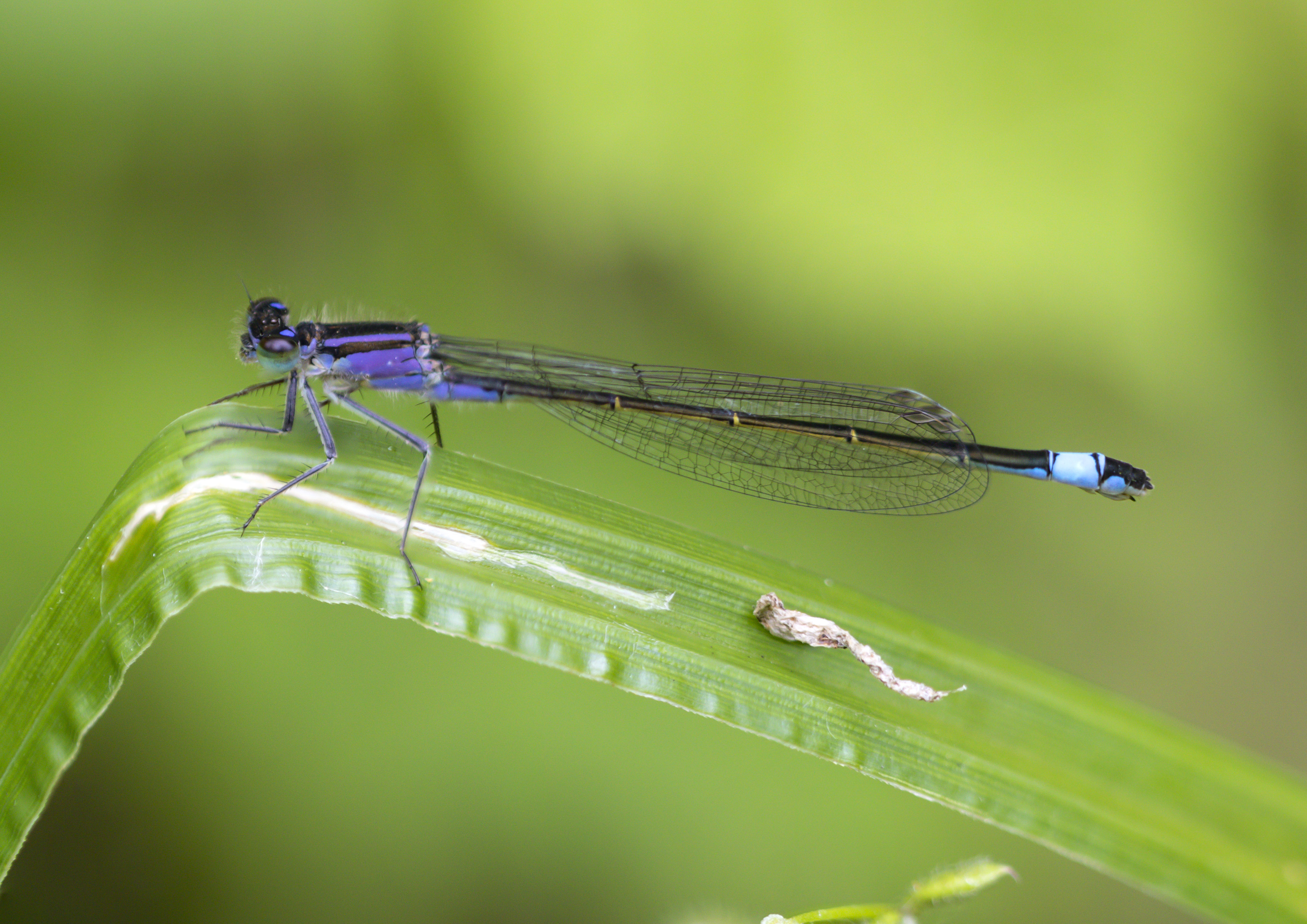
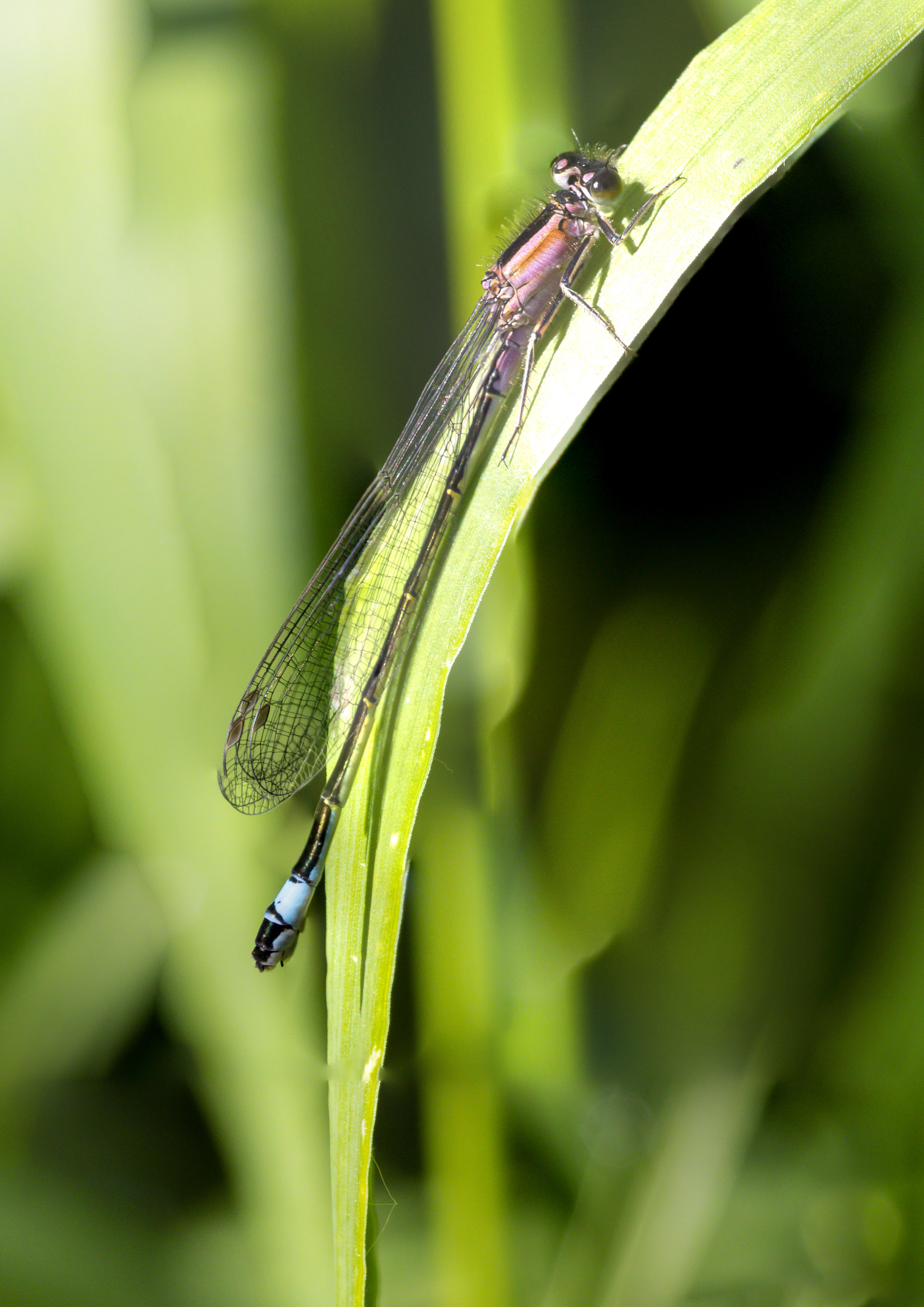
Take the blue-tailed damselfly. It’s a fairly common species where I live in Wiltshire, and the male is easy to identify because it has a bright blue ring around its “tail” (actually, it’s a long abdomen – like someone had stretched you on the rack to an improbable degree). But the female blue-tailed comes in five different colour forms – blue is the normal, but it is also available in green, purple, orange and pink. The pictures below are both female blue-tailed damselflies.

female blue-tailed damselfly

female blue-tailed damselfly

As if that wasn’t enough, some completely different species of damselflies are so strikingly similar that you need a magnifying glass to tell them apart. Take the males of the “Emerald Damselfly”, and the “Scarce Emerald Damselfly” respectively, for example.  Because both species change both eye colour and body colour on the way to adulthood, the only reliable indicator is that the Scarce Emerald has a tiny incurving bend to the tips of its inner anal appendages.

Yes, I really said that. And the inner anal appendages of a damselfly are perhaps a millimetre long. If, like me, you drove for several hours to get to a site where the Scarce Emerald is known to hang around, but where it occurs alongside the regular Emerald Damselfly, then all you can do is photograph every metallic green damselfly you see, and then zoom in on your camera screen and try and work out which it is by closely inspecting its naughty bits. It’s almost like watching pornography, but nowhere near as much fun.

But personally, I won’t hear a word against Damselflies. Because one thing these multicoloured marvels do, is eat midges. And anyone who has read my book (“Encounters – a journey to find and photograph some of Britain’s best-loved wildlife”) will know that I really, really hate midges, following an evening spent in the most midge-prone part of the UK. So here’s to damselflies, whatever their colour. And here’s to the poor male damselfly, who somehow has to recognise that the female of his species can come in a bewildering variety of colours. It seems that damselflies, at least, can’t afford to be prejudiced.

Small oddities can be big business

I recently did a three-hour round trip in order to photograph a specific damselfly – the Southern Damselfly. It’s nothing special to look at (below), and at a first glance you could mistake it for one of several other species.  But it is a distinct species, and to me that lent it a value that it might not otherwise have. I was lucky to find it so close to my home – the next nearest known location is an eight-hour round trip away.

Female Southern Damselfly

Female Southern Damselfly


Today I was researching a trip to see another rare species, the Scarce Blue-tailed Damselfly. Apart from some very subtle markings, it’s almost identical to another quite common damselfly, the (wait for it) blue-tailed damselfly. It’s just a bit more scarce. The closest reliable location to me, Latchmore Bottom in the New forest, is a four hour round trip. But as I read up on the site, I discovered that there had been attempts to restore the original flow of the watercourse that feeds the site where the damselfly lives. There were very good reasons why that work should be done – to help restore lost habitat and help protect downstream resident from the effects of flooding. Yet such actions would have probably destroyed the location of this rare insect.

Now I can imagine the frustration of those whose homes may still face flood risk because some nutter wants to protect a rare damselfly. I mean, it’s virtually identical to one you can find practically everywhere. But that ignores the lure of such things. When I did go to see the scarce blue-tailed, on a Thursday morning in school term time, there were at least four other groups of people looking for it. And one of those, a very nice couple and seemingly sane couple, had driven from Cambridge – more than an eight-hour round trip. And if they are anything like me, they all bought snacks and drinks and petrol en route.

We always seem to associate the economic benefit of wildlife tourism with the large scale. But these little insects have probably generated several hundred pounds a year for the local economy, all from a tiny insect that you could easily overlook. And that benefit will keep on coming, year after year, for as long as those insects survive. So whether you see  biodiversity as important or not, you might want to consider what is in your area that others might want to see.

Powered by WordPress & Theme by Anders Norén