Naturalist. Nature writer. Nature photographer.

Category: Uncategorised Page 1 of 6

One for sorrow

It was one for sorrow, two for joy in the rhyme of my childhood. It went as far as ten, but never reached thirty-five, so now I’m unsure of my fate.

I’ve walked just five minutes from my home, to search for damselflies in the series of small pools that are part of an optimistic flood relief scheme created alongside a local housing estate. As I arrive, the flock of magpies, more than I have ever seen in one place before, take to the air shrieking defiance, making the sky flicker. Between ‘gulp’, ‘tiding’, charm, and ‘littering’, some of the many collective nouns for them, I choose ‘mischief’: they are clearly up to something.

Ringed by grassy banks filled with teasle and thistle, punctuated by ragwort and fleabane, the damselfly ponds graduate slowly, the deeper areas of water filled with reed mace and phragmite, the shallows with water mint and hard rush, the glistening mud by the fat yellow fingers of bird’s foot trefoil. I slowly circumnavigate each of them, and the mud between speaks to me. It’s a palimpsest, a recorder of travels. Here, twin almond slots incise the ground, the marks of roe deer that came here in the night to drink. There, the smaller, daintier, ballerina hooves of Muntjac, spaced out with speedy flight, are intercut with the spear-shaped tracks of a following fox. And last, cutting through all, a deep indentation of four claws and a “D” shaped pad: one of this morning’s dogwalkers had paws to clean.

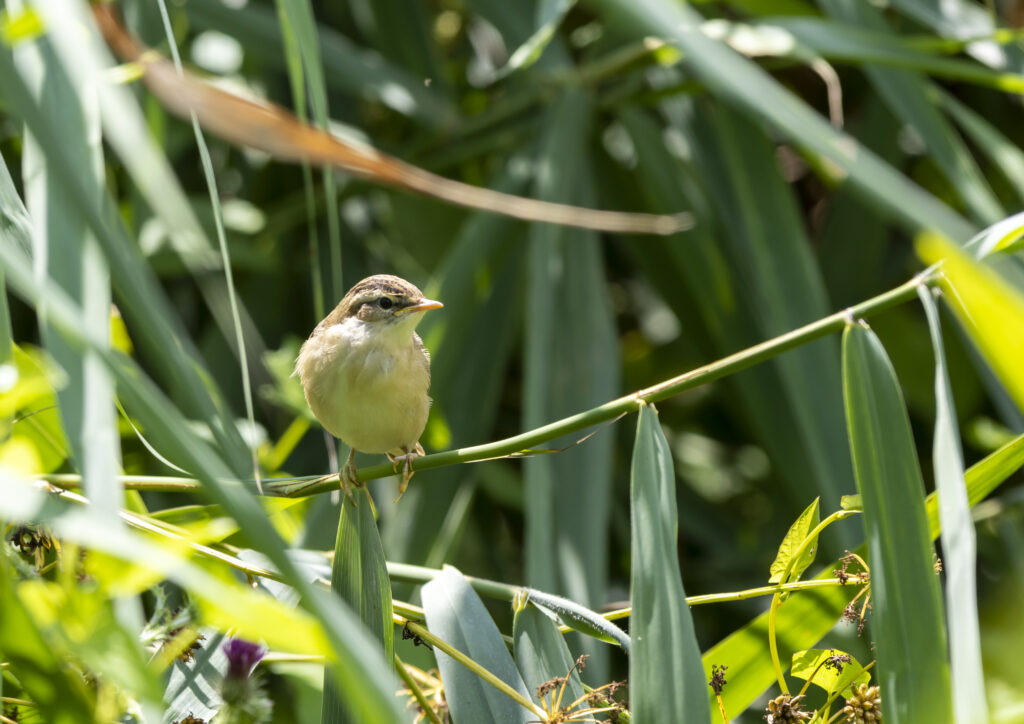
There are no damselflies, which is puzzling. I wonder if I have left it too late in the day, if it is too cloudy or cool for them to fly. But I can hear a rustling within the reeds, a clatter of wings, and glimpse movement. I assemble it from its parts: a glimpse of creamy chest and sparrow-like back, a pale leg, and finally a dark-capped head with a cream ‘supercilium’ or stripe above its eye. It’s a sedge warbler, a juvenile, recently fledged. And there is a second, and a third, moving clumsily through the stems, hunting for insects near the water line. This explains the paucity of damselflies, and perhaps also the gathering of magpies, inveterate takers of other birds’ young. The fledgling warblers will stay here for a few more weeks to fatten up, before winging their way to sub-Saharan Africa, to Senegal or Ethiopia, sometimes in one prodigious, unbroken, four-day flight.

fledgling sedge warbler

fledgling sedge warbler

And so, I turn to the task before me: “thirty-five for feeling alive”, maybe?


It’s the small details that matter

I fulfilled a small ambition yesterday.

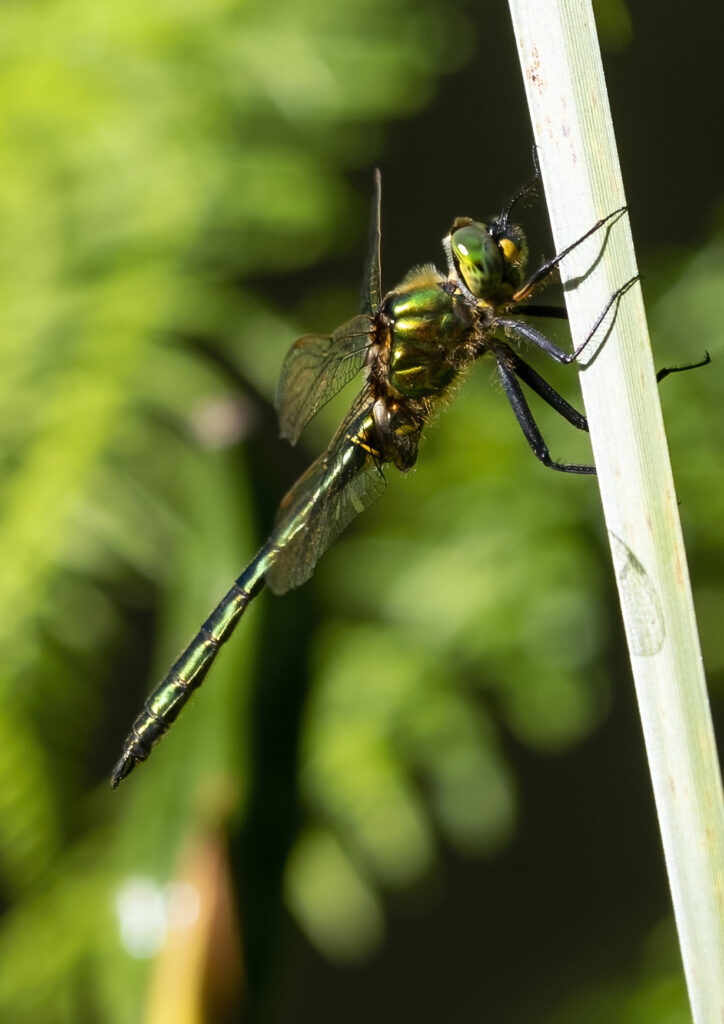
I have for some time tried to find and photograph the Brilliant Emerald dragonfly. It ‘s a Ronseal insect, doing exactly what it says on the tin: it is brilliantly emerald. So, since the weather has finally graced us with something other than rain, I thought I’d give it another go. It’s an acid pool lover, so if you want to see it your options are limited to Scotland, or to a cluster of small colonies in the heathlands of the southeast.  Having tried Warren Heath, the nearest location to my home,  last year, this time I went to the Basingstoke canal. It’s unusual for a canal to be both placid and acidic, but the Basingstoke canal between Aldershot and Farnham is exactly that – very slightly tea-coloured, and peaceful and serene in the gaps between the whining, thundering roars of aircraft taking off from nearby Farnborough Airport.

I have never seen so many fish in a canal, including at one point a foot-long young pike who look spoiled for choice in  the meals department. I kept looking for kingfisher, but like so many canals, this section lacked the high muddy banks that the birds need to nest in, and there was not some much of a tweet of one – much to the relief, I expect, of the local anglers.

I saw the Brilliant Emerald with moments of arriving, out over the water, a jewel hanging from glittering golden wings. It’s one of those species, like the Kingfisher,  that makes you wonder about evolution. Bar strapping an anti-collision light to it, you couldn’t make it more obvious, and I was suddenly grateful for the relative lack of birdsong along the canal sides, because I expect they would takes these beautiful insects at once. Or maybe it’s a double-bluff: many brilliantly-coloured insects are that way to act as warning that they are toxic or poisonous. Perhaps the BE is bluffing  and hoping that such an obviously bright dragonfly will be left alone.


brilliant emerald dragonfly

Either way, here it is: a male Brilliant Emerald dragonfly pausing for breath, the result of three years of effort for me.  Was it worth it? Oh yes.

When it comes to nature versus nurture, I’m voting nature

Snow was forecast for today, so when a hungry cat woke me at 4 AM I did what any sensible person would do: I pushed him off and tried to go back to sleep.

When he tried again at 5 AM, and resorted to his usual ploy of jumping up on to the bedside table and progressively knocking things one by one to the floor to get some attention, I did what any sensible person would do, gave up, went downstairs and fed him and his larger and less annoying sibling.  Since I was up anyway, I looked out of the window for the promised snow, and saw nothing.

I woke again at 6 AM, this time at my own urging, since this is the time of morning I get up to go to work. I have done so for so many years now that my body automatically wakes me at this time whether I want it to or not. I looked out of the window for the promised snow and saw nothing.  By 7 AM, when I pulled the curtains back in the lounge ready to start my day, I looked out of the window for the promised snow and saw 3 inches had suddenly arrived.  This wasn’t the timid snow that we normally get in this country, snowflakes like grains of rice that really couldn’t be bothered to get out of bed themselves.  No, this was big fat fluffy snow, the size of three cornflakes welded together drifting down from a grey sky  and piling up in front of my very eyes.  From the upstairs windows of my house it looked white,  like swan down floating downwards.  From downstairs in my kitchen, it looked grey, and I wondered how something grey could be visible against a grey sky, but somehow it was.

Normally in weather like this, I’d head out into the countryside in the hope of seeing a fox or deer standing out against a field of snow.  But this year, with lockdown in full swing and the health services stretched to breaking point, I felt that would be a responsible.  So instead I went for a slow and measured walk around my local lake and the small piece of woodland that sits atop it. The sky was grey, and the air cold.  It’s an odd thing: cold air has no smell, or rather it has its own smell. Cold air smells only of cold air,  you can’t detect the other scents that lie beneath it. I stepped out into Narnia, into filigree tracery of black twigs each outlined above with a white line, as if a mad painter had been out and highlighted the tops of every one.  Cold air has its own smell, and snow has its own sound. The scrunch and squeak when you walk on it is like nothing else, except perhaps rubbing blocks of polystyrene together.

For some time as I walked, I saw no wildlife.  The waters of the lake had a grey stillness to them, covered as they were in most places by a thin floating layer of slush. The swan family paddled through it effortlessly, with the adolescent cygnets, now shedding the last of their brown feathers for the pure white coat of an adult, looking around themselves in wonder at how the whole world had suddenly turn to swan. It wasn’t until I reach the woodland that I started to see and hear things move.  A family of long – tailed tits chattered their way through the trees, searching for insects, creating little flurries of snowfall as they bounced onto a twig and off again. One even managed to score a direct hit on me, a small softness of cold hitting exactly on the back of my neck and sliding down beneath my clothes.  But I didn’t begrudge the long-tail that caused it: there is something cheerful about the relentless busyness of longtails, especially when they are all puffed up against the cold,  looking for all the world as though someone has stuffed a small pencil into the pom-pom lost from somebody’s fluffy hat.  I find them irresistibly cute.

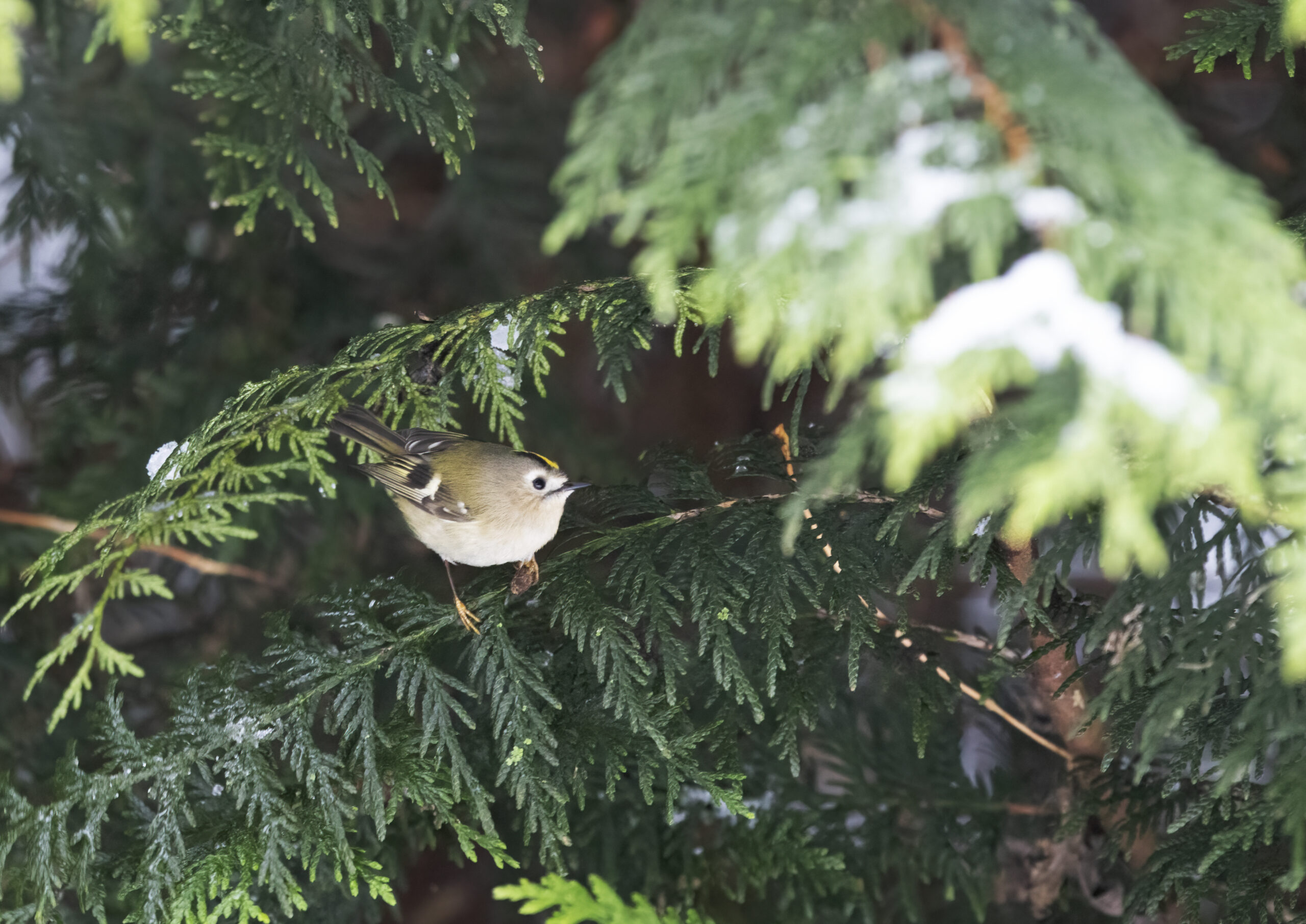
Further into the woodland, I heard a high-pitched sound, fluttering on the very edge of my hearing, and caught sight of a small olive shape fluttering.  Three pine trees, their branches still green, were bent and bowed under blankets of white snow.  And beneath them our smallest bird, the Goldcrest, searching them on hovering wings. Weighing no more than half a Jaffa cake, the Goldcrest is our answer to the Hummingbird, and I watched as it hovered on blurring wings as it poked its slender beak into nooks and crannies looking for spiders.  They are short lived birds, with an average life expectancy of about eight months, so this bird had never seen snow before, and its parents hadn’t lived long enough to to teach it what was snow was like. As so much of our wildlife does, this small bird was operating on instinct.

As long-lived as humans are, we often forget how ephemeral the lives of much of our wildlife can be. Consider for a moment the mayfly, which has lived all of its life underwater until the day when it emerges, changes its body shape entirely, grows wings, and and then has to learn how to fly and mate and lay eggs on the wing without any instruction or previous experience at all. Like its parents, it will live less than a day, and will never pass the skills that it has so quickly learned on to its own offspring. While my Goldcrest may live for longer, it still faces the same challenge.  The world it knew changed completely in the space of an hour, the temperature plummeted, and this tiny bird, which has to feed almost constantly all day simply in order to stay alive, had to adapt or die.

Humankind likes to think that it is very intelligent, but I wonder how many people, if suddenly picked up and dropped into a desert, say, or the Arctic, would manage to adapt so thoroughly and so quickly. But the simple fact that I saw a Goldcrest today means that at least two other Goldcrests managed this trick last year.  And my Goldcrest’s great – great – grandparents somehow managed to survive the “Beast from the East” which brought much of the human world to a shuddering halt this time two years ago.  The same is true of every bird and animal that I’ve seen these last few days.  Each of them has survived through conditions that no person would have managed to survive without help, and in a great many cases, they’ve done it without guidance of any kind.  My Goldcrest is living, breathing proof that it is nature, not nurture, that makes us what we are. And what it makes my little Goldcrest is one very tough little bird indeed.

goldrcrest

goldcrest


Oh my. I think I’m a birder

For many years, there’s been a regular occurrence when I’ve been out walking. Someone has spotted my camera and said “Oh, you’re looking for birds, are you?” and I’ve had to explain that, like Russel from the Disney film ‘Up’, I’m actually a “friend to aaaaaaallll nature”, and not – most definitely not – a birder. I felt that the birder market was, to put it mildly, a bit overcrowded. Sadly, some of the birders I met were also unfriendly and showed little sign of caring about wildlife beyond getting a tick on a patch list. I was better off out of it.

But yesterday I met a woman near a gate in central Oxford. It was the gate to Port Meadow, a large grassy field that had substantially flooded in recent rains. It was my second visit to the site in a week, driving a sixty mile round trip each time, and I’d got up at six in the morning so that I could finish my day’s work in time to race there. I’d used my last two pound coins in the parking meter, and as I got out of my car it started to rain.

As I hefted my camera with a long lens on a tripod, the woman asked me what I was doing there.

“I’m looking for a duck”, I replied.

Understandably, she gave me a guarded look, the sort of look you give someone when you first suspect that they may be just a teensy, tiny bit deranged. The vast, 300-acre flooded expanse of Port Meadow behind me was teeming with literally hundreds of ducks and geese.

“What duck?” she asked.

“A Garganey”, I replied. I held my hands fourteen inches apart. “It’s about that big, and it looks almost exactly like most of the other ducks out there”.

“Is it rare?” she asked.

“Well, there’s only one of them out there,” I replied, adding “and even that one may have gone by now.”

Two hours later, the sun had finally gone for good behind a bank of thick grey cloud. I was standing in the flooded meadow, the water halfway up my wellies, and the water inside my wellies starting to rise from the pelting horizontal rain that had soaked the windward side of me and was trickling down my trousers, inside and out.  I’d looked carefully at duck after duck after duck after duck, assessing head streaks and the precise boldness of wings patterns, but the Garganey had indeed gone. I started my twenty-minute long, sodden walk back to my car, and halfway  there realised that at some point the waterproof cover had blown off my rucksack and that was now sodden, too. It was getting dark, I was bone-weary, and the cover was camouflage pattern so I had no chance whatsoever of finding it. But even so, I found myself debating whether it was worth trying to come back again at the weekend. And that’s when it hit me, so hard that I actually stopped in my tracks.

I was a birder.

Somehow, over the previous few months, an interest in seeing different species of bird had seeped into my bones. I’m still passionately interested in butterflies and dragonflies and snakes and mammals and plants, but somehow, the piece of the jigsaw that had always been missing had turned up. I realised that I now liked birds enough to travel miles and experience considerable discomfort to see them, something that has always been the case for me with the rest of Britain’s flora and fauna, but was never the case with birds. Now it is. I am a birder.

I still haven’t seen a Garganey, but tomorrow I’m supposed to be laying flooring in the main bedroom and instead of planning it I’m wondering if I can nip out around dawn to find a Ring Ouzel that’s been reported on a nearby hill. I’m definitely a birder now, but how long I get to live as one may depend entirely on how long my wife’s already badly stretched patience lasts…

The last wings of Autumn

A few weeks ago I posted (“A case of premature exclamation”) about another failure in my years-long search for the Common Hawker dragonfly.  I have driven many hundreds of miles and devoted a great many hours to the search and come up empty handed. But last week my wife and I went for a short week’s break to Northumberland, in the lands right next to the Scottish border. It’s a place we have both wanted to visit for some time, and it didn’t disappoint. It’s a stunningly beautiful landscape, full of castles, rolling hills and lovely coastal views.

As part of our visit, my wife with her usual patience agreed to com with me on a quick trip in search of the Common Hawker. We drove to Kielder water, the largest artificial lake in the UK, turned our backs on it, and slogged up the sides of the gentle valley that surrounds it. Remember, this is our only holiday in this very stressful year, we only have four days,  it’s early October and the previous day it had been cold and drizzly. It was also blowing a lively gale as the leading edges of the first named storm of the year starting to arrive. But rather than browsing antique shops or having a nice meal, my wife and I were climbing up a hillside that quickly turned into bog. We saw nothing – and unusually, I do mean nothing. Not a bird, not an animal, not an insect. We trudged on and on,  and the conversation started to droop, although the views were absolutely stunning. Eventually we reached our target, a deep pool the colour of stewed tea surrounded by a boardwalk of plastic planks topped with chicken wire. On one side, the depths gave way to shallows with mats of pond weed and reeds, and the whole site was surrounded by marshy ground and bracken. It was ideal dragonfly habitat, but there was not a dragonfly in sight.

I always knew it was going to be the longest of long shots. We were beyond the end of the normal flight season for the Common Hawker, which peaks in July and August and  tends to vanish around the third week in September. It had been cold and wet, and dragonflies like the sun. Weeks earlier, the pool would have been alive with the sound of clattering dragonfly wings, but all I could hear now was the keening of the wind through a nearby stand of pines. It was my wife’s idea to stop and eat lunch. The location was peaceful, we hadn’t seen another living soul, and it was well past lunchtime. I apologised to her for dragging her through the bog on another wild goose chase, but my wife, ever pragmatic and patient just said we should wait a while and see if anything turned up while we were eating.

And to my astonishment, it did.

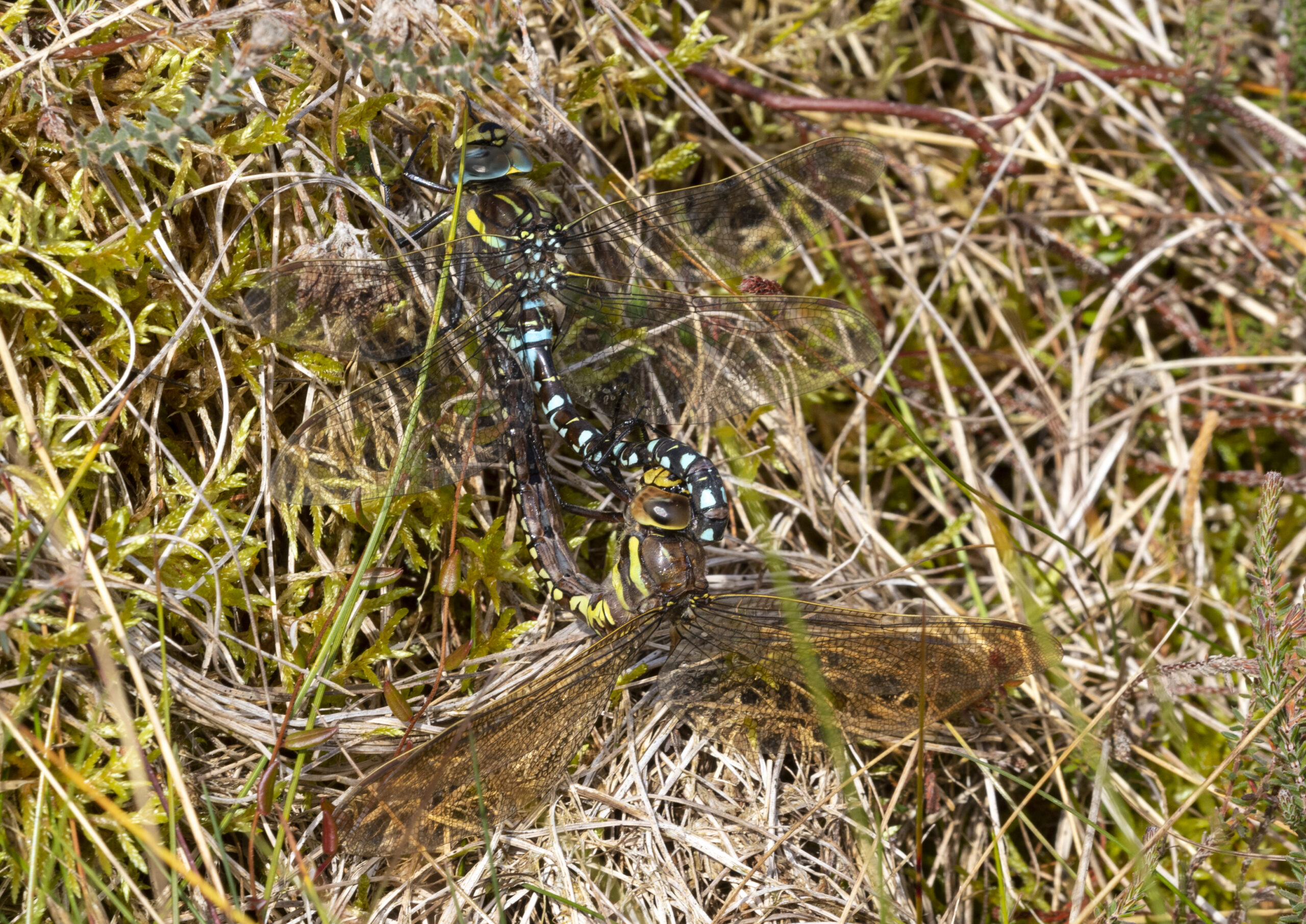
Twenty minutes later, the sun had brought the temperature up a little, and I saw a dragonfly on the pond. As always, I never saw how it got there – it just materialised. One moment there wasn’t a dragonfly, the next moment there was. Then there were two, and being dragonflies they immediately started fighting. I took a string of photos as the distant pair on the far side of the pond clattered into the water. And then, still locked together, they rose from the pond and disappeared behind a large,  brown and desiccated heather on the far side of the pool. I shouldered my camera and went to look for them. At first I missed them and walked right past them. Then I found them, low down amongst some grassy stems above a bed of sphagnum moss, and understood why they hadn’t immediately flown away when I neared them. They hadn’t been fighting. They were mating. I later looked at my photos and realised that the male had seized the female and dunked her in the peaty water, staining her normally clear wings brown. Holding a female underwater until she gives in is sadly a common tactic of male dragonflies who want to mate with a reluctant female. The two dragonflies hung together, the tip of her abdomen touching the place just below his thorax where a dragonfly’s penis lives. The wings each had a golden “costa” or leading edge of the wings. He had narrow shoulder stripes, she had none, and both had orangey-brown wing spots and eyes that…

Hang on. Yellow costa and orange wing spots?  I looked closer.

Eyes that are almost fused together – check. A noticeable waist on the male – check. Oh Lordy, Lordy. It seems that Common Hawkers are like busses: you wait three years for one and then two come along together.

So ladies and gentlemen, with more pleasure than I can possibly convey, I finally give you: the Common Hawker.

common hawkers mating

common hawkers matingWhat do you mean it looks like all the other dragonflies… ?


A short haul flight during lockdown that few people noticed

I went to Brighton yesterday. Why not? It was a sunny if windy day, one of a run of days of nice summery weather that would have been really appreciated during summer but was rather more annoying now that the schools have gone back. But if you live in the UK, wonky weather is the deal you sign up to.

But surprisingly for a 3-hour drive (lorry fire on the M25) to a seaside town, I wasn’t heading to the beach. I was heading to some hilly ground to the East of the town, to meet an old friend. I could seas the sea quite clearly, and it did look inviting until I reminded myself that this was September in Britain and the sea probably had pack ice floating in it (I may be exaggerating a touch).  So why was I here? I had come to try and see an insect, a butterfly, that might just be one of those European migrants trying to set up home in the UK, the difference here being that we don’t have warships trying to stop them. It’s the long-tailed blue butterfly.

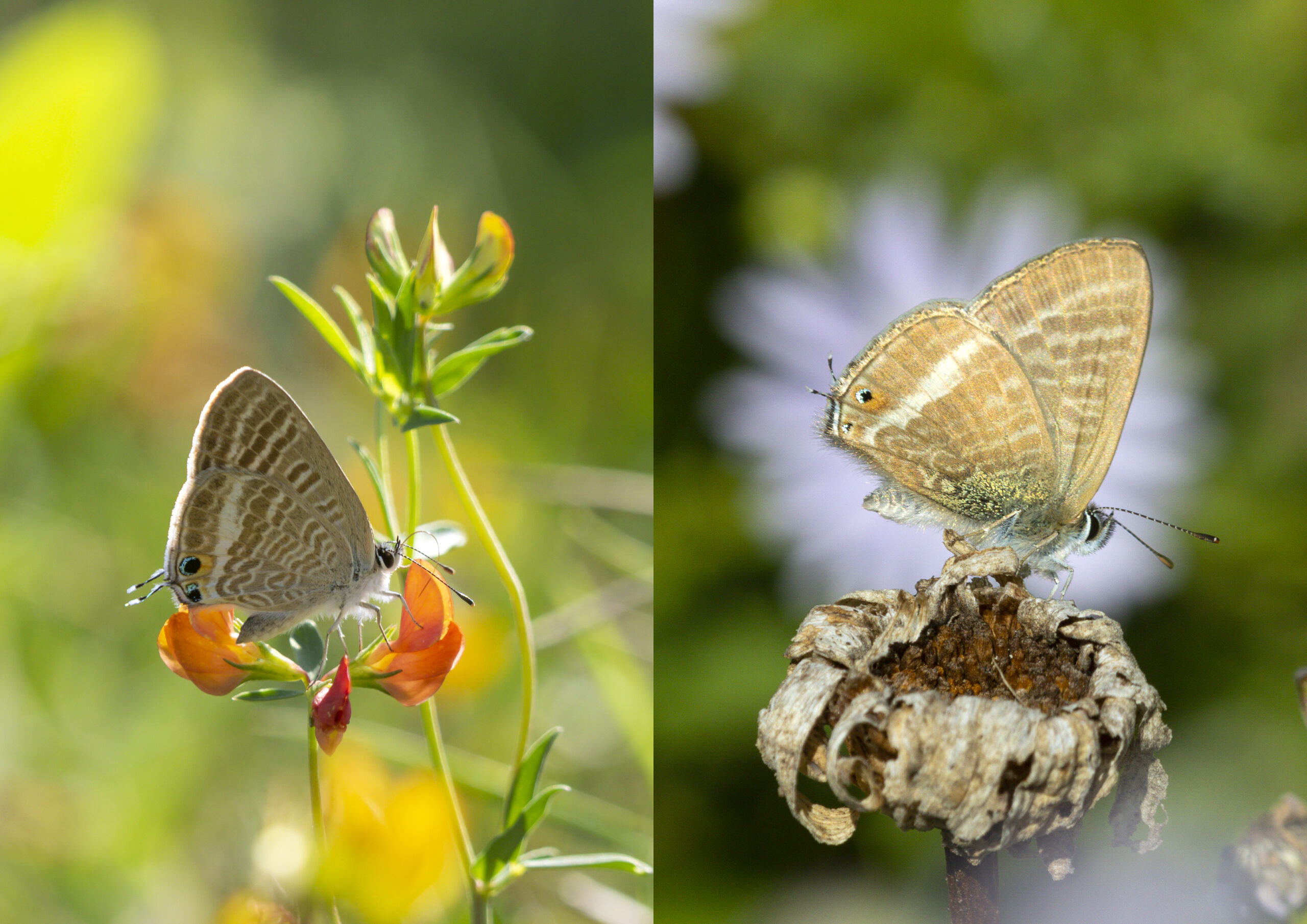
I’ve seen the long-tailed blue butterfly before. In the carefreee, covid-free halcyon days of 2018, I jetted off to Minorca on holiday. Being the kind of person I am, it didn’t take many days of lying on a beach before my feet got twitchy and I set off inland with a camera hunting for wildlife. In the back of a town centre development near Cala Galdana, I found a patch of ground that had been bulldozed to make way for some building work that hadn’t happened. On  the back of the rubble-strewn site, some everlasting sweet peas had bloomed. And on the sweet peas, I found the long-tailed blue, butterfly sometimes called the “pea blue”. It’s a striking butterfly, with underwings chased in fine repeated fawn and white lines, like a doodle you would make on a boring phone call. The upperwings of the male are a deep, violet blue, but it is name for two short “tails” that project back from each wing, accompanied on the underside by two glittery eye-dots. What are they for? Nobody knows for sure, but it’s possible that they are a defence mechanism, a handy, disposable part of the butterfly’s wing that a pursuing predator can catch while the rest of the butterfly escapes. Or it may just be what counts as really sexy in butterfly world.

I arrived a a spot on the hills where the same everlasting sweet pes grows wild. There were perhaps a dozen plants, most finished for the year and faded, but one of which bore a fresh, neon pink bloom. Surprisingly, this plant seemed to hold no attraction for any butterflies at all, but on a nearby stand of faded blooms, I came face-to-face with my holiday romance. Nearly eight hundred miles and at least three countries away from where I’d last seen one, this was actually no foreign butterfly. Clean and crisp, this butterfly hadn’t flown the Channel: it’s parents had. The long-tailed blue can fly huge distances, crossing mountain ranges, and a hop across the Channel was nothing to it. It’s a born invader as remarkably, it can complete its entire life cycle, going from egg to caterpillar to chrysalis to butterfly in as little as four weeks in good weather. This long-tail was  born here, on this Brighton hillside, as British as I am. The test now will be whether any of these new citizens’ eggs will survive our winters to emerge next year. If they do, Britain will have acquired two more “native” species of butterfly in a single year.

So here are two long-tailed blues, in phots taken 800 miles apart. Can you tell the Spaniard from the Brit?

long tailed blues


A case of premature exclamation

For over a year now, I have been searching for a particular dragonfly. Irritatingly, its name – the “common hawker” -suggests it is easily found, but that couldn’t be further from the truth,and it’s actually quite scarce in the south of the UK. It’s a lover of pools which have acidic water, the kind that you find in pine forests and peat bogs, and those are in short supply near where I live. So I have travelled hundreds of miles to places offering the right habitat to try and find it. I have walked miles in the acidic bog areas of Somerset and the New Forest. I have been bitten and scratched, got water inside my welly, and seen… well, a brief glimpse of one would be a charitable answer, because I’m not even sure that the one I saw was a Common Hawker.

So this year, after lockdown ended, I had another go. I went to a place in Somerset with the delightful name of “Priddy Mineries” where the dragonfly has been seen. In fact, it’s was seen there about twenty minutes after  I left the site, empty-handed, last year.  Conditions weren’t ideal, as the leading edge of a storm front was crossing over, and it was very windy, and fairly overcast, conditions which are anathema to most dragonflies. But needs must, so off I went, driving along roads that were starting to become familiar, I’ve been to Priddy so often looking for things that turned out not to be there.

Now don’t get me wrong, Priddy is a fantastic place for wildlife of all stripes, and well worth a visit. But it’s not so pleasing when you’ve gone to find a particular insect and never seen it. I joined a few other dragonfly enthusiast at one of the prime dragonfly pools  (known as “odo-nutters”, after the family name for dragonflies, “Odonata”) and we watched and waited. One of my companions cheerfully informed me that he’d photographed one just the day before, right where I was standing. Of course, it had been sunnier then. And less windy.

After an hour or two, I decided to walk the nearby stands of bracken that were sheltered from the winds by tall pines. I found a dragonfly there – the black darter – that is uncommon if not rare. And then I saw it.

Zipping expertly in and out of the trees, up and down, like a ping-pong ball on the speakers at a Led Zeppelin concert, was a medium-sized dragonfly. It had the right kind of patter. It was in the right place. And then – miracle of miracles – it settled, something that Common Hawkers rarely do. It had settled on a piece of old heather, which Common Hawkers do on those rare occasions when they stop flying. Serendipity. Everything was coming together. But wait: what was this? It had settled right next to another that I hadn’t spotted. Male and female, side by side. An uncut diamond lying by the side of the road. A huge nugget found with the first strike of the shovel. The kind of story Odonutters tell each other on dark nights over a bottle of Fanta. I screamed aloud. I danced the kind of jig people with two replacement knees dance – a kind of rolling sideways shuffle, if you’re interested -and told passing strangers. I took photo after photo after photo until I couldn’t think of any more photos to take. I went home buzzing.

When I got home and looked at my pictures. They were lovely images of a two dragonflies side by side. Except they weren’t the Common Hawker. They were a pair of males of the almost-identical Migrant Hawker, far more common in the South. In my excitement, I’d made the classic error of all wildlife-watchers: seeing what I’d expected to see. It’s a mistake I’ve made before and will doubtless make again, but it was particularly galling this time.

I couldn’t face returning to Priddy, and the Common Hawker flight season ended before I could go anywhere else to look for it. Like so much of our wildlife, from the ephemeral butterflies and dragonflies to the migrant birds that visit us for a while and then leave, I would have to wait for another year for a chance to see it. So here to keep you entertained, is a nice shot of two Migrant Hawkers. I hope you enjoy it, because it’s all you’re getting until Summer 2021

Migrant hawkers

Migrant hawkers. Pah

The art of anal appendages

I never dreamt that ‘anal appendages’ would become a part of my life. I mean, who would? And yet somehow, they have become something I not only talk about, but carefully examine.

When I started my long, slow love affair with the natural word, it was all about seeing and photographing living things that are easily accessible – things like great spotted woodpeckers, buzzards and bank voles. Over time, I developed good fieldcraft skills, and as I’ve done so I’ve gradually discovered species that are more challenging to see, getting up close and personal with kingfishers and hares, badgers and owls. But becoming more proficient creates its own problem. Once you have seen the easy-to-see species, the ones that are left are, by definition, not so easy. The job just gets harder and harder.

Largely as a result of habitat needs, but all too often as a result of being wiped out in all but a few locations, our wildlife is not spread evenly around the country. You can’t see an animal that doesn’t live where you do without travelling, and so, like many before me, I’ve gradually started clocking up the miles, ranging the length and breadth of the country to try and see rare or unusual species. One of the families[1] of creatures that I like are the Odonata, the dragonflies and damselflies. These winged marvels date from 300 million years ago, long before the dinosaurs, and those millions of years of evolution were certainly not wasted. If your body plan doesn’t alter significantly in 300 million years of endless kill-or-be-killed competition, then you know that it’s a pretty good design. Able to lift off vertically and hover, Odonata can also fly backwards, forwards, sideways and even upside-down, something even the most advanced modern aircraft still struggle to replicate. Their compound eyes, each with thousands of hexagonal light receptors, wrap around the sides of their heads, allowing them to see in front of them, above them, and behind them at the same time. These brilliantly coloured eyes are part of a target tracking system the envy of a guided missile destroyer, which allows them to pick out a single gnat in a cloud of them and snatch it unerringly out of the sky before eating it with some of the first teeth seen in nature. They succeed in catching prey in 95% of their hunts, which means that they are actually the world’s deadliest animal – compare this to a hunting success rate of just 25% in lions or 5% in tigers.  Even the great white shark, another ancestral species who has spent millions of years getting it right, only manages to make a kill in 50% of its hunts.

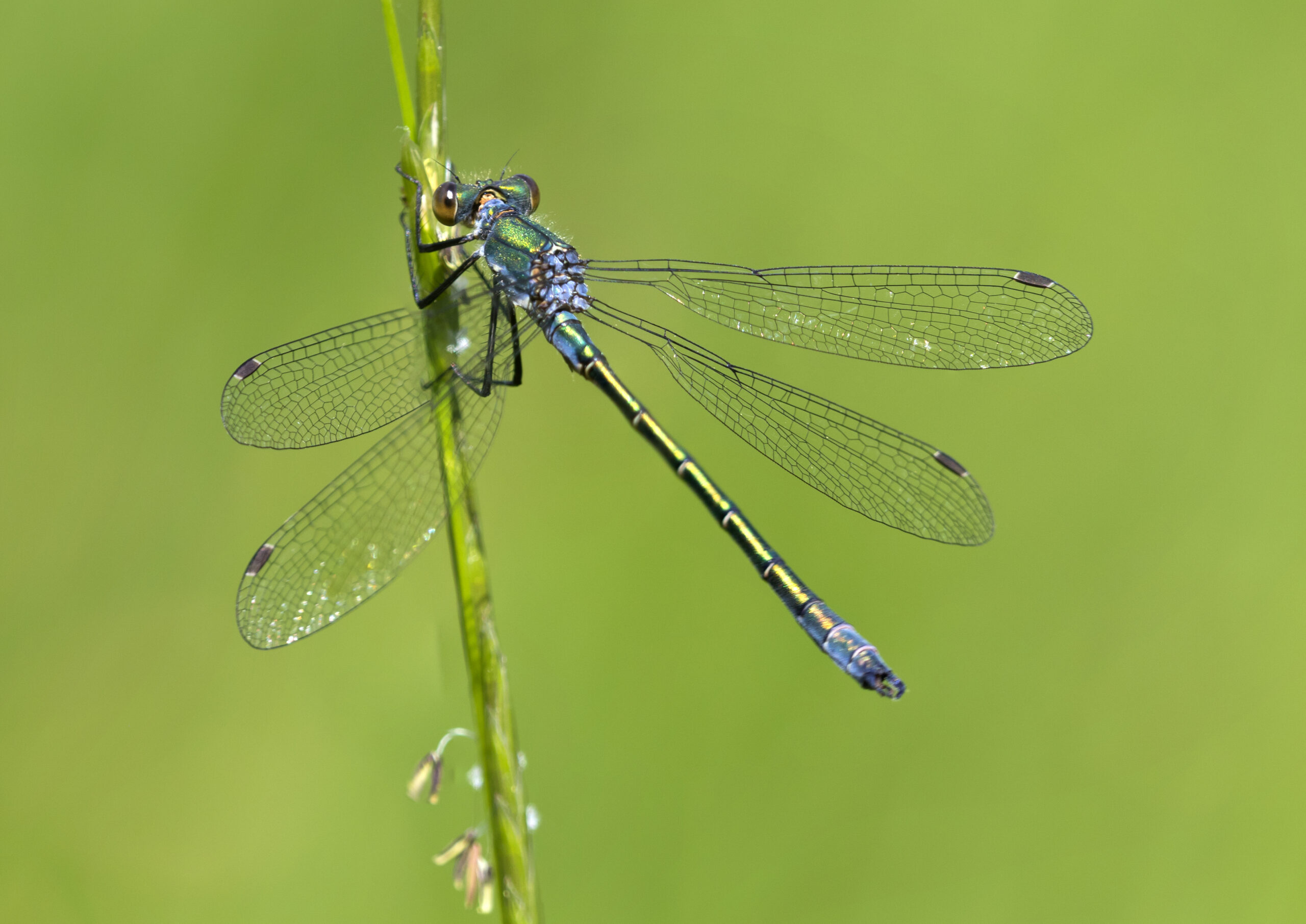
The scarce emerald damselfly

The scarce emerald damselfly

The problem for the damselfly-spotter is that many of our damselflies can look very similar indeed.  Identifying what you’re looking at takes experience, practice, the help of experts and a very good guidebook or two (I have about five). Colour plays a large part, but unfortunately many Odonata change colour – the blue-tailed damselfly, for example, starts off life as pale lemony colour, and matures quickly into a medium blue colour (for the males) or pale blue, orange, purple, pink or green for the females. So to definitively identify some damselflies, you need to start looking at small (and I do mean small – these are not big insects) details. There are the colour spots towards the ends of the wings called “Pterostigmata” (literally “wing marks”) whose colour and shape can help separate, say, a common emerald damselfly from a southern emerald. Then there is the patterning on some of the segments, where a “U” shape may mean a variable damselfly while a cup shape may point to an azure damselfly. And then there are… anal appendages.

Shaped like your finger when you beckon someone, a damselfly’s anal appendages are sometimes called “claspers”. They occur only on the male, and are tiny, perhaps two millimetres long, but if you want (for example)  to tell your genuinely rare “scarce emerald” from the much more abundant “common emerald”, there’s literally no substitute for comparing these. Their purpose is to grab a female damselfly around the neck during mating. Like the docking mechanism on a space shuttle, their design is specific to the shape of the female’s neck, which is why, for some very similar species, they can be the only way to be sure that the small insect in front of you is the one you’ve just driven 150 miles to see. The sight of damselfly enthusiasts peering closely at magnified images of anal appendages is far more common that you would ever have believed.

anal appendages of the scarce emerald damselfly

The anal appendages of the male scarce emerald damselfly, The inner pair are perhaps a millimetre long, and it is the exact shape of the flattened tips of these that is diagnostic of this species. Who knew?

So there you have it. Anal appendages: just one more wonderful part of nature you probably never knew existed.


[1] Just so nobody shouts at me – biologists class Odonata as an ‘order’, which is strictly speaking a branch of the tree of life above ‘family’.

The master of illusion

One of the things I loved about the Harry Potter books was Harry’s invisibility cloak.  I really liked the idea of being able to sit somewhere and have the world pass me me by without anyone or anything knowing that I was there. But while Harry’s cloak is fictional, the power of invisibility is all too real. Camouflage is a pattern which breaks up the shape and outline of something, making it harder to see. I use it myself quite often. Wearing camouflage clothing that makes me look more like a bush and less like a human being, means that wildlife will often come much closer to me than it would otherwise.  On a few occasions, even people have walked right past me, unaware that I am there.

But in the no-rules contest-to-the-death that is the reality of life for every living thing except humans, invisibility can be literally a matter of life and death. Take the grayling butterfly, for example. Like all butterflies, it’s high on the snack list for a vast range of predators, everything from the familiar sparrow and bluetit to  sophisticated aerial hunters like dragonflies and flycatchers (who contrary to their name, will happily take butterflies as well). The grayling likes places with grey rocks, or areas of heathland, those spaces of patchy gorse and low-growing heather, typically dotted with stunted birches or stands of pines. Heathland is typically littered with the  bleached and weathered remnants of old bits of heather. It’s a background that is naturally confusing, full of random lines, making shapes hard to see. The grayling butterfly has a cryptic  camouflage on its closed wings that makes it blend almost perfectly in with its background. There’s a grayling in the shot below, which was taken on Greenham Common. It’s actually easier to see in this shot than in most of the ones I took.

Spot the Grayling!

Spot the Grayling!

For prey species, evolution ruthlessly weeds out weak or ineffective camouflage. If you get seen, you get eaten, so those species which rely on camouflage as their only means of defence can be extremely hard to see.  Which means it was a privilege recently to manage to see – in every sense  – a bird that I have long wanted to see, one which takes this art of camouflage to a whole new level. It’s the Bird Who Is Not There. It’s the nightjar.

Like the grayling, the nightjar likes heathland, or clear felled areas of pine forest. It’s a ground-nester, so very much at risk from foxes and other predators. But the nightjar has developed camouflage so stunningly perfect that even its eyelids are painted – it will typically watch you with its eyes almost completely closed, in the way I used to watch horror films as a kid. From above, it looks exactly like  a pile of old heather or dried leaves. From the side it’s a bit of stick, or a growth on a tree branch. I have had the experience with adders, whose camouflage is orders of magnitude more rudimentary, of looking at them, looking away, and then not being able to find them again. With the nightjar, I looked away, looked back, and would have bet my life that there was no bird there at all.

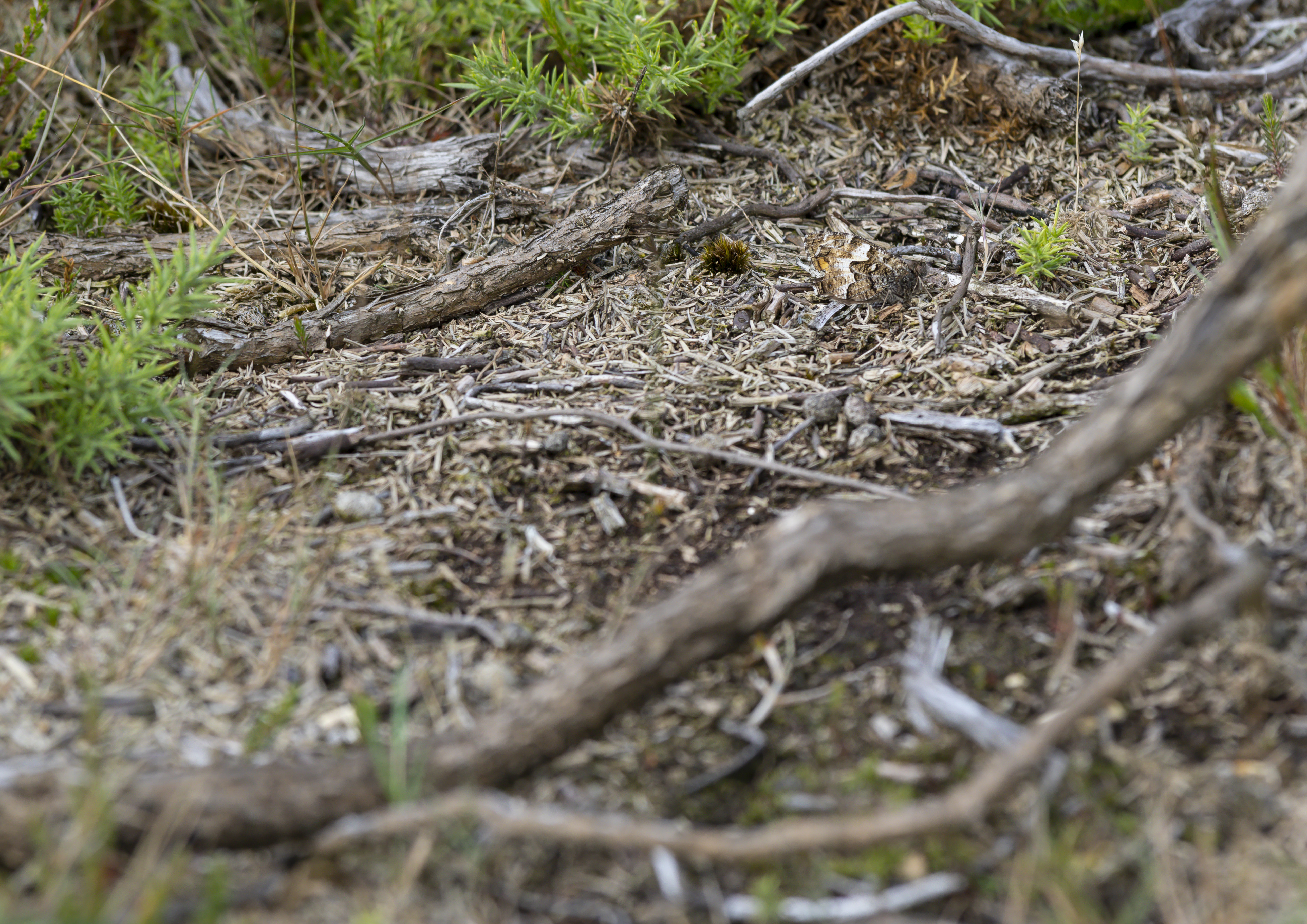
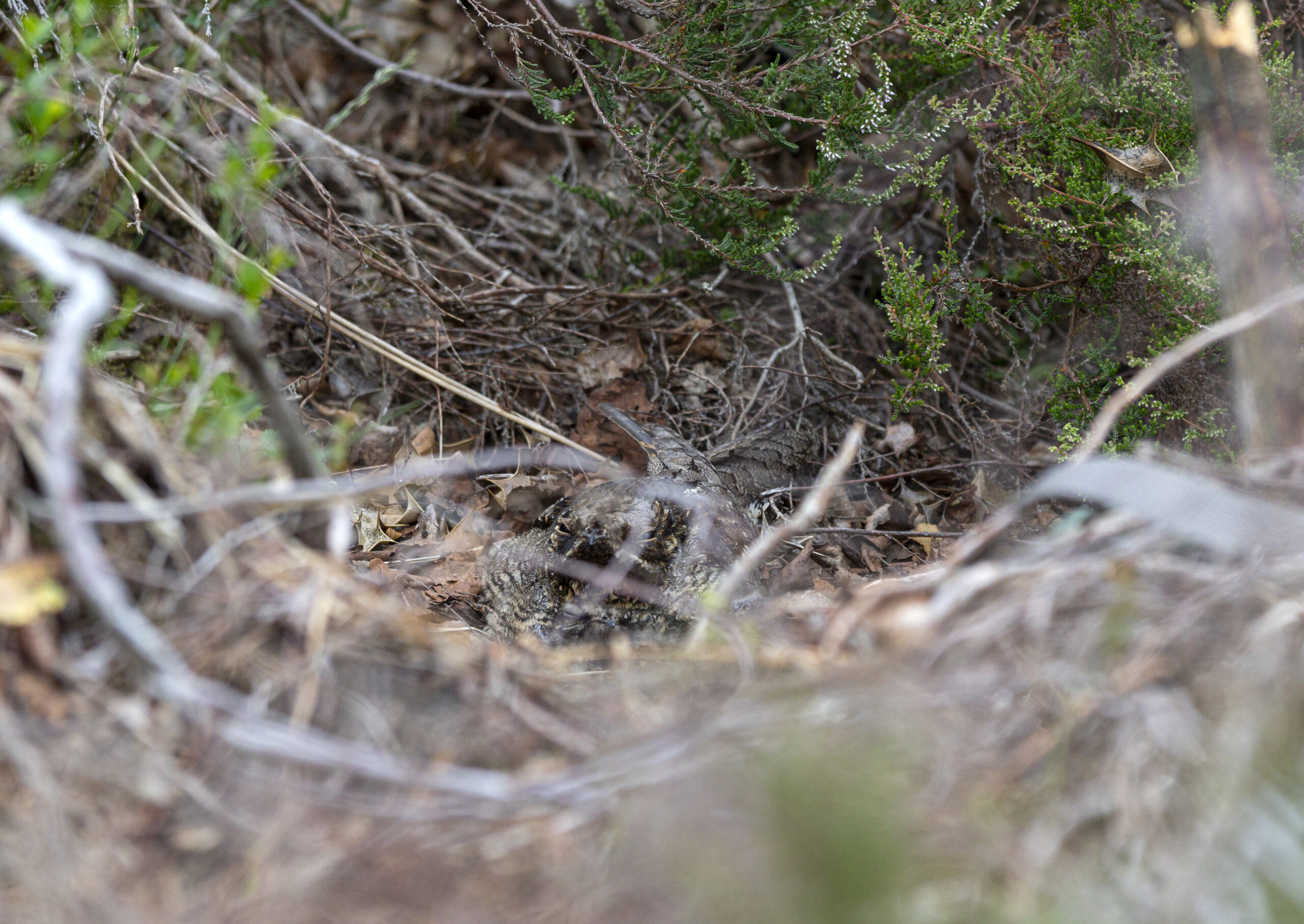
nesting nightjar

nesting nightjar

I could only see this particular bird because it had nested on some brown leaves which didn’t completely match its camouflage. I could sense that there was something there, some mismatch in the landscape, but it took me almost five minutes of looking before I finally understood that I was looking at a bird. Even then I got it the wrong way around, mistaking wing for head until the nightjar slightly opened one eye. I managed a quick photo, above, before retreating out of sight and checking to make sure that the bird had not been disturbed by my brief visit. Trust me, the photo makes the nightjar a whole lot easier to see than it is when you are simply walking through heathland. I could have walked over it without ever knowing it was there.

The nightjar is an unconventional bird in other ways as well. Its ‘song’ (usually only the male sings) is a fast, two-tone purring sound, like a cross between a contented cat and a Geiger counter in the centre of  Chernobyl.  It’s semi-nocturnal, hunting during late dusk and early dawn, right on the borders of night. It hunts for  insects, which it catches either by flying low over vegetation like a bat, or by launching, flycatcher-like, from its perch to grab them from the air. A ruthlessly efficient hunter, it does not normally need to hunt for long before retreating back its roost or nest. It is also improbably long-winged, so much so that on the ground its wings are crossed behind its back like an impatient tail-coated waiter (you can make them out in the photo), while in the air it has the shape of a kestrel with a thinner body. Like swallows, nightjars drink and bathe on the wing, and like swallows they migrate back to sub-Sarahan Africa after their three-month UK breeding season ends in August (swallows stay longer, but are perhaps at less risk of being trodden on).

So there you have it. The nightjar, a bird better camouflaged than an army sniper, that flies at night like an owl, sings like a radiation detector, hunts like a bat, looks like a kestrel and breeds like a swallow. I suspect it comes to the UK not because of our plentiful supply of insects, but because of our renowned love of the weird and eccentric.

Much later that day, I stood  on a woodland track as the last dregs of the light drained from the western sky. I heard a “kwi”call, like the opening notes of the call of a female Tawny Owl, which is the flight call of the Nightjar. Moments later a shape appeared,  nothing more than a silhouette against the blue-grey darkness. It was a male nightjar. Unafraid of me, it approached and circled me, no more than fifteen feet above my head, calling all the time. And then, as suddenly as it had appeared, it vanished again, disappearing silently into the darkness. The true master of illusion.


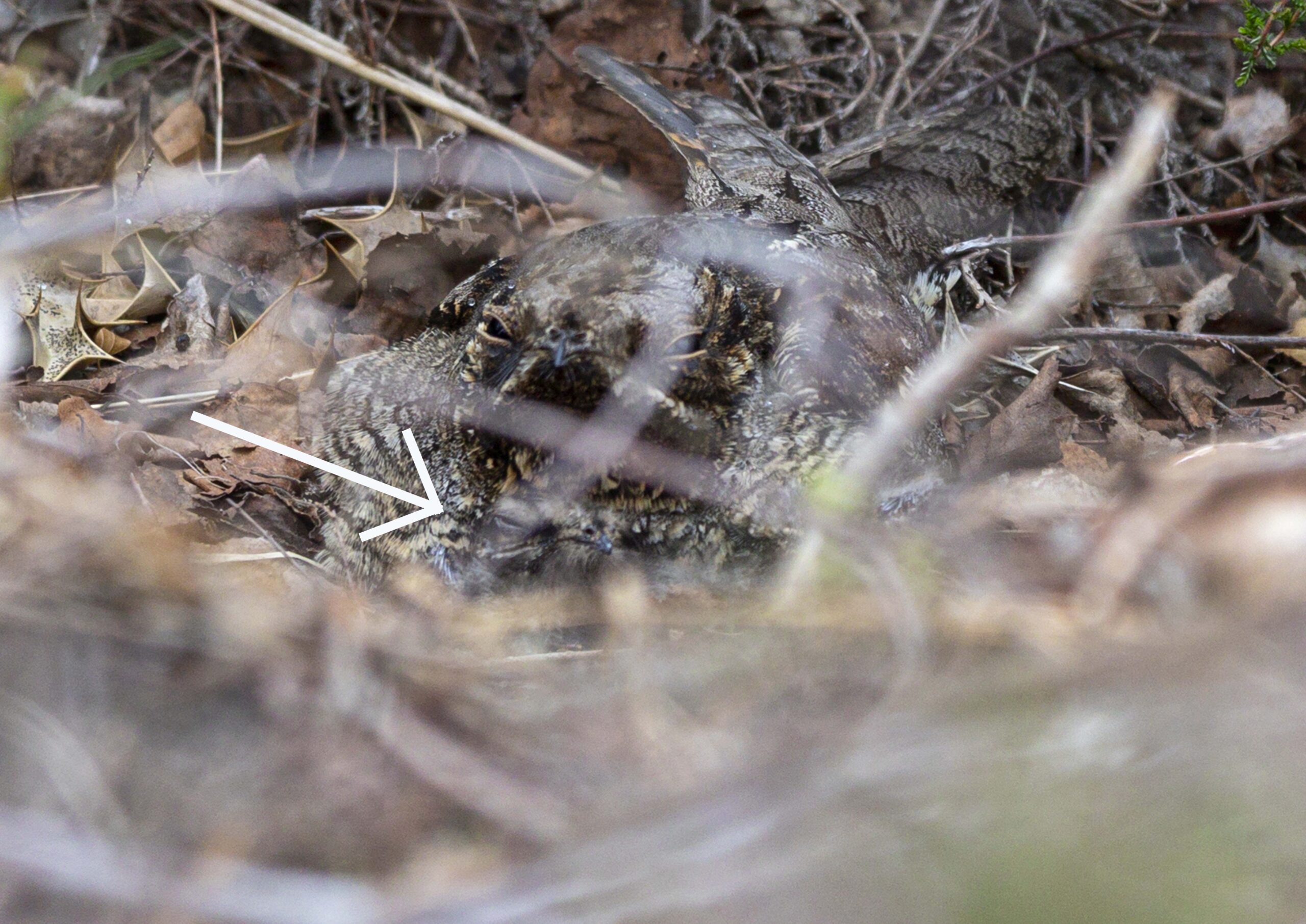
PS – and is if to prove my point, a friend who read the blog said “You do realise that you can clearly see a nightjar chick in the photo, don’t you?” I magnified the image, which I must have looked at a hundred times by now – and they were right. There, just below the female’s head, you can clearly see a chick. And I hadn’t spotted it.

nesting nightjar detail
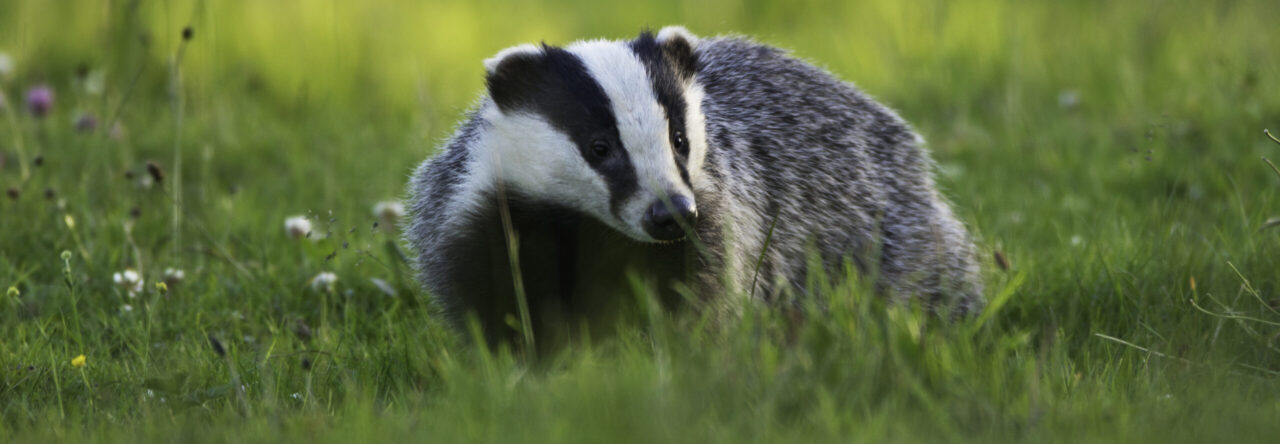
nesting nightjar detail


A case of mistaken identity?

I was at the Gloucestershire Wildlife Trust’s Coombe Hill reserve yesterday. It’s a top spot for Dragonflies, but unfortunately it seemed to lack the Whinchat  I’d hoped to see – or at least, they weren’t anywhere near the bits of the reserve I was. I’d had a close view of a beautiful sedge warbler singing, watched as a spotted flycatcher fed its young in the branches of a downed tree, and watched a bevy of green sandpiper being ever so slightly overawed by the arrival of a grey heron. They didn’t fly off, but did noticeable shuffle sideways to make room.

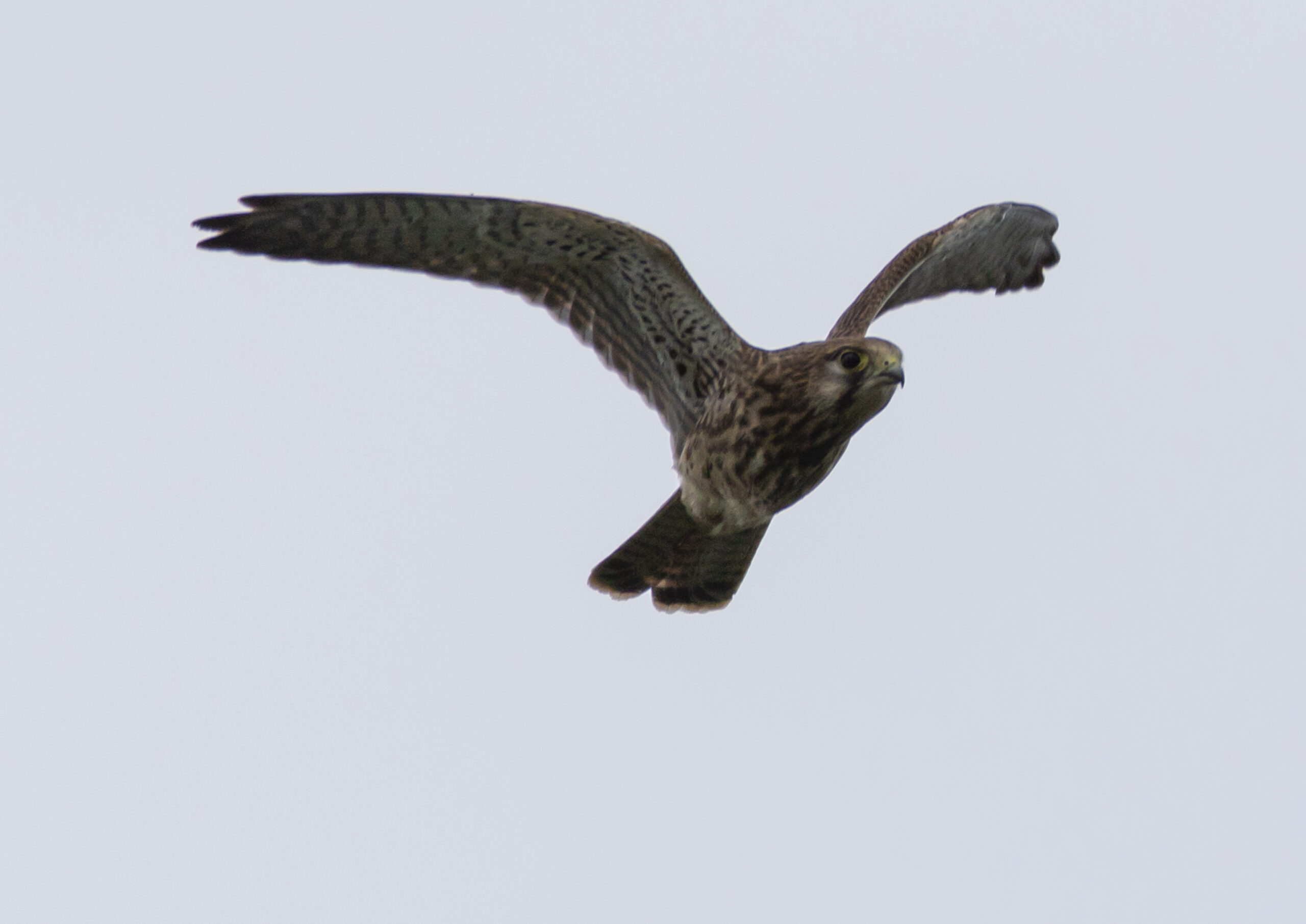
But the day’s best bit came just as I was leaving. It was early evening, and a clutch of swifts was circling, making the most of the small insects that rise into the air as evening starts to fall. But then they started mobbing another bird, flying alongside it en masse and diving at it. Now I have seen birds mobbed by others many times. I’ve watched red kites attacked by crows, fearful because the kites will eat their eggs and chicks. I’ve witched a kestrel attacked by peregrines to force it to release its prey. But I have never seen the serene swift do anything other than fly dazzling aerobatics looking for prey. The bird that had attracted their attention was a fairly large bird of prey. At first I thought it was a hobby, attracted by the plentiful dragonflies that are its main food. Perhaps the swifts had seen it taking things in the air and saw it as a threat? But as it got closer, I could see that it wasn’t a hobby. It was such a large bird that I thought it might be a peregrine. That would explain the swifts mobbing it, because a peregrine eats small birds and wouldn’t object to a meal of swift if it could catch such an aerobatic bird. But then the raptor flew right over my head, about thirty feet up. It wasn’t a hobby, or a peregrine. It was the largest female kestrel that I have ever seen. Female kestrels are larger than the males, but even so this bird was half as big again as any I’ve ever seen before.

I’ve wondered for many hours why swifts should mob a kestrel, a bird known much more as a hunter of small, ground-based prey. But then the penny dropped: this bird was so big that I thought it was a peregrine. Perhaps the swifts made the same mistake? Could this simply be a case of mistaken identity?

one very large kestrel

one very large kestrel


Page 1 of 6

Powered by WordPress & Theme by Anders Norén