Naturalist. Nature writer. Nature photographer.

Month: October 2020

Oh my. I think I’m a birder

For many years, there’s been a regular occurrence when I’ve been out walking. Someone has spotted my camera and said “Oh, you’re looking for birds, are you?” and I’ve had to explain that, like Russel from the Disney film ‘Up’, I’m actually a “friend to aaaaaaallll nature”, and not – most definitely not – a birder. I felt that the birder market was, to put it mildly, a bit overcrowded. Sadly, some of the birders I met were also unfriendly and showed little sign of caring about wildlife beyond getting a tick on a patch list. I was better off out of it.

But yesterday I met a woman near a gate in central Oxford. It was the gate to Port Meadow, a large grassy field that had substantially flooded in recent rains. It was my second visit to the site in a week, driving a sixty mile round trip each time, and I’d got up at six in the morning so that I could finish my day’s work in time to race there. I’d used my last two pound coins in the parking meter, and as I got out of my car it started to rain.

As I hefted my camera with a long lens on a tripod, the woman asked me what I was doing there.

“I’m looking for a duck”, I replied.

Understandably, she gave me a guarded look, the sort of look you give someone when you first suspect that they may be just a teensy, tiny bit deranged. The vast, 300-acre flooded expanse of Port Meadow behind me was teeming with literally hundreds of ducks and geese.

“What duck?” she asked.

“A Garganey”, I replied. I held my hands fourteen inches apart. “It’s about that big, and it looks almost exactly like most of the other ducks out there”.

“Is it rare?” she asked.

“Well, there’s only one of them out there,” I replied, adding “and even that one may have gone by now.”

Two hours later, the sun had finally gone for good behind a bank of thick grey cloud. I was standing in the flooded meadow, the water halfway up my wellies, and the water inside my wellies starting to rise from the pelting horizontal rain that had soaked the windward side of me and was trickling down my trousers, inside and out.  I’d looked carefully at duck after duck after duck after duck, assessing head streaks and the precise boldness of wings patterns, but the Garganey had indeed gone. I started my twenty-minute long, sodden walk back to my car, and halfway  there realised that at some point the waterproof cover had blown off my rucksack and that was now sodden, too. It was getting dark, I was bone-weary, and the cover was camouflage pattern so I had no chance whatsoever of finding it. But even so, I found myself debating whether it was worth trying to come back again at the weekend. And that’s when it hit me, so hard that I actually stopped in my tracks.

I was a birder.

Somehow, over the previous few months, an interest in seeing different species of bird had seeped into my bones. I’m still passionately interested in butterflies and dragonflies and snakes and mammals and plants, but somehow, the piece of the jigsaw that had always been missing had turned up. I realised that I now liked birds enough to travel miles and experience considerable discomfort to see them, something that has always been the case for me with the rest of Britain’s flora and fauna, but was never the case with birds. Now it is. I am a birder.

I still haven’t seen a Garganey, but tomorrow I’m supposed to be laying flooring in the main bedroom and instead of planning it I’m wondering if I can nip out around dawn to find a Ring Ouzel that’s been reported on a nearby hill. I’m definitely a birder now, but how long I get to live as one may depend entirely on how long my wife’s already badly stretched patience lasts…
The last wings of Autumn

A few weeks ago I posted (“A case of premature exclamation”) about another failure in my years-long search for the Common Hawker dragonfly.  I have driven many hundreds of miles and devoted a great many hours to the search and come up empty handed. But last week my wife and I went for a short week’s break to Northumberland, in the lands right next to the Scottish border. It’s a place we have both wanted to visit for some time, and it didn’t disappoint. It’s a stunningly beautiful landscape, full of castles, rolling hills and lovely coastal views.

As part of our visit, my wife with her usual patience agreed to com with me on a quick trip in search of the Common Hawker. We drove to Kielder water, the largest artificial lake in the UK, turned our backs on it, and slogged up the sides of the gentle valley that surrounds it. Remember, this is our only holiday in this very stressful year, we only have four days,  it’s early October and the previous day it had been cold and drizzly. It was also blowing a lively gale as the leading edges of the first named storm of the year starting to arrive. But rather than browsing antique shops or having a nice meal, my wife and I were climbing up a hillside that quickly turned into bog. We saw nothing – and unusually, I do mean nothing. Not a bird, not an animal, not an insect. We trudged on and on,  and the conversation started to droop, although the views were absolutely stunning. Eventually we reached our target, a deep pool the colour of stewed tea surrounded by a boardwalk of plastic planks topped with chicken wire. On one side, the depths gave way to shallows with mats of pond weed and reeds, and the whole site was surrounded by marshy ground and bracken. It was ideal dragonfly habitat, but there was not a dragonfly in sight.

I always knew it was going to be the longest of long shots. We were beyond the end of the normal flight season for the Common Hawker, which peaks in July and August and  tends to vanish around the third week in September. It had been cold and wet, and dragonflies like the sun. Weeks earlier, the pool would have been alive with the sound of clattering dragonfly wings, but all I could hear now was the keening of the wind through a nearby stand of pines. It was my wife’s idea to stop and eat lunch. The location was peaceful, we hadn’t seen another living soul, and it was well past lunchtime. I apologised to her for dragging her through the bog on another wild goose chase, but my wife, ever pragmatic and patient just said we should wait a while and see if anything turned up while we were eating.

And to my astonishment, it did.

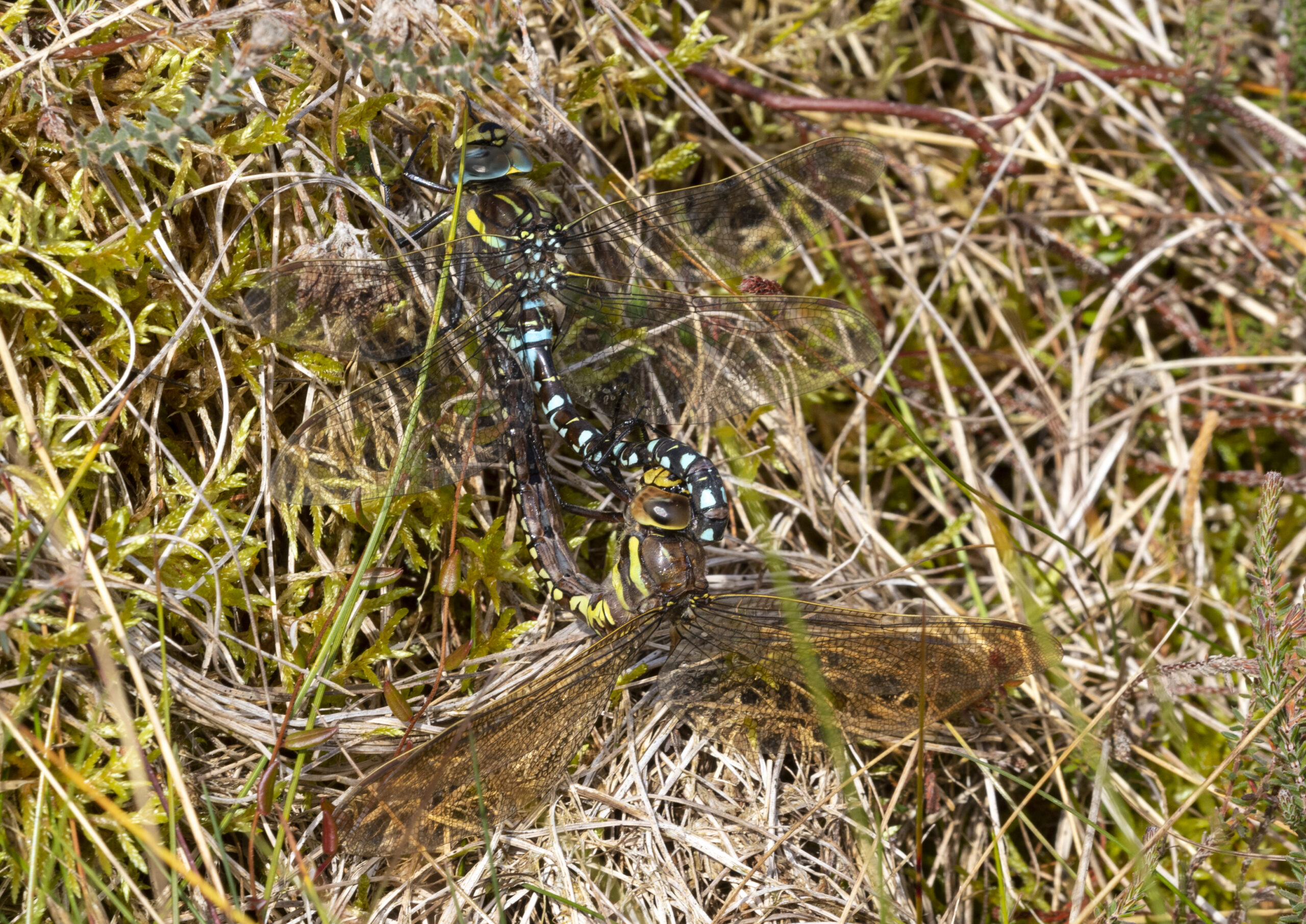
Twenty minutes later, the sun had brought the temperature up a little, and I saw a dragonfly on the pond. As always, I never saw how it got there – it just materialised. One moment there wasn’t a dragonfly, the next moment there was. Then there were two, and being dragonflies they immediately started fighting. I took a string of photos as the distant pair on the far side of the pond clattered into the water. And then, still locked together, they rose from the pond and disappeared behind a large,  brown and desiccated heather on the far side of the pool. I shouldered my camera and went to look for them. At first I missed them and walked right past them. Then I found them, low down amongst some grassy stems above a bed of sphagnum moss, and understood why they hadn’t immediately flown away when I neared them. They hadn’t been fighting. They were mating. I later looked at my photos and realised that the male had seized the female and dunked her in the peaty water, staining her normally clear wings brown. Holding a female underwater until she gives in is sadly a common tactic of male dragonflies who want to mate with a reluctant female. The two dragonflies hung together, the tip of her abdomen touching the place just below his thorax where a dragonfly’s penis lives. The wings each had a golden “costa” or leading edge of the wings. He had narrow shoulder stripes, she had none, and both had orangey-brown wing spots and eyes that…

Hang on. Yellow costa and orange wing spots?  I looked closer.

Eyes that are almost fused together – check. A noticeable waist on the male – check. Oh Lordy, Lordy. It seems that Common Hawkers are like busses: you wait three years for one and then two come along together.

So ladies and gentlemen, with more pleasure than I can possibly convey, I finally give you: the Common Hawker.

common hawkers mating

common hawkers matingWhat do you mean it looks like all the other dragonflies… ?


Powered by WordPress & Theme by Anders Norén