Naturalist. Nature writer. Nature photographer.

Month: September 2020

A short haul flight during lockdown that few people noticed

I went to Brighton yesterday. Why not? It was a sunny if windy day, one of a run of days of nice summery weather that would have been really appreciated during summer but was rather more annoying now that the schools have gone back. But if you live in the UK, wonky weather is the deal you sign up to.

But surprisingly for a 3-hour drive (lorry fire on the M25) to a seaside town, I wasn’t heading to the beach. I was heading to some hilly ground to the East of the town, to meet an old friend. I could seas the sea quite clearly, and it did look inviting until I reminded myself that this was September in Britain and the sea probably had pack ice floating in it (I may be exaggerating a touch).  So why was I here? I had come to try and see an insect, a butterfly, that might just be one of those European migrants trying to set up home in the UK, the difference here being that we don’t have warships trying to stop them. It’s the long-tailed blue butterfly.

I’ve seen the long-tailed blue butterfly before. In the carefreee, covid-free halcyon days of 2018, I jetted off to Minorca on holiday. Being the kind of person I am, it didn’t take many days of lying on a beach before my feet got twitchy and I set off inland with a camera hunting for wildlife. In the back of a town centre development near Cala Galdana, I found a patch of ground that had been bulldozed to make way for some building work that hadn’t happened. On  the back of the rubble-strewn site, some everlasting sweet peas had bloomed. And on the sweet peas, I found the long-tailed blue, butterfly sometimes called the “pea blue”. It’s a striking butterfly, with underwings chased in fine repeated fawn and white lines, like a doodle you would make on a boring phone call. The upperwings of the male are a deep, violet blue, but it is name for two short “tails” that project back from each wing, accompanied on the underside by two glittery eye-dots. What are they for? Nobody knows for sure, but it’s possible that they are a defence mechanism, a handy, disposable part of the butterfly’s wing that a pursuing predator can catch while the rest of the butterfly escapes. Or it may just be what counts as really sexy in butterfly world.

I arrived a a spot on the hills where the same everlasting sweet pes grows wild. There were perhaps a dozen plants, most finished for the year and faded, but one of which bore a fresh, neon pink bloom. Surprisingly, this plant seemed to hold no attraction for any butterflies at all, but on a nearby stand of faded blooms, I came face-to-face with my holiday romance. Nearly eight hundred miles and at least three countries away from where I’d last seen one, this was actually no foreign butterfly. Clean and crisp, this butterfly hadn’t flown the Channel: it’s parents had. The long-tailed blue can fly huge distances, crossing mountain ranges, and a hop across the Channel was nothing to it. It’s a born invader as remarkably, it can complete its entire life cycle, going from egg to caterpillar to chrysalis to butterfly in as little as four weeks in good weather. This long-tail was  born here, on this Brighton hillside, as British as I am. The test now will be whether any of these new citizens’ eggs will survive our winters to emerge next year. If they do, Britain will have acquired two more “native” species of butterfly in a single year.

So here are two long-tailed blues, in phots taken 800 miles apart. Can you tell the Spaniard from the Brit?
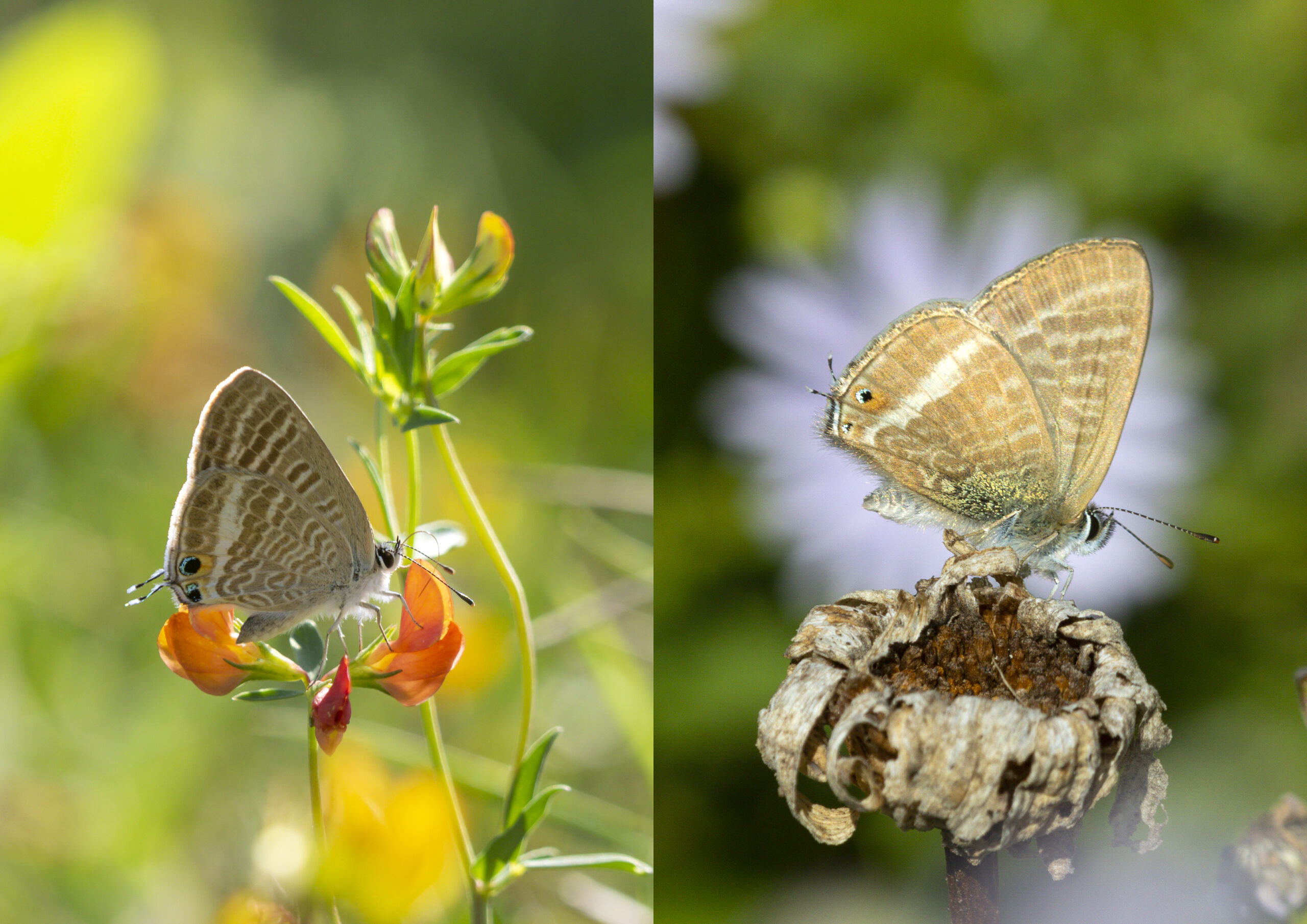
long tailed blues


A case of premature exclamation

For over a year now, I have been searching for a particular dragonfly. Irritatingly, its name – the “common hawker” -suggests it is easily found, but that couldn’t be further from the truth,and it’s actually quite scarce in the south of the UK. It’s a lover of pools which have acidic water, the kind that you find in pine forests and peat bogs, and those are in short supply near where I live. So I have travelled hundreds of miles to places offering the right habitat to try and find it. I have walked miles in the acidic bog areas of Somerset and the New Forest. I have been bitten and scratched, got water inside my welly, and seen… well, a brief glimpse of one would be a charitable answer, because I’m not even sure that the one I saw was a Common Hawker.

So this year, after lockdown ended, I had another go. I went to a place in Somerset with the delightful name of “Priddy Mineries” where the dragonfly has been seen. In fact, it’s was seen there about twenty minutes after  I left the site, empty-handed, last year.  Conditions weren’t ideal, as the leading edge of a storm front was crossing over, and it was very windy, and fairly overcast, conditions which are anathema to most dragonflies. But needs must, so off I went, driving along roads that were starting to become familiar, I’ve been to Priddy so often looking for things that turned out not to be there.

Now don’t get me wrong, Priddy is a fantastic place for wildlife of all stripes, and well worth a visit. But it’s not so pleasing when you’ve gone to find a particular insect and never seen it. I joined a few other dragonfly enthusiast at one of the prime dragonfly pools  (known as “odo-nutters”, after the family name for dragonflies, “Odonata”) and we watched and waited. One of my companions cheerfully informed me that he’d photographed one just the day before, right where I was standing. Of course, it had been sunnier then. And less windy.

After an hour or two, I decided to walk the nearby stands of bracken that were sheltered from the winds by tall pines. I found a dragonfly there – the black darter – that is uncommon if not rare. And then I saw it.

Zipping expertly in and out of the trees, up and down, like a ping-pong ball on the speakers at a Led Zeppelin concert, was a medium-sized dragonfly. It had the right kind of patter. It was in the right place. And then – miracle of miracles – it settled, something that Common Hawkers rarely do. It had settled on a piece of old heather, which Common Hawkers do on those rare occasions when they stop flying. Serendipity. Everything was coming together. But wait: what was this? It had settled right next to another that I hadn’t spotted. Male and female, side by side. An uncut diamond lying by the side of the road. A huge nugget found with the first strike of the shovel. The kind of story Odonutters tell each other on dark nights over a bottle of Fanta. I screamed aloud. I danced the kind of jig people with two replacement knees dance – a kind of rolling sideways shuffle, if you’re interested -and told passing strangers. I took photo after photo after photo until I couldn’t think of any more photos to take. I went home buzzing.

When I got home and looked at my pictures. They were lovely images of a two dragonflies side by side. Except they weren’t the Common Hawker. They were a pair of males of the almost-identical Migrant Hawker, far more common in the South. In my excitement, I’d made the classic error of all wildlife-watchers: seeing what I’d expected to see. It’s a mistake I’ve made before and will doubtless make again, but it was particularly galling this time.

I couldn’t face returning to Priddy, and the Common Hawker flight season ended before I could go anywhere else to look for it. Like so much of our wildlife, from the ephemeral butterflies and dragonflies to the migrant birds that visit us for a while and then leave, I would have to wait for another year for a chance to see it. So here to keep you entertained, is a nice shot of two Migrant Hawkers. I hope you enjoy it, because it’s all you’re getting until Summer 2021

Migrant hawkers

Migrant hawkers. Pah

Powered by WordPress & Theme by Anders Norén