Naturalist. Nature writer. Nature photographer.

Month: March 2019

A question of trust and respect

Fresh from my close encounter with Boar, a week later I went back in search of them. This time, I was fortunate enough not just to meet two females, but also their piglets, or “humbugs”. And these animals were sufficiently trusting to allow me, after a time, to sit quietly with them.

There are people who say that we should not disturb wildlife and so should never interact with them. To a large extent, I agree with that. But where human and animal treat each other with respect, where the animal is not made dependent on the human for contact, food or shelter, and where the encounter is always upon the wild animal’s terms – i.e. it can come and go, or send you away as it chooses, then I think it’s OK.  And so I was happy to sit quietly and respectfully and watch as a female boar suckled her young not fifteen feet from me, all the while fully aware that I was there. (A boar’s sense of smell is so acute that they would have known I was there if I was a hundred yards away, never mind five). I’ve had such encounters with wild animals many times now, with many different species. It is always a matter of respect and trust. Respect the animal, and all of its needs (including the need not to become so relaxed around people that it falls prey to the unscrupulous) and it may, just may, trust you back.
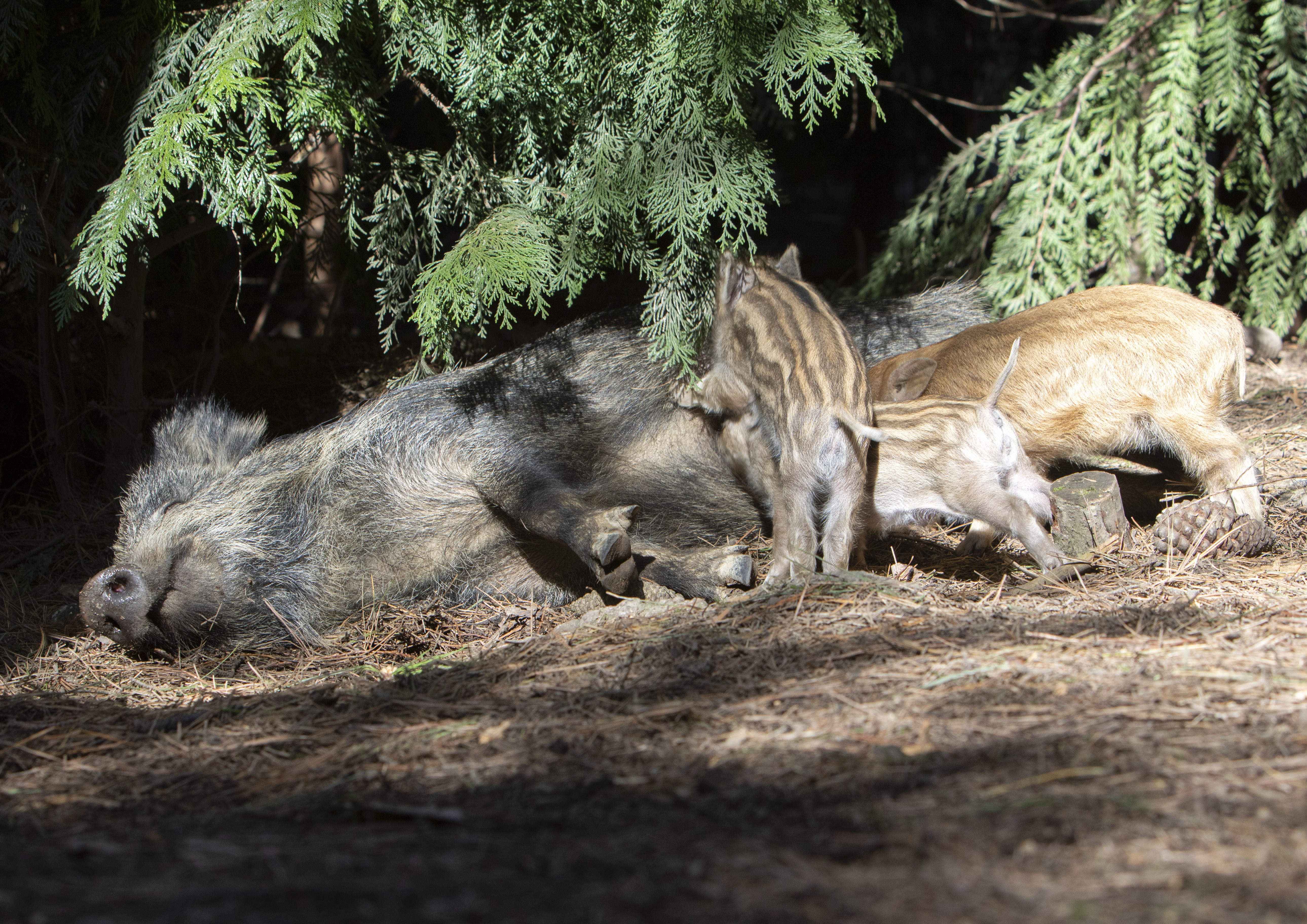
Boar Sow suckling

Boar Sow suckling

This sow was suckling two very different sizes of humbug, which makes me suspect that she has adopted the offspring of another female. The humbugs weren’t bothered by the arrangement. One good feed later and all were fast asleep in the sunshine. Had the ground not been so uncomfortable, I would have been as well.
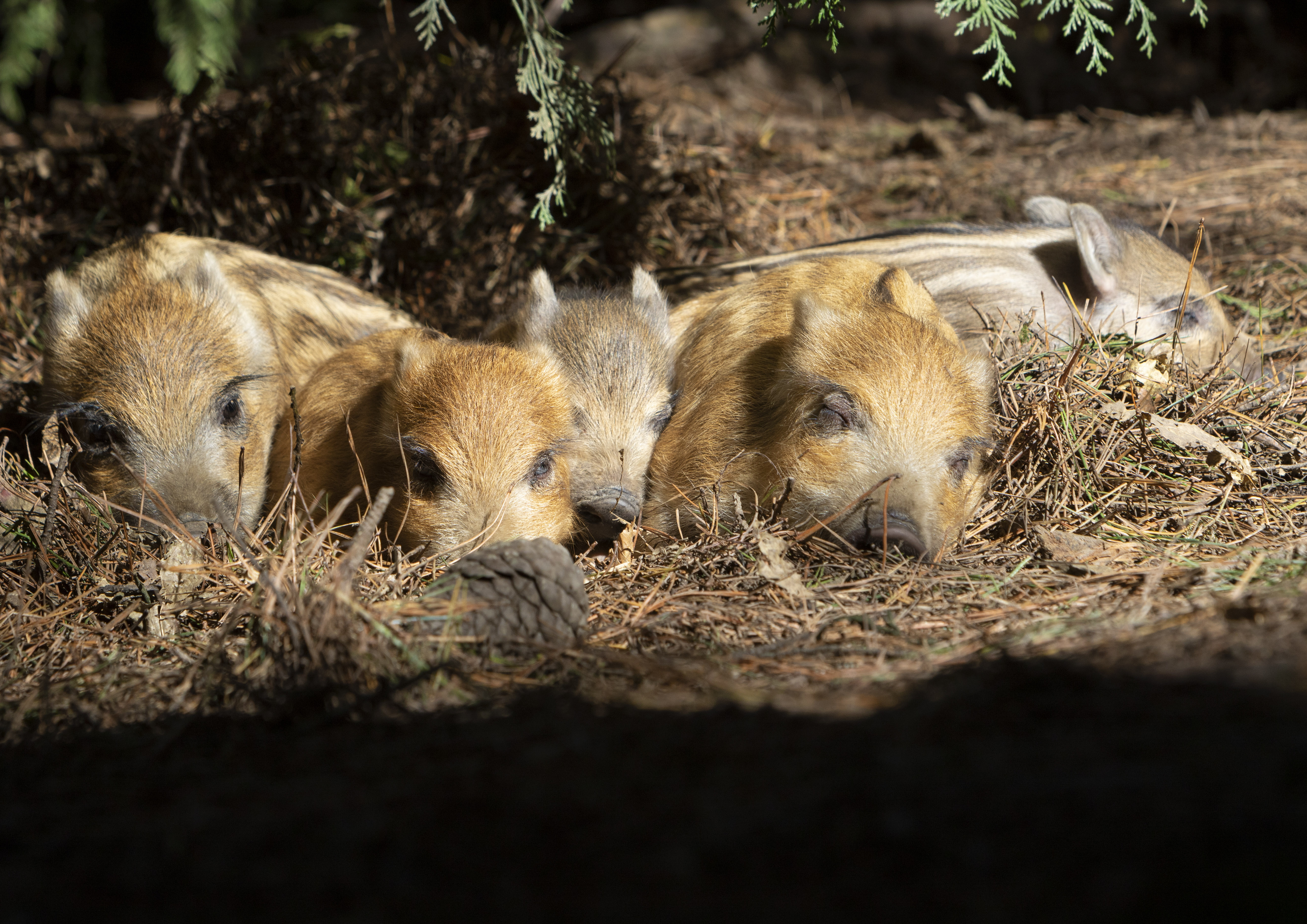
Sleepy piglets

Sleepy piglets

After several hours, I left the boar, largely because I had taken every photograph I could ever imagine. When I got home, I discovered that I’d clocked up some 2,500 images. Camera shutter units do wear out, and I’d probably taken a year off the life of my camera. But it was more than worth it to spend time with these animals. Ugly or beautiful, dangerous or cute  – that’s for you to decide, but I know where my vote lies.

humbugs at play

humbugs at play

Boared to death

I went to the Forest of Dean recently. Mainly, I was looking for adders again, and pleased to find a few in a second spot. Then I went looking for boar.

Now I understand that people have mixed feeling about boar, which are large, powerful animals. The impact they have on the Forest is evident – everywhere, there are signs of boar feeding, which they do by pushing their snouts into the ground and turning it over. But boar regularly get a rather hysterical press – the latest was, sadly, that otherwise reliable publication, The Times, which descended to a headline about “superboar” who were “rampaging” through the Forest.  Well, as I can attest, although with decent fieldcraft you can generally catch sight of boar, they certainly aren’t rampaging – unless that’s your term for animals which run away at the slightest hint of a human. Nor did I see a single one with a cape. (I’m sure there’s a joke in there somewhere, something to do with Flying pigs and “superboar” –  but as you’ll have gathered, there’s a reason I don’t do stand up comedy). They are often quite hard to find.


With the help of a local Forester who knows the woods like the back of his hand, I eventually found some boar. Indeed, together we eventually found three different sounders, all with young piglets, or “humbugs” as they are known. But then came the moment when a group comprising a female and two near-adult offspring came close. And then closer. And then really close. Was this to be the moment when these dangerous animals attacked me? Past blog entries flashed before my eyes.

wild boar selfie

“superboar” selfie

No. The boar simply ambled past us, on the hunt for what they actually eat- not people, but nuts and roots and worms. Two slowly faded into the undergrowth, but one followed the same trail as us, and as we emerged five minutes later onto one of the main forest tracks, this lone boar did so as well.  Twenty feet away was a woman out for a walk. She saw the boar, and her absolute terror was plain. She immediately grabbed a large stick with which to defend herself, while the boar, realising that it had got separated from its family, just stood and looked around,  faintly confused. I explained to the woman that the boar wouldn’t hurt her, and she gradually relaxed a little, but was still obviously and immensely relieved when the boar finally twigged it had taken a wrong turn and ambled back into the trees.

Of such small victories are battles won. This one woman now knows that, when treated with respect, boar aren’t the bloodthirsty and aggressive animals they are painted as being. Not so much “rampaging” through the forest as “wandering” through it. They can certainly be a nuisance. But a threat? Perhaps not.

Vanishing quickly from a place near you

I get it. I really do. Adders are not everyone’s cup of tea. My own wife is a little leery of snakes, and I don’t blame her. They don’t walk. They slither, in a silent, unnerving way.

Snakes could do with  a good PR agency. They certainly get bad press. Think of Kaa in the Jungle Book. And who was really to blame in the Garden of Eden? They are synonymous with Evil and nasty things that bite.

Female Adder

Female Adder

Adders in particular are unloved. Wrongly billed as Britain’s only venomous snake, they are feared even by people who have never seen one. Which may well be most people before long, as recent research shows that Adders, always good at vanishing into the undergrowth, are now disappearing from the country.

A recent report by Emma Gardner of the University of Reading, has revealed a catastrophic decline in Adder numbers. So what? I hear you ask? Well love or loathe them, Adders are a good indicator species. Where they thrive, wildlife in general is usually doing well. Where they aren’t, the area’s wildlife is usually impoverished. Their loss should be a concern to anyone who loves wildlife, scaly or otherwise.

One interesting fact revealed by the study is that, contrary to what you’d expect from a warmth-loving animal,  Adders emerge from hibernation earlier in the North than the South. It seems that even Northern Adders are tougher than their soft Southern counterparts.

More research is needed, but the report’s conclusion is that the biggest threat to Adders is unthinking human disturbance. Adders are, it seems, are just as easily upset by people as people are by Adders. So perhaps it’s time that we each gave the other a bit of space, and left these magnificent animals alone.

You can read the full text of Emma’s study, for free, by following the links from here:

https://www.reading.ac.uk/news-and-events/releases/PR794608.aspx

The Owl and the pussycat

I have a very cute cat. In fact, I have two. They are adorable, cuddly grey tabbies. They are extremely placid – you pick them up, turn them upside-down and tickle their tummies. And one of them is raving psychopath. Despite being extremely well fed, Bramble goes out into the neighbourhood and delivers a steady stream of dead and dying wildlife to my feet. When I’m not chasing traumatised mice around the bedroom, I’m impressed by just how efficient a predator he is. He spends 80 percent of his life asleep, 19.99% begging for food, stealing food and trying to steal food, and 0.001% being utterly lethal to small mammals. I saw him outside the other evening and realised that in the dark, my tabby just disappears. His random stripes break up his outline, and make it exceptionally hard to see him, except when, as in this case, he’s sat under a streetlight.

I was struck by the similarities while looking for Short-eared Owls recently. We have a pair flying around Barbury Castle in Wiltshire at the moment, and I cajoled my wife into coming to see them with me. I told her how rare they are, what excellent fliers they are, what a privilege they are to see. Except we didn’t. After two hours in which we saw exactly no owls, we went home. So I was surprised when my wife again agreed to join me owl-hunting again the following evening. After another hour of nothing, we were on the verge of going home when the owls finally turned up. They are large birds, perhaps the size of a chubby seagull, with the same flat faces that Barn Owls have – as if their fronts have been sawn off. And just like my cat, they have a wonderful set of tabby stripes running their length. That’s a rather curious thing until you know a little more about these magnificent birds

Short-eared Owl, Barbury Castle

Short-eared Owl, Barbury Castle

Barn Owls have the same flat faces as Short-eared Owls, and for the same reason. Both species hunt voles. The flat face acts like a parabolic reflector, channelling the faintest of  sounds of scuttling vole towards their ears. Like the barn Owl, this gives Shorties excellent hearing. But unlike Barn Owls, Shorties have huge yellow eyes. Why?  The answer is that like the Little Owl, these owls often fly in daylight.  They are “crepuscular”  hunters, hunting mainly in that wonderful  time of half-light just before and after the sun sets or rise. It’s very much a  time for specialists. Vision-led hunters like Kestrels struggle as the light is dim and the landscape is overlaid with long shadows. Sound-led hunters like the Barn Owl struggle with the wind that blows around sunrise and sunset, and the noise of human traffic. But the Shortie, combining the best of both worlds, manages just fine.

But there’s another oddity. The Night-flying Barn Owl is an ivory – white colour. But just as with Bramble, the Shorties these stripes serve as camouflage. So why does an Owl need camouflage? The answer is not to allow it to hunt, but to stop it being hunted itself. Shorties nest, and often roost, on the ground. They love a patch with tussocks of long grass whose tops have dried – which is exactly what their superb camouflage lens into. So here is an Owl that flies during the day, sleeps on the ground, and has the keen eyes of a Peregrine married with the keen ears of a Barn Owl. And while they are ferocious and successful predators;  just like my cat Bramble, I think they are rather cute.

Powered by WordPress & Theme by Anders Norén