Naturalist. Nature writer. Nature photographer.

Month: December 2020

The God of small things

A break in walking and blogging due to the pressures of a family illness and several weeks of interminably grey weather saw me champing at the bit to get out of doors again. Now don’t get me wrong: I like a bit of  bad weather. I’m a fan of the Scandinavian edict that there is no such thing as the wrong weather, just the wrong clothing. But grey weather, that kind that floats an almost invisible drizzle in the air day after day just seems to sap the fun out of life. So I was delighted this morning to find a light dusting of snow on the ground when I pulled the curtains back. Light snow is an almost perfect weather condition in my book. It’s bright and cheery, with all of the reflected brightness and cleanliness of a snowfall, whilst having none of the wheel-spinning, train-delaying, sock-soaking, frost-biting coldness that a deep snowfall brings.  It allows the small child in me to engage fully, without the sombre adult in me tutting somewhere in the background. I even got to engage the four-wheel-drive setting on my car. It probably wasn’t needed, but as I specifically bought a four wheel drive vehicle after the “beast from the East” in 2018, there was a sense that I could finally turn to my wife and say “See! I told you needed it!” Man the Smug, the next evolutionary step after Homo Purchase Indecision.

This morning I went up to Barbury Castle.  It sits high up on the Wiltshire Ridgeway,  and its elevation means that it frequently gets a little more snow than we do lower down. On this day, it made the difference between the light dusting of icing sugar in my back garden, and the demented-baker-throwing-flour-around that appeared as I arrived at the Castle. I was hoping to get a photograph of a Stonechat, a small bird looks very much like a Robin: it’s a similar size, and has a similar red breast, although nowhere near as intense and deep a red as that of a Robin. I was really hoping to get a photograph of a Stonechat on something covered in snow, thinking it would make a nice image for next year’s Christmas card. Stonechats often perch on fence posts, so I went to a spot where I knew Stonechats frequently hang around which was adorned with snow-covered fence posts, and waited. And waited. The sun came out. A million dogwalkers, part of the . And then, perhaps an hour after I first arrived, a beautiful female stonechat finally turned up. In the manner of Stonechats, she hopped down to the ground to forage between the bent-over stems of bleached grasses, each accompanied by a miniature snowdrift on its leeward side, then hopped back up to the fence line. Ground, fence wire. Ground, fence wire. She diligently hopped her way along a hundred yards of fence without ever once stopping on a snowy fence post. I had also left my gloves behind in my rush this morning, so my hands were freezing and I was fed up. I I was just about to scream when a passing couple asked me if I’d seen anything good today.

“Not a …”

I stopped. It was  beautiful sunny morning. I was outside. The cold wind that was making my hands ache was also reminding that I was alive and well and able to see this day.  I had watched a bird which, while not rare or endangered, is still one that few people would recognise. There was snow on the ground, and people were out enjoying themselves. Perhaps it was time to remind myself to value the small things in life, the small pleasures that we can so easily take for granted, like health, and wildlife, and blue skies and sun shining on snow.

Half an hour later, most of the snow had gone, but my stonechat found a small puddle of it on top of a post and stood in it. A pair of red kites drifted over the escarpment, startling a hare, which lolloped off downhill at breakneck speed, disappearing into a woodland a quarter-mile away. A kestrel lofted, wings slowly beating until it dropped unseen on something small, one life exchanged for another. I met (at a very respectful distance) a friend I hadn’t seen for months. I watched an unexpected flock of linnets – now that is a rare bird – dance over me. Eventually the skies darkened, sleet started to fall,  and I turned for home, but not before I said a prayer of thanks for the God of small things, of small mercies and small successes and small kindnesses and, yes, even small birds.
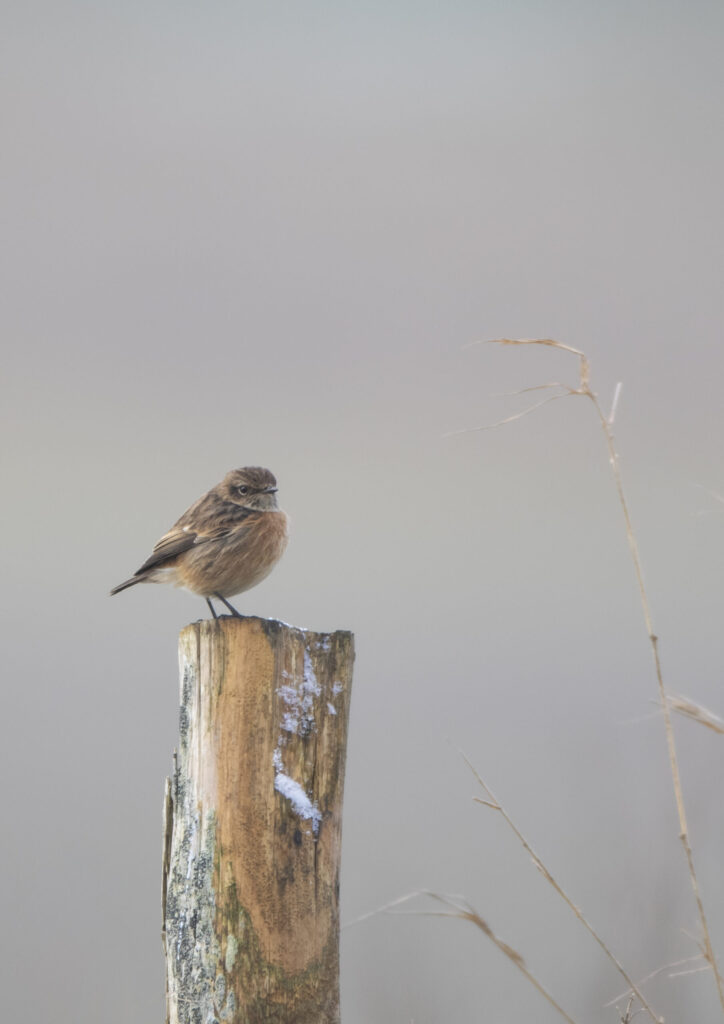
stonechat
stonechat

A tale of the unexpected

For weeks now, my wife and I have taken to walking every morning before we start work, not so much from a lockdown “permitted daily exercise” perspective as from a lockdown “stomach needs resizing” one. We walk a few different routes, but my favourite is down to our local lake. I like it because if we get a nice sunrise the waters reflect it, which is always cheering when all that the rest of the day holds is work. But mainly I like it because there is the chance to spot some wildlife. In my relentless drive to see the rare and exotic away from my home, I’ve tended to overlook the value of the space around my home, on the borders of a spreading housing estate. The folly of that has been slowly brought home to me over the last few weeks. Several lockdown walks have brought my wife and I  close encounters with a Kingfisher, often as a dazzlingly blue rocket streaking along barely a wing’s length above the water, but on one morning walk recently, we strolled down to the edge of the lake to look at it, only to be surprised by the Kingfisher as he plopped down from a branch just a few feet away, and hurtled off bearing a small, wriggling fish in his beak.  On another walk, we treated to a furious display of indignant piping as a pair of Kingfishers, cruelly out of sight around the curve of a thick bush, battled for ownership of the lake’s prime fishing. One friend, who has watched them for years and can identify them individually by bent feathers and broken beak-tips, told me that the fighting  pair were Father and Son. The Father is more than four years old. That’s far from a record for  Kingfisher, but is twice the average two-year lifespan. The following day’s walk we saw no sign of Kingfisher, but a Little Egret and a Grey Wagtail occupied the small stream that feeds the lake. A day later, a buzzard scraped the low, grey sky overhead. But two days later came a sighting that made me literally dance a little jig of joy, like a kid who just got his dream present at Christmas.

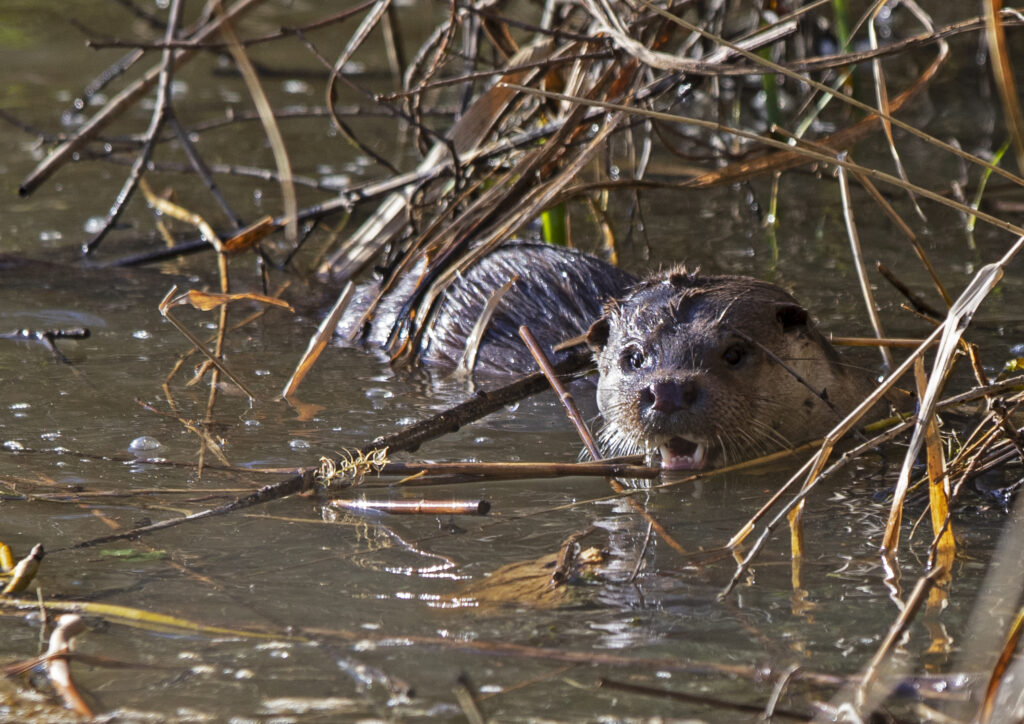
It’s always an effort to emerge in the mornings, particularly when it’s cold and wet. This day was both, clad in a freezing fog that apparently liked the town so much that it stayed all day. Spectral trees faded into the background and the moisture gathered  on my eyelashes as I walked until I was blinking tears. The footpath gradually faded into grey, lit by streetlamps that from a distance seemed to be globes of light hanging unsupported in the air. It wasn’t a day where I had high expectations of seeing anything, let alone any wildlife: even the usual dog-walkers seemed absent. My wife and I walked down the path, crossed under the main road, and emerged out near to the small curved weir that holds back the lake’s waters. Across the lake, grey water faded into grey sky, as if some slovenly painter had forgotten to add a horizon. A small movement caught my eye, and there it was. A crisp wake, as though a sharp knife was cleaving the water in two, was spearing out from the bank, b purposeful and powerful, a torpedo fired aimed towards one of the small islands that dot the lake. I was pretty sure what it was the second that I saw it, but then it dove into the water, a long, slick back arching gracefully downwards, followed by a small flip of a powerful tail. I was less than a quarter-mile from my home, watching a wild otter.

I have been privileged to see otters many times. I have watched a mother otter groom her kitt’s fur just yards from me, and once saw an entire family group of five otters at the same time. This distant glimpse was, in many ways, nothing special for me. But it was special for me, because this otter was on my doorstep. I have lived near this lake for almost thirty years, and watched it gradually transform from bulldozed mud and optimistic saplings into a habitat, punctuation in a chapter of houses and more houses  and more houses that is still being written. This is my space, my community, my local patch. My otter.

And there it is. Not the answer to all of the woes that face the natural world in our far from sufficient husbandry, but perhaps one of the many tools we will need to fix it. I cared about this otter because it was, in its own way, part of my community. A neighbour, of sorts. Perhaps if we could all feel that way, the world might become, in a small way, a better place.

Powered by WordPress & Theme by Anders Norén