Naturalist. Nature writer. Nature photographer.

Author: admin Page 4 of 8

The master of illusion

One of the things I loved about the Harry Potter books was Harry’s invisibility cloak.  I really liked the idea of being able to sit somewhere and have the world pass me me by without anyone or anything knowing that I was there. But while Harry’s cloak is fictional, the power of invisibility is all too real. Camouflage is a pattern which breaks up the shape and outline of something, making it harder to see. I use it myself quite often. Wearing camouflage clothing that makes me look more like a bush and less like a human being, means that wildlife will often come much closer to me than it would otherwise.  On a few occasions, even people have walked right past me, unaware that I am there.

But in the no-rules contest-to-the-death that is the reality of life for every living thing except humans, invisibility can be literally a matter of life and death. Take the grayling butterfly, for example. Like all butterflies, it’s high on the snack list for a vast range of predators, everything from the familiar sparrow and bluetit to  sophisticated aerial hunters like dragonflies and flycatchers (who contrary to their name, will happily take butterflies as well). The grayling likes places with grey rocks, or areas of heathland, those spaces of patchy gorse and low-growing heather, typically dotted with stunted birches or stands of pines. Heathland is typically littered with the  bleached and weathered remnants of old bits of heather. It’s a background that is naturally confusing, full of random lines, making shapes hard to see. The grayling butterfly has a cryptic  camouflage on its closed wings that makes it blend almost perfectly in with its background. There’s a grayling in the shot below, which was taken on Greenham Common. It’s actually easier to see in this shot than in most of the ones I took.
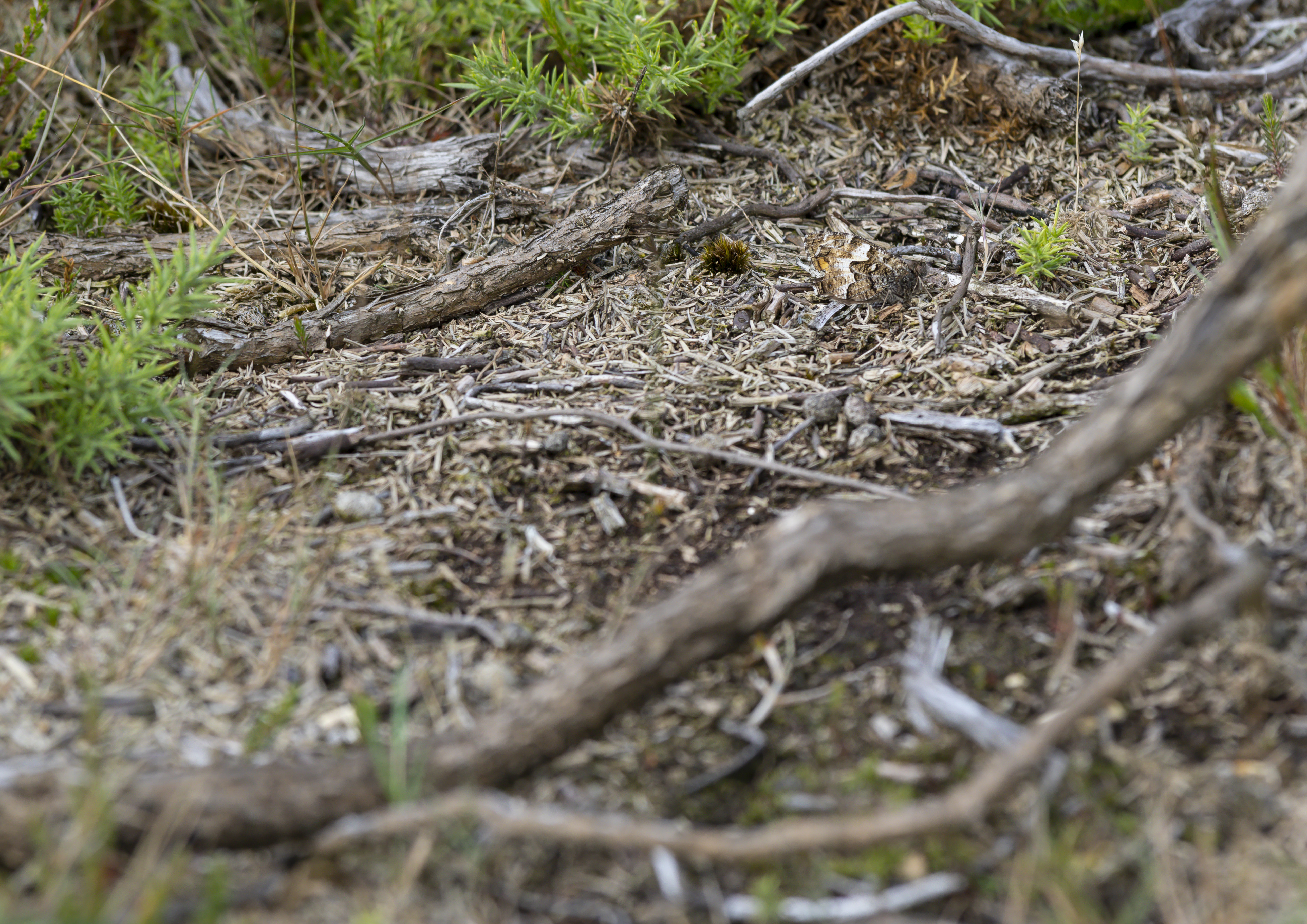
Spot the Grayling!

Spot the Grayling!

For prey species, evolution ruthlessly weeds out weak or ineffective camouflage. If you get seen, you get eaten, so those species which rely on camouflage as their only means of defence can be extremely hard to see.  Which means it was a privilege recently to manage to see – in every sense  – a bird that I have long wanted to see, one which takes this art of camouflage to a whole new level. It’s the Bird Who Is Not There. It’s the nightjar.

Like the grayling, the nightjar likes heathland, or clear felled areas of pine forest. It’s a ground-nester, so very much at risk from foxes and other predators. But the nightjar has developed camouflage so stunningly perfect that even its eyelids are painted – it will typically watch you with its eyes almost completely closed, in the way I used to watch horror films as a kid. From above, it looks exactly like  a pile of old heather or dried leaves. From the side it’s a bit of stick, or a growth on a tree branch. I have had the experience with adders, whose camouflage is orders of magnitude more rudimentary, of looking at them, looking away, and then not being able to find them again. With the nightjar, I looked away, looked back, and would have bet my life that there was no bird there at all.
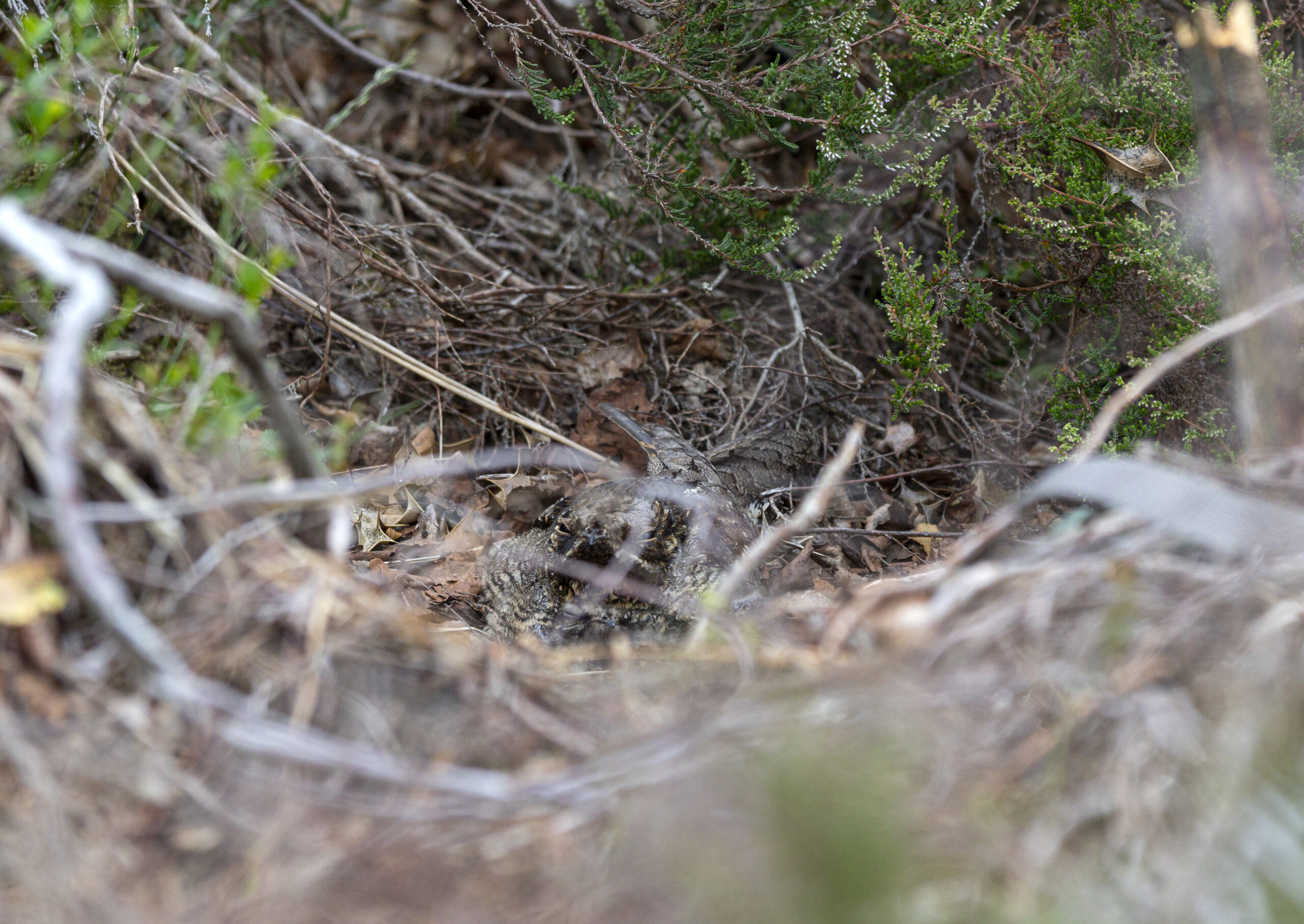
nesting nightjar

nesting nightjar

I could only see this particular bird because it had nested on some brown leaves which didn’t completely match its camouflage. I could sense that there was something there, some mismatch in the landscape, but it took me almost five minutes of looking before I finally understood that I was looking at a bird. Even then I got it the wrong way around, mistaking wing for head until the nightjar slightly opened one eye. I managed a quick photo, above, before retreating out of sight and checking to make sure that the bird had not been disturbed by my brief visit. Trust me, the photo makes the nightjar a whole lot easier to see than it is when you are simply walking through heathland. I could have walked over it without ever knowing it was there.

The nightjar is an unconventional bird in other ways as well. Its ‘song’ (usually only the male sings) is a fast, two-tone purring sound, like a cross between a contented cat and a Geiger counter in the centre of  Chernobyl.  It’s semi-nocturnal, hunting during late dusk and early dawn, right on the borders of night. It hunts for  insects, which it catches either by flying low over vegetation like a bat, or by launching, flycatcher-like, from its perch to grab them from the air. A ruthlessly efficient hunter, it does not normally need to hunt for long before retreating back its roost or nest. It is also improbably long-winged, so much so that on the ground its wings are crossed behind its back like an impatient tail-coated waiter (you can make them out in the photo), while in the air it has the shape of a kestrel with a thinner body. Like swallows, nightjars drink and bathe on the wing, and like swallows they migrate back to sub-Sarahan Africa after their three-month UK breeding season ends in August (swallows stay longer, but are perhaps at less risk of being trodden on).

So there you have it. The nightjar, a bird better camouflaged than an army sniper, that flies at night like an owl, sings like a radiation detector, hunts like a bat, looks like a kestrel and breeds like a swallow. I suspect it comes to the UK not because of our plentiful supply of insects, but because of our renowned love of the weird and eccentric.

Much later that day, I stood  on a woodland track as the last dregs of the light drained from the western sky. I heard a “kwi”call, like the opening notes of the call of a female Tawny Owl, which is the flight call of the Nightjar. Moments later a shape appeared,  nothing more than a silhouette against the blue-grey darkness. It was a male nightjar. Unafraid of me, it approached and circled me, no more than fifteen feet above my head, calling all the time. And then, as suddenly as it had appeared, it vanished again, disappearing silently into the darkness. The true master of illusion.


PS – and is if to prove my point, a friend who read the blog said “You do realise that you can clearly see a nightjar chick in the photo, don’t you?” I magnified the image, which I must have looked at a hundred times by now – and they were right. There, just below the female’s head, you can clearly see a chick. And I hadn’t spotted it.
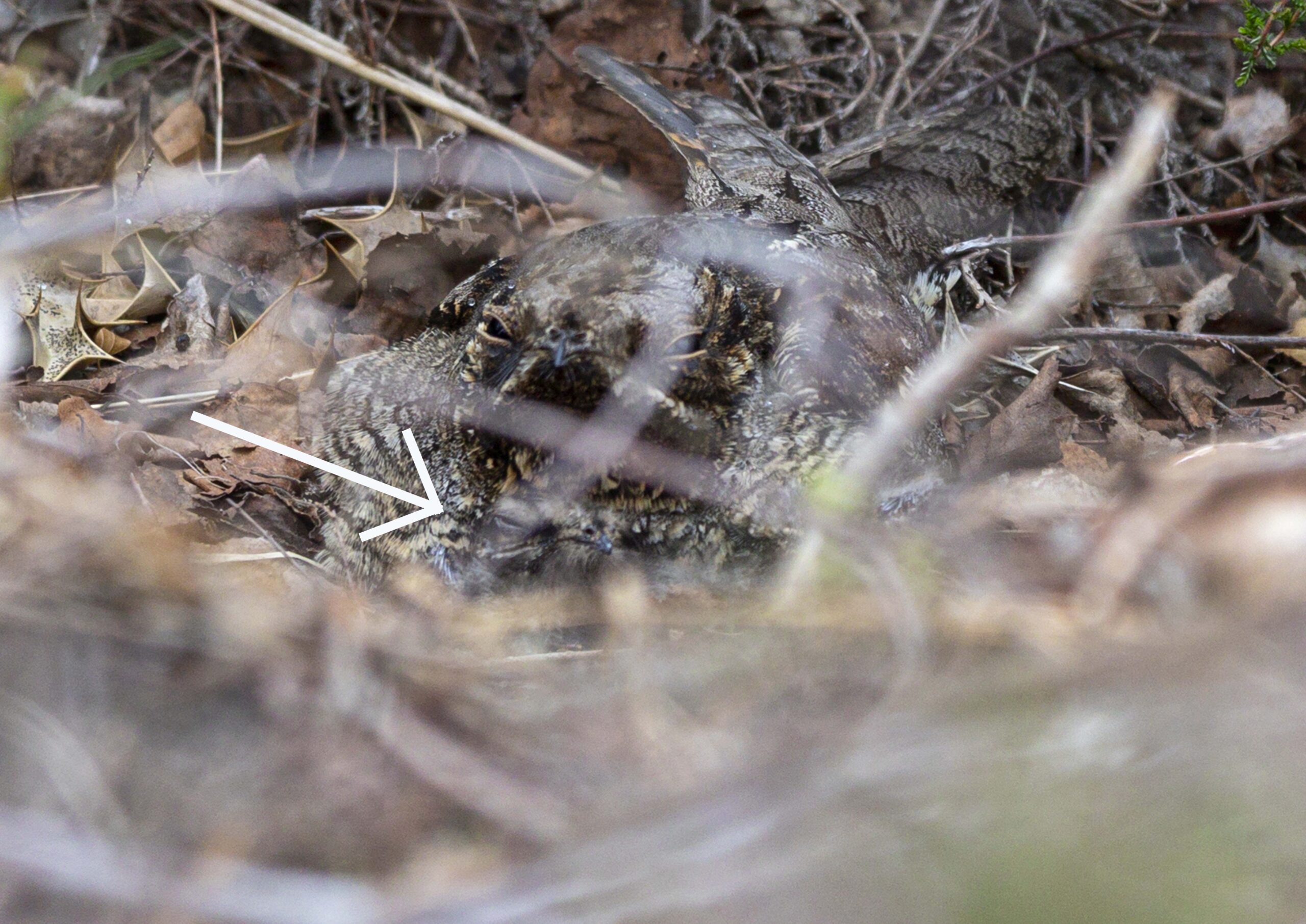
nesting nightjar detail
nesting nightjar detail


A case of mistaken identity?

I was at the Gloucestershire Wildlife Trust’s Coombe Hill reserve yesterday. It’s a top spot for Dragonflies, but unfortunately it seemed to lack the Whinchat  I’d hoped to see – or at least, they weren’t anywhere near the bits of the reserve I was. I’d had a close view of a beautiful sedge warbler singing, watched as a spotted flycatcher fed its young in the branches of a downed tree, and watched a bevy of green sandpiper being ever so slightly overawed by the arrival of a grey heron. They didn’t fly off, but did noticeable shuffle sideways to make room.

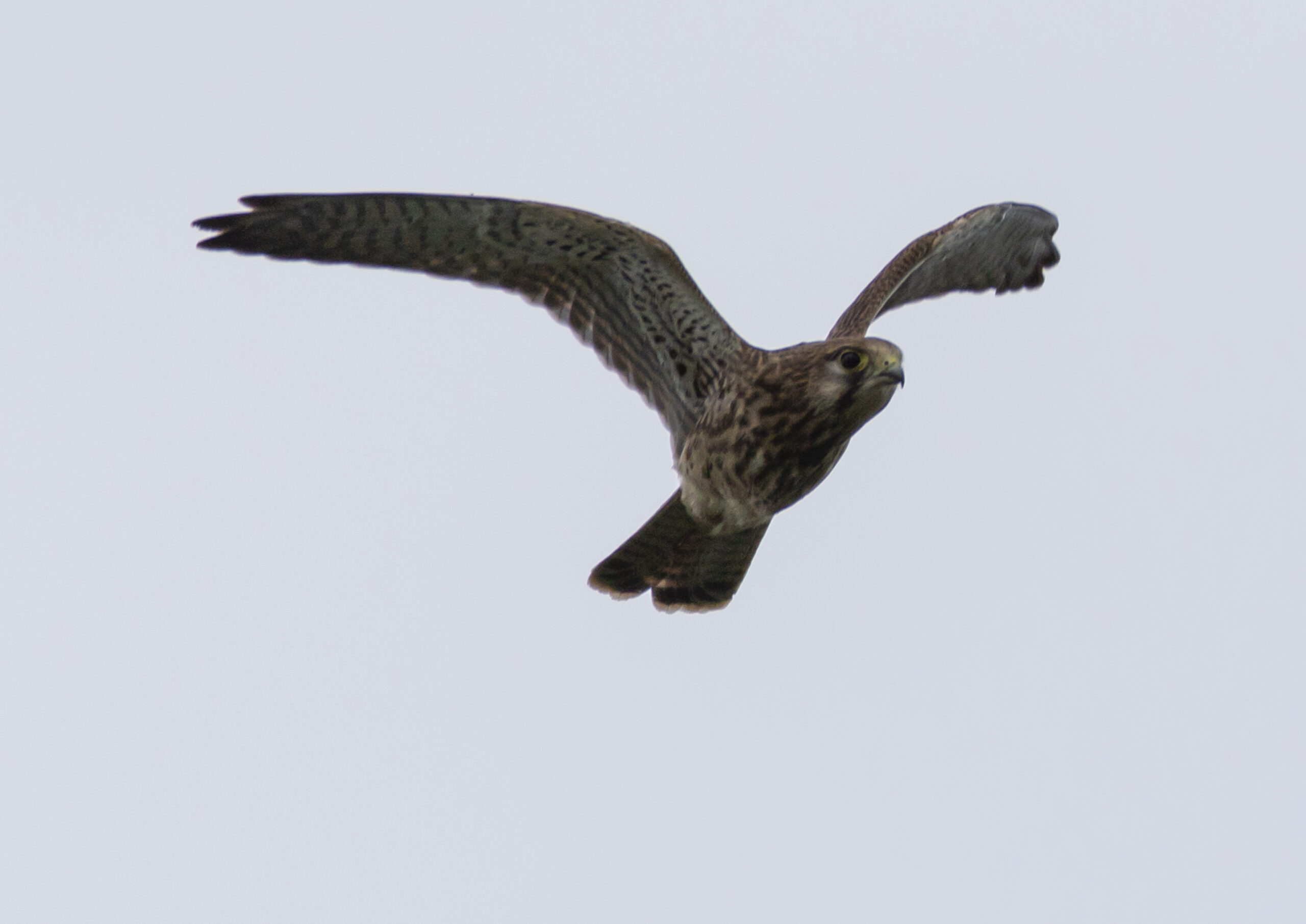
But the day’s best bit came just as I was leaving. It was early evening, and a clutch of swifts was circling, making the most of the small insects that rise into the air as evening starts to fall. But then they started mobbing another bird, flying alongside it en masse and diving at it. Now I have seen birds mobbed by others many times. I’ve watched red kites attacked by crows, fearful because the kites will eat their eggs and chicks. I’ve witched a kestrel attacked by peregrines to force it to release its prey. But I have never seen the serene swift do anything other than fly dazzling aerobatics looking for prey. The bird that had attracted their attention was a fairly large bird of prey. At first I thought it was a hobby, attracted by the plentiful dragonflies that are its main food. Perhaps the swifts had seen it taking things in the air and saw it as a threat? But as it got closer, I could see that it wasn’t a hobby. It was such a large bird that I thought it might be a peregrine. That would explain the swifts mobbing it, because a peregrine eats small birds and wouldn’t object to a meal of swift if it could catch such an aerobatic bird. But then the raptor flew right over my head, about thirty feet up. It wasn’t a hobby, or a peregrine. It was the largest female kestrel that I have ever seen. Female kestrels are larger than the males, but even so this bird was half as big again as any I’ve ever seen before.

I’ve wondered for many hours why swifts should mob a kestrel, a bird known much more as a hunter of small, ground-based prey. But then the penny dropped: this bird was so big that I thought it was a peregrine. Perhaps the swifts made the same mistake? Could this simply be a case of mistaken identity?

one very large kestrel

one very large kestrel


Not so tough, after all

This last week I went on a  trip to Cumbria, in search of “Britain’s only alpine butterfly”, the Mountain Ringlet.  This small butterfly is adapted for the colder, harsher climates at altitude, having a hairy body and wings, and flies in tiny colonies at altitudes (in England) from 350m upwards. It can be remarkably hard to see because each colony flies only for a few days, the timing o which varies, and it only flies in still, sunny weather – a rarity at these altitudes.

So it was with much more hope than expectation that I set off up Irton Fell, part of a range of high hills in Cumbria, and home to three known colonies. The day before (indeed, most of the week before) had been one of dark skies and torrential rain. Any extant ringlets would have been hard pushed to fly at all. But the morning had dawned fair and hot, so I set off. The climb to the sites was relatively easy – a steep walk, rather than a scramble over scree or a real climb, although it did involve walking uphill through a small stream at one point. The weather on the Cumbrian mountains can change quickly and without warning, and I was depressed at the number of people I saw walking without any safety precautions at all – a couple in light summer clothes without so much as a bottle of water, let alone rain gear or the means to find their way if the mists came down.

At the first site, I found ringlets immediately. But not the mountain kind – this was the regular ringlet butterfly, along with many meadows browns. Despite its name, the mountain ringlet actually looks more like a small meadow brown. This led to many excited chases, followed by the crushing disappointment when the butterfly turned out to be something other than a mountain ringlet.  I carried on uphill to a second site, where I saw the same thing. And finally I climbed to the stunning location known as Greathall Gill. At aroud 1200 feet, this was the highest colony and likely to emerge slightly later in the year than the others. Greathall Gill is an impressive scar, a knife slash down the otherwise stable Wasdale granite, the sides puckered and resembling the gills of a fish – which is not where the name comes from: “gill” just means “gorge”. Here. against the flow of a strong wind, I searched for mountain ringlet in a colony described as “large”. For half an hour, I saw nothing. And then a small movement among the grasses. A small butterfly, about the right size, was flying strongly against the breeze. I ran after it. It zigged and zagged, as if determined not to let me get a close look at it. And then it stopped.

Not the rare mountain ringlet, but rather a small heath, a common butterfly much more at home (as its name suggests) on a sea-level heathland than high up in the fells. And then to add insult to injury, a second butterfly passed me. This was a red admiral, also far, far from its normal home. I was even passed by a large hawker dragonfly, which flew past me and plummeted over the edge of Greyhall Gill wit the carefree abandon of those that can fly.

I never did see the mountain ringlet. Soon after the red admiral appeared, the clouds came over and the drizzle returned. The couple in summer clothing passed me, heading quickly downwards thankfully safe, but looking rather cold.

Perhaps the small heath and red admiral were blown up the fells by the strong winds. But whatever the cause, they seemed quite happy to be flitting around up there, while “Britain’s only alpine butterfly” was conspicuously absent. Despite all of its special equipment for surviving the cold, it turned out to be a bit of wimp. Not so tough, after all.


Drama, unseen

In 1938, American broadcaster Orson Welles broadcast a radio dramatisation of the famous HG Wells’ book “The war of the worlds”. In an era where you got your news from the radio, the drama was taken literally and caused widespread alarm. People listened to their radio sets as a war raged that they could not see.

I was reminded of this broadcast this evening. I’d been to Ravensroost wood in Wiltshire, again seeing what butterflies were around. On my way out of the wood, I paused, standing still by the base of oak tree, to see if I could see the purple hairstreak butterfly ( a lover of oaks) flying at the crown. I also wanted to see if there was a fox or buzzard in the area, as I’d heard multiple alarms calls from birds nearby. And then all hell broke loose.

In the undergrowth at the side of the track, furious, high-pitched squeaking erupted, coupled with rustling of the dry leaflitter under the green vegetation. Grass stems wiggled and shook. I have typical hearing loss for a man of my age and these squeaks were only just in the range I can hear, but there was no doubt in my mind: what I was hearing was a small mammal, perhaps a bank vole or a wood mouse, in deep, deep trouble.

For almost three minutes, the sounds continued. Rustle after rustle as an unseen thing or things rocketed up and down a twelve-foot section of the grassy undergrowth. Squeak after squeak. Like the Orson Welles broadcast, I was listening to a war I couldn’t see: I could only hear the sound effects. And then, suddenly and almost shockingly, all I could hear was silence.

I later worked out what I think was going on. The alarm calls were typical of what woodland birds do when they see a predator – like a fox, a buzzard, or… a weasel. I’ve seen a weasel family in the woods before – they bred very near to this tree,  a couple of years before. And a weasel is very partial to voles. They are, in fact, the perfect vole predator, essentially a fast-moving extremely bendy tube with a set of very sharp teeth at the front. Everywhere a vole goes, a weasel can follow. It’s a deeply one-sided contest, and the vole is rarely the winner. I think what I heard was a vole running for its life, being pursued by an absolutely lethal predator. And as expected, I don’t think the vole won.

I can’t be sure, of course, that that is what was happening. I didn’t see any of the combatants. But it was a reminder that  life and death are a constant in nature, even on a sunny summer’s evening. Whether it is a a slug eating a leaf or a buzzard eating a squirrel, a great many things in the natural word survive only because of the violent death of others. Fortunately, voles breed at an astonishing rate. No matter how many weasels Ravensroost has, we’re unlikely to run out.  So no photos with this blog entry, just a silent prayer for one departed vole.


You know it’s hot….

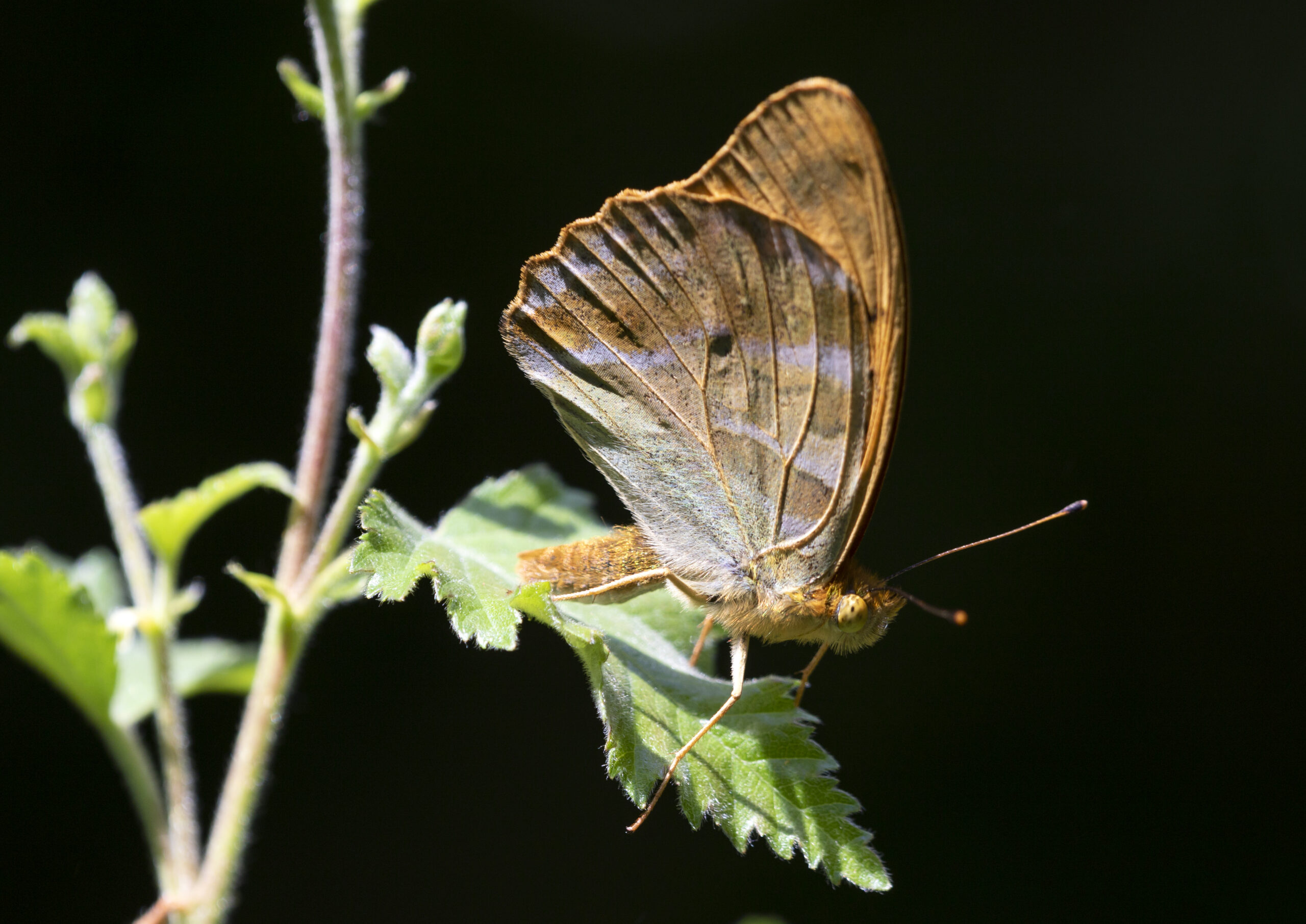
Today was officially the hottest day of the year, clocking in at a sweltering 33C at Brize Norton, which is the closest official weather station to my home. Despite suffering from the effects of mild heatstroke yesterday, I decided to go out and visit my favourite local woodland, Ravensroost, to look for butterflies.  In the heatwave we had last year, the drought became so intense that the purple hairstreak butterfly, normally found only at the very tops of oak trees, was found flopping around on the ground looking for any moisture it could find. I even had one sup on my finger for a while. I went looking for them again today, and although I saw one, it was zipping around at a lively pace and unwilling to settle. So were the other butterflies. You know its hot when even the normally sun-worshipping butterflies seek out the shade. I came across this silver-washed fritillary who looked utterly wilted. She (it’s a girl, folks) kept returning to the same spot to rest up, under the bushes but in a small spotlight of sunshine.

silver washed fritillary

silver washed fritillary

But the day’s prize for the most memorable moment came with a young roebuck, his antlers still in velvet (i.e.. growing under their velvety coat). I had watched him and photographed him from afar, then he simply vanished. I figured he’d run out of the wood, so gave up being stealthy and just walked normally, scuffing my feet, snapping twigs, up a track that ran beside the clearing I’d seen him in. Then I just happened to glance to one side – and there was the buck, chilling in the shade of an oak tree. He was no more thantwenty feet from me and could clearly both see me and hear the camera, but it was just too hot to move. You know it’s hot when even the deer don’t run away. Eventually he got up, stared at me for a while as if to say “Really? In this heat?” then ambled out of the compartment. It was a wonderful encounter, and I’m almost sad now that the heat will break tomorrow.

Roebuck

One very hot Roebuck


The Large Heath

I’ve been trying over the last couple of years to see all of Britain’s native butterflies and dragonflies. Plenty of people have done it before me, and indeed Patrick Barkham wrote a very good book about his personal quest to see all of our butterflies in one hectic summer. I think he was mad, and I suspect he would agree, although his quest did make for a good read. I decided to be more restrained  in my own plans, but even so, the Covid-19 lockdown has now made them impossible. Butterflies usually have very short flight periods, often just a few weeks. Even though summer has barely started, some that I have never seen have already finished for the year. Others remain tantalisingly out of reach  behind the iron curtain of the Scottish border. While getting a criminal record for trying to sneak across a border might make for a good cocktail story, it’s not something I care to try.

So when the chance came for me to see both a dragonfly I’ve never seen (the White-faced darter) and a butterfly I’ve never seen (the Large heath) in the same place – Whixall moss – at the same time, it was too good to pass up. My encounter with the white-faced darter is chronicled elsewhere, but the large heath, now that is another story. Every butterfly guide I own (and I have several) describes the large heath as “flighty”. That’s a euphemism for “hardly ever sits still and runs away as soon you point a camera anywhere near it”. The assistant reserve manager of Whixall Moss, the ever-affable Stephen Barlow, told me it was very hard indeed to photograph. There’s nothing like building up your expectations…

On the day I visited the moss, it took a while for the large heath to condescend to visit us. It’s a sun-lover, a butterfly that would be delightfully at home on the Costa del Sol, but perversely chooses to live in the borderlands of Wales, hardly a place known for prolonged fine weather. But when it starts moving, the large heath seems to dislike stopping. Rest and food are for wimps. The large heath instead devotes its time to the endless search for sex. Which I can understand, given a 1.000-acre bog to search and relatively few large heaths in the world.  For hour after hour I would pan my camera around the landscape, following a butterfly in the hope it would settle. I wandered the reserve and camped out in places where the butterfly had all that it needed – the right nectar plants, the right plants upon which to lay its eggs. No butterflies came near. The sun came out, and the heat grew. The butterfly danced.  One stopped just long enough for me to realise that it had happened, and then lifted off long before I could even bring my camera to bear. The sweat was dripping off my nose. The reserve manager went home, wishing me good luck. I decide to go home as well. On a blisteringly hot day, I ran out of water. That’s a red flag for me- I suffer from gout, and if I run out of water, I always suffer. I decided to leave. And as I turned to sling my camera over my shoulder, a large heath landed just fifteen feet away from me, and decided to nectar long enough for me to photograph it. It had taken me three and a half sweltering hours to get one picture. I was running late for my three hour drive home, and I was parched, but I couldn’t have cared less. Once again, nature had taken pity on me and given, at the last second, something I so desperately wanted to see. So here it is, the large heath. I hope you like it, because I’m not going back for another go anytime soon.

large heath butterfly

large heath butterfly


When the wood falls silent

It’s gloomy in the small woodland near my home. The air is thick and heavy, full of the musty smell of parched vegetation longing for relief, as a day of heat and sharp shadows has ceded a sullen, pregnant sky, full of threat and fine drizzle. Underneath the arched cathedral roof of spindly, overcrowded ash and beech, the wood is quiet, waiting.  I can hear the rustles of a foraging blackbird, the indignant bubblewrap sound of a disputing wren, and the feeble trickling of the sedated stream, shorn of its winter might and power and little more now then a series of connected pools.  But there is a sound missing.

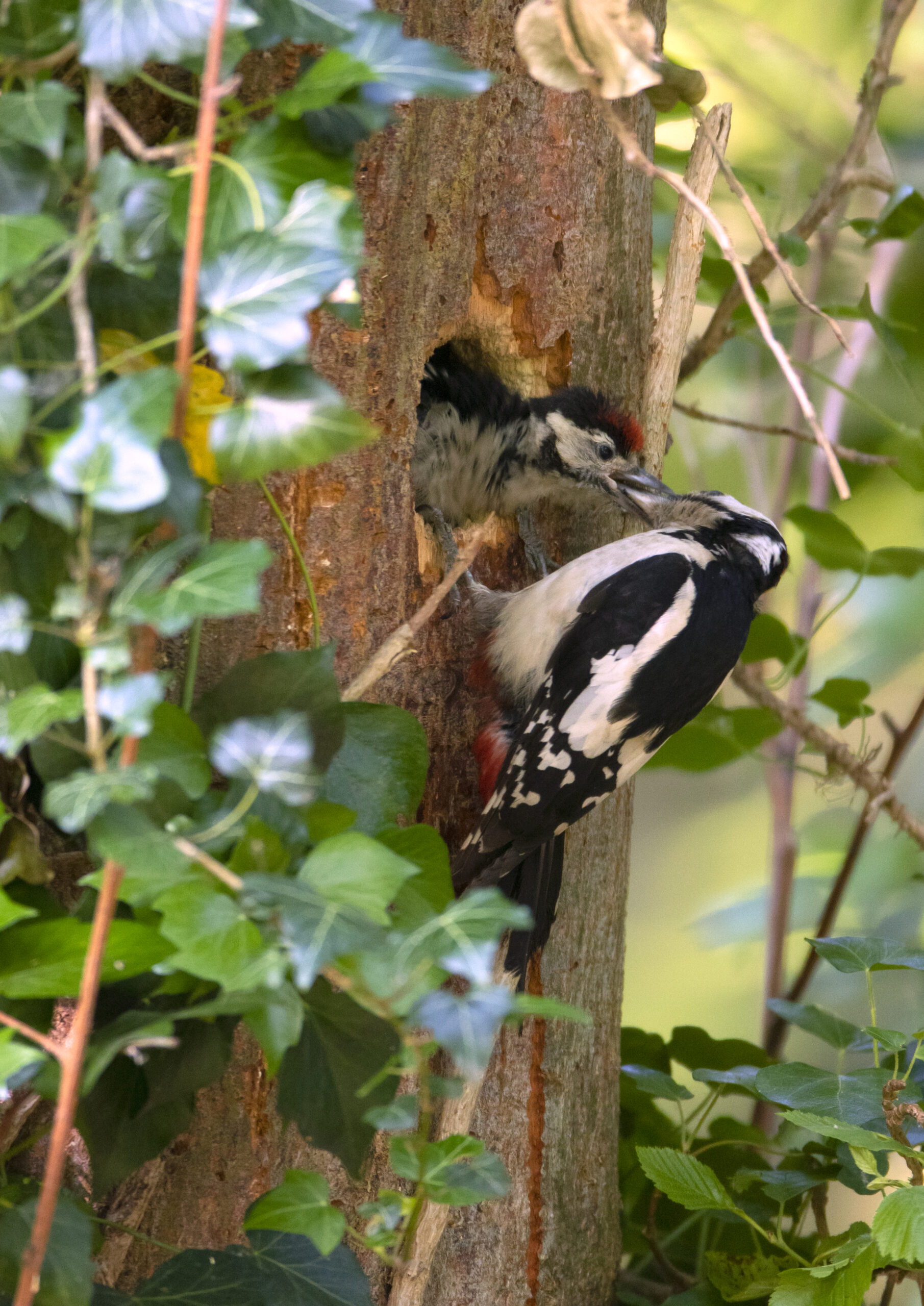
Ahead of me are the bleached, ivy-draped remains of an ash that snapped in the gales six winters past. Near the splintered crown there is a hole, perhaps two inches across. A foot lower is a second, eighteen inches below that a third, and a fourth at the height of my own head. This one is ringed with bright wood, and I can make out tiny conical indentations around the edge where it has been patiently shaped to an almost perfect circle. I have haunted this tree for weeks now, watching silently from the shadows as one after the other, two parent birds have fed a shouting chick inside.  They are great spotted woodpeckers, and for four years they have chosen to nest here, next to a path used constantly by dogwalkers and lockdown families, perhaps for the safety that the presence of people brings from the squirrel and weasel that would steal their precious young. Two days ago, these woods were filled with a relentless sound, like a dog endlessly chewing on a squeaky toy, as the young woodpecker demanded food and food and food. Now the nest hole is silent, and I have missed the moment that I had so hoped to see when, damp and ruffled, the young woodpecker emerged. I feel a mixture of sadness that I missed the moment, joy that the chick has fledged, and an absurd pride that its parents again trusted humans enough to nest within easy reach of us.

great spotted woodpecker feeding chick

great spotted woodpecker feeding chick

As the light dims further, and the rains starts, the silence of the woods feels oppressive until I hear, far above my head, the “bick…bick” call of the female. Perhaps protecting this tree is still ingrained within her; or perhaps she is wistful, truly empty-nesting, her frantic efforts now at an end. I turn up my collar, give her a small wave of farewell, and head for my own nest, empty also these last five years.

The stuff of nightmares

I went up to Whixall moss yesterday. It’s a massive 2,3888 acres of bog. It’s also about a three-hour drive from my home, so not a trip I undertake lightly. Why does any sane individual drive three hours to spend a day in a bog, I hear you ask? The answer is that acidic peat bogs like this one are rare animals indeed, especially south of Scotland. And this rare animal has many rare animals of its own. I went to photograph the white-faced darter dragonfly. Whixall is one of the very few places in England which has this species – indeed, since Whixall straddles the England/Wales border, it may well be that the specific pool where I eventually found it is actually in Wales. I also went to find a rare butterfly, the Large Heath, which I’ll discuss in another blog post. But it was what was lurking in the small pool that terrified me and fascinated me in equal measure.

Regular readers will know that I’m not good with spiders. I’m a naturalist, and I appreciate their place in the food web. I appreciate the fact that they have been with us for tens of millions of years. I admire their efficiency and spidey-skills. But they also make my skin crawl. It is a measure of my devotion to the natural world that I will watch them and photograph them.

Tucked away in the dark and damp edges of this pool was a Fen raft spider, a female about two inches across including legs. This delightful little arachnid can use water-repellent hairs on its legs to literally walk on water. It sits on the bank of the pool with its front legs sitting on the water surface, feeling for vibrations. When it feels the minute vibrations of a victim nearby, its skates out across the water’s surface and grabs it. It is venomous – so much so that people are advised not to try to pick it up (the bite isn’t dangerous, just painful). But if it can do that to a human, imagine how it feels to be a pond skater or other small invertebrate that the Fen Raft eats.

fen raft spider

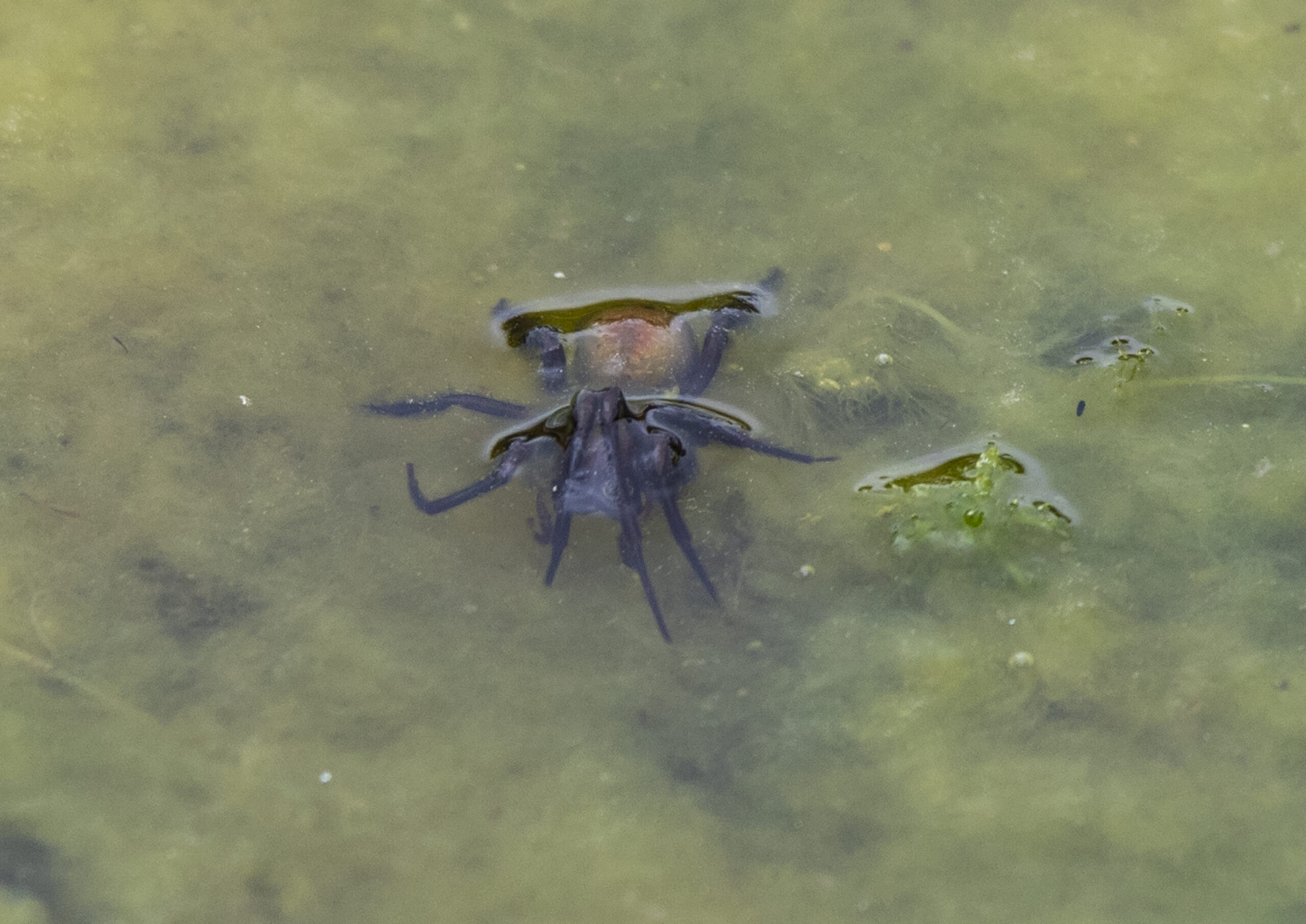
fen raft spider waiting for prey.This is a second, much smaller one I spotted.And then the assistant reserve manager at Whixall pointed out something even more remarkable to me – a diving bell spider. I’m ashamed to say it’s not a species I’ve ever heard of before. This incredible spider has abandoned the land completely. It lives almost its entire life underwater, but it still needs air to breathe, so this astonishing arachnid creates a “diving bell” out of silk, which its fills with air brought down from the surface by trapping it in the fine hairs of its body. The spider, lives, eats, mates and even gives birth underwater in this diving bell. I managed to see one on a visit near to the surface, where it was walking along the spagnum moss floating just underwater.

diving bell spider

diving bell spider. 

So there you have it. Two spiders, each superbly adapted to live on and under the water. Just remember that the next time you flush a spider down the loo…

The armchair naturalist

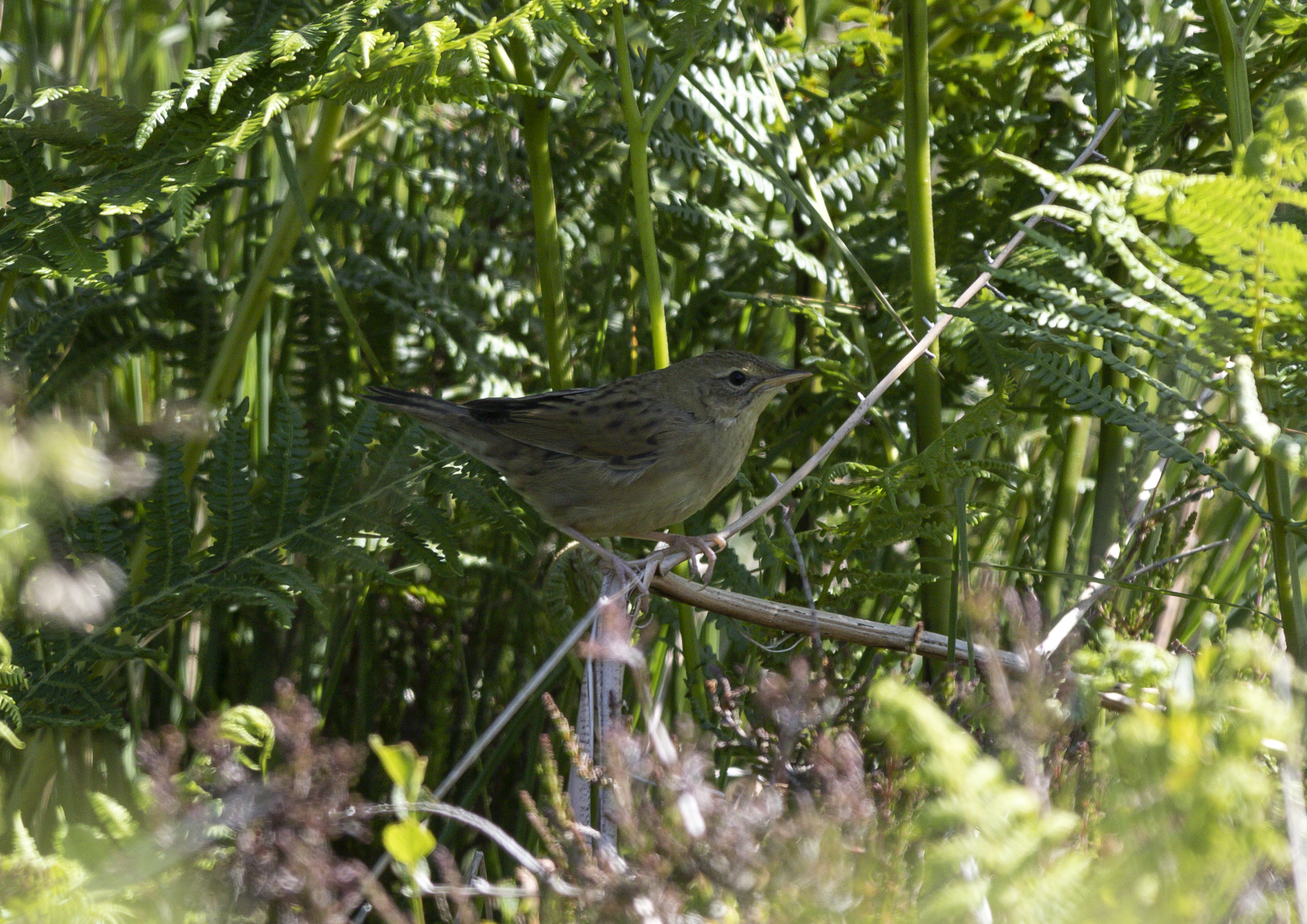
The weather’s been a little poor lately. Apart from some much-needed repair work around the house, I’ve been using the time to try and catch up, pruning out hundreds of unwanted photos that have been silting up my hard drives. I’ve also been trying to carefully identify all those “??” species, where I’ve taken a photograph of something, not been too sure what it was, and made a mental note to look it up when I got home, which I often then fail to do. So I’ve been slowly trawling through the images I’ve taken over the last five years, suite of ID books in hand. It’s been well worth it. The small red damselfly was on my list of things I wanted to try and see this year – except that I’ve already seen it. Twice.  The quick snapshot of a small bird I saw skulking in the bushes on Exmoor has turned out to be a grasshopper warbler, a very difficult species to find.

Some of the species I’ve seen still elude my poor identification skills. A shot I took at Rainham Marshes looks very much like a sparrow… but something about the beak and the shape of the head doesn’t feel quite right. I’ve learned over the years that the tiniest of details can matter when you are trying to identify something. The slightly greater curve on the anal appendages of a damselfly, structures which are perhaps a millimetre long. can turn an commonplace emerald damselfly into the are “scarce emerald” one. But by nature-spotting in my files I’ve discovered that I’ve actually seen 2% more of the British resident bird species than I thought I had.  And I’ve done it all with a cup of coffee in hand, without getting out of my chair. I could get used to this.

grasshopper warbler

Yes, it was a grasshopper warbler


Lockdown diaries 28th May

As our horizons have shrunk with Covid-19, so small victories have become something worth savouring. Today I had a small victory, along with a huge dose of luck.

I disapprove of treating wildlife-spotting like stamp collecting. It seems disrespectful, somehow, to treat living things in this way. But the exhilaration that I get from seeing a creature I’ve never seen before, particularly if it’s rare or special, is beyond compare. It’s like finally meeting your favourite movie star, except that you can actually do it, rather than sitting in your bedroom dreaming about doing it. So I try to hold good to my principles by seeking out species I’ve never seen before but keeping my fist-bumped “yes” if I succeed to a muted and soberly professional level. Today was a quietly exuberant fist-bump day. With access to the Isle of Wight still extremely difficult, I could feel my chances of seeing a rare butterfly, the Glanville Fritillary, slipping away in 2021. The Glanville is named after the Lady Glanville who discovered it (although it had presumably been knocking around for a millenia before she noticed it). It is a small, bright, brown-orange butterfly with chequer-patterned wings. It is largely confined to the Isle of Wight where it loves the hot, dry crumbling chalk cliffs. It likes a good landslide, the Glanville, and the Isle of Wight regularly obliges.

But then I learned about a small colony of the butterfly near London. Originally “seeded” by a butterfly enthusiast, the colony is sneered at by purists as being an “introduction”, but the colony has been self-sustaining for many years now and I think they’ve earned the right now to be treated as locals. Either way, this site offered me my only chance to see this rare insect, so off I went. The site, Hutchinson’s Bank, in Croydon, is an odd spot to find a rare insect. I drove past rows of prewar semis and postwar tower boxes, alongside a light railway and under what would normally be the flightpath of many aircraft, to find a small section of sloping hillside. I wandered around this for a while, seeing nothing of interest, until I went through a gate and all of my nature-watcher’s antennae went up.  Ahead of me was a narrow, V-shaped dell, perhaps 300 feet long and thirty wide, looking for all the world as if the tip of a sharp knife had been scraped across the world. On the one side was a bank of long grasses bordered by fencing and bushes. On the other was a steeply-sloping bank, perhaps twelve feet high, of crumbling beige soil interlaced with small stones of chalk. I had barely walked through the gate when a butterfly flew past me and landed on a dusty patch of ground where the grass had been worn away revealing a white patch of chalk. It was the Glanville.

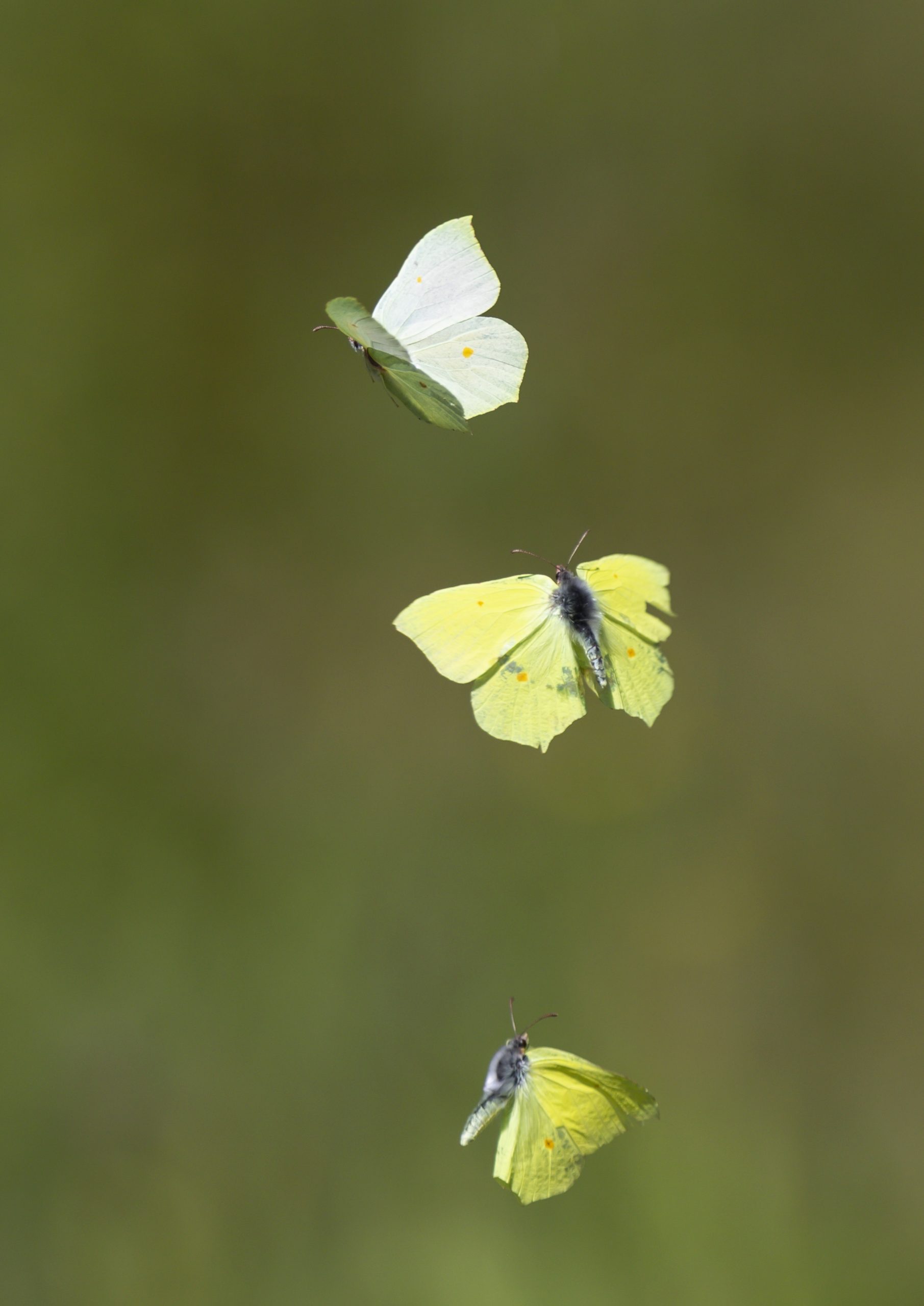
In some ways, I felt slightly cheated. I’d driven for over two hours to get here, walked for another half hour finding the spot, and then my quest is over in about ninety seconds? It didn’t feel like much of a heroic deed. So I contented myself with taking photograph after photograph. More people arrived, as did more Glanvilles. Social distancing wasn’t an issue because the day had got so hot and sticky that even I didn’t want to be near me. In the end I ran out of water to drink and called it a day. But the Gods hadn’t finished. As I walked back to the car, I saw a female Brimstone, a large and common yellow-green butterfly, being pursued by two males. They briefly perched  on the end of a pine branch, then all three zoomed into the air again. I took a quick photo more out of habit than anything else. It turned out that my quick snap would eclipse all my other carefully-taken images, as all three ascending butterflies were in a line in the air, close to perfect focus. something that you can never normally achieve. It was pure luck, but the image that resulted, below, is already one of my favourites. Sometimes, the commonplace is even better than the rare.

brimstone butterflies

brimstone butterflies


glanville fritillary

glanville fritillary


Page 4 of 8

Powered by WordPress & Theme by Anders Norén